
English learning at home
Teach Your Child English When You Do Not Speak English
Learn how to teach your child English when you do not speak English with a 10-minute home routine, audio and picture cards for ages 5 to 10.
By Talkio Kids ·
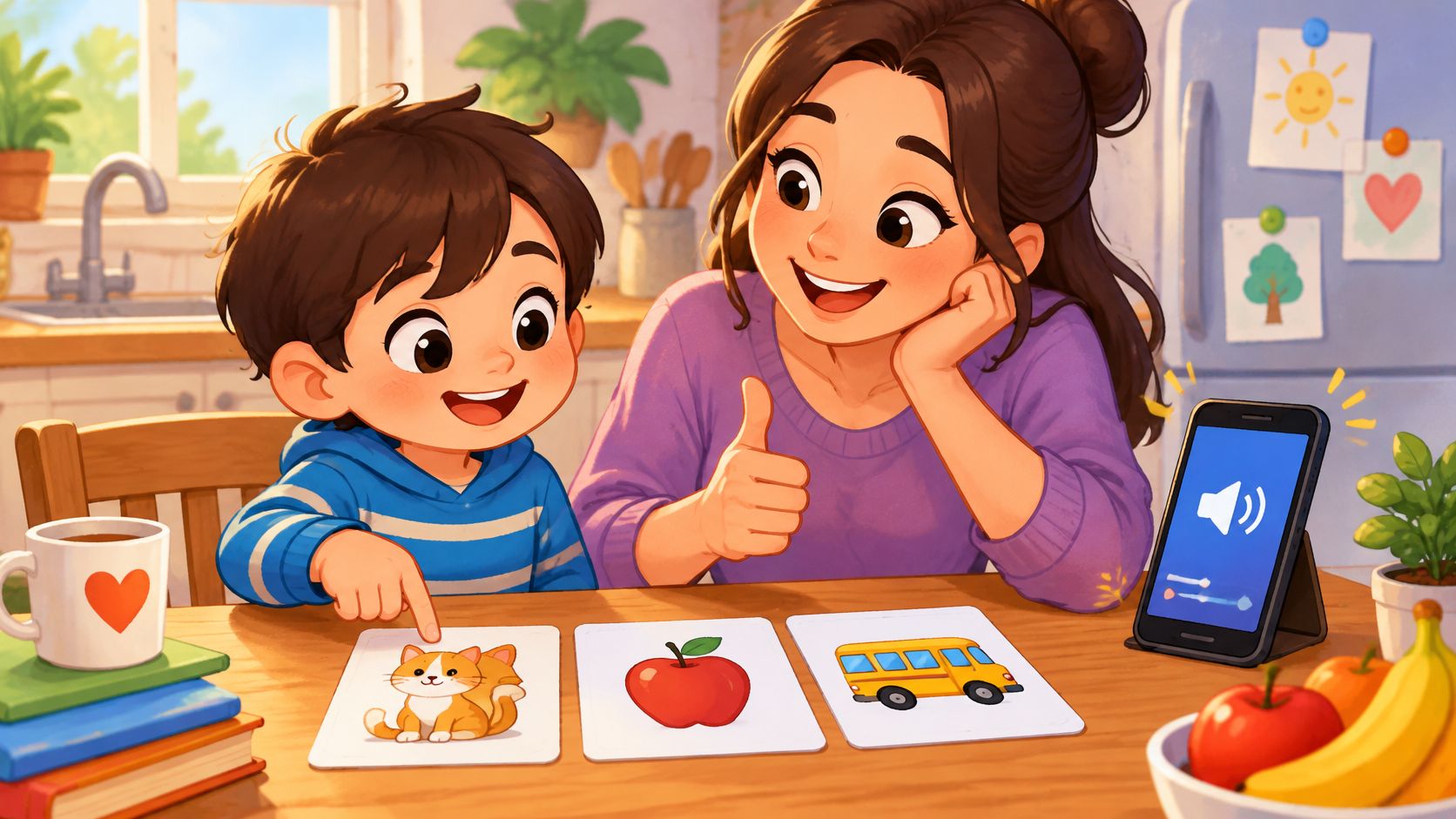
You have the note from school, the app a friend mentioned is open on the kitchen table, and your child is waiting. You want to say something useful in English and the words aren't there.
That gap between wanting to help and feeling unqualified is the most common thing parents bring to this subject, and it rests on a misunderstanding. Teaching a beginner doesn't require you to be the English model in the room. It requires you to set the routine, bring the pictures and the praise, and keep showing up.
The demand is real, too. The British Council's English Effect report estimates that approximately 1.75 billion people worldwide speak English at a useful level, about one in every four people on the planet. Parents who don't speak it still want their children to have a foothold in it.
Your 10-Minute Routine Step by Step
A parent who can't hold a conversation in English can still run a useful ten-minute session at home. A research review on linguistically diverse families found that parents who are non-English-speaking or have limited English proficiency often provide the strongest support for overall language development by talking with children in the family's first language. That interaction builds vocabulary, conversation skills, comprehension and confidence, which are the foundations an additional language rests on.
So this routine splits the job. You handle the structure, the pictures, the meaning and the praise, in whatever language you think in. English arrives through a recording, a song, or a single word you're comfortable saying aloud. The British Council's home practice guidance recommends regular activities of about 10 to 20 minutes, adjusted to your child's concentration, and suggests a warm-up, new language, a game or craft, a picture-book ending and a short follow-up. Ten minutes sits comfortably inside that.
Here's the whole routine on one page.
| Part | Time | Parent does | Child does |
|---|---|---|---|
| Warm-up song or rhyme | 2 minutes | Plays or sings the song and joins with the gestures | Sings, claps or copies one action |
| New words | 3 minutes | Points to three or four pictures, says each English word and gives its meaning at home | Repeats each word after you |
| Listening game | 3 minutes | Hides a picture or object and says its English name | Finds it and says the word |
| Close | 2 minutes | Gives a high five and asks one question about the day in your home language | Says one English word without prompting |
| Total | 10 minutes | Stays calm, smiles and praises effort | Practises for a short, focused session |
How to Run Each Part
1. Fix the moment. Choose a slot that already exists in your day: after breakfast, during bath time, the last ten minutes before lights out. A routine survives on the trigger, not on willpower, so the same time matters more than the perfect time.
2. Sit side by side, not opposite. Put three or four picture cards or real objects between you. Sitting shoulder to shoulder turns the session into shared attention rather than a test, and a child who feels tested stops answering within a week.
3. Say the English word once, then the meaning in your language. Say "bus, bus," then explain in the language you use for everything else: the big vehicle that takes children to school. Your child needs the concept hooked to the sound, and only you can supply the concept quickly.
4. Play the word again. Let the audio say it, or say it yourself a second time. Two meetings, from two sources, help a beginner separate the word from the speaker's voice.
5. Ask for a point, a match or a repeat. A sound, a nod, a finger on the picture all count. Beginners understand far more than they can produce, so demanding a full sentence early shuts down the talking.
6. Praise the effort, not the accent. A smile, a thumbs up, or a warm word in your language does more for the next session than any correction. Pronunciation tidies itself up over months of hearing good models.
7. Keep the same five words for a week. Repetition is what moves a word from "heard it" to "know it". Changing the set daily feels fresh to you and feels like fog to a beginner.
Three Slips That Undo a Good Routine
- Translating whole sentences. It turns a game into a grammar lesson and doubles the talking. One word, one meaning, then move on.
- Correcting every pronunciation. Pick one sound to polish per week, and let the rest pass. A child who is interrupted four times in three minutes learns that speaking is risky.
- Changing the words daily. A beginner needs many meetings with the same set. Five words for seven days beats thirty-five words for one.
The rule that carries the rest: if a session goes badly, cut the length in half rather than the warmth. Five affectionate minutes beat fifteen tense ones.
The same four parts fit a five-year-old with toy animals and a ten-year-old with written word cards. Only the materials change.
The One-Week Check
After seven days, ask two questions. Does your child point to the right picture without help? Do they say at least one English word on their own? Two yeses mean keep the set for a few more days, then add three new words. One yes means repeat the same week with the same words. No yeses means the session is too long, too quiet or too crowded, so shrink it to five minutes and one word.
Criteria for Choosing a Beginner English Tool
An app or picture dictionary only earns its place at home if two people can use it: the child alone, and the parent following along. Product pages usually describe the child's experience and skip yours. Use the checklist below on any tool before you commit.
| Criterion | What to look for | Why it matters at home |
|---|---|---|
| Audio for instructions | Every instruction and word is spoken as well as written | Parent does not need to read English directions |
| Offline use | Lessons, pictures and audio stored on the device | Practice works during travel or with limited data |
| Speaking fallback | Speaking steps still work if the microphone is refused | The child can still practise without the mic |
| Home-language support | New words explained in languages families speak at home | Parent does not have to translate perfectly |
| Simple progress | Progress kept on the device with no English report | Parent does not need to read English dashboards |
| Independent use | Child can start and follow lessons alone | Parent is free to encourage instead of teaching |
| Honest promises | Claims limited to learning benefits, no guaranteed fluency | Sets realistic expectations for the first months |
Audio sits at the top because it removes you from the reading job. If every instruction is spoken, your child can start a lesson on a day when you're cooking, tired, or unable to decode the screen.
Offline use isn't a travel luxury. In a national study described by New America, 66% of Latinx parents reported schooling disruptions linked to being under-connected, including taking part by cellphone or not finishing work. Practice stored inside the app removes that friction entirely.
Home-language explanations matter because they let a new English word land on a concept your child already owns. Progress kept on the device matters because an English-language dashboard is one more thing you can't read at 8pm. Independent use matters because it changes your role from substitute teacher to encourager, which is the role that predicts a child sticking with practice.
Before any purchase, watch one five-minute session. Sit beside your child, stay quiet, and notice the first moment they need you to read something aloud. That moment tells you more than any product description.
Talkio Kids, a beginner app for ages 5 to 10, meets several of these criteria: instructions and words are spoken as well as written, the course works offline, and progress stays on the device with no dashboard to read. A wider comparison of app types sits in this guide to how to choose an English learning app for kids. Tutors adapting the same checklist for paid sessions will find the setup notes on classroom tools for online tutoring from David T.C. Tutoring Services useful for running a five-minute review over video.
Picture and Word Games for Ages 5 to 10
The routine holds steady from five to ten. What changes is the material on the table and how much independence a child wants. A ten-year-old beginner is not a small five-year-old, and treating them like one is the fastest way to lose their interest.
The same four parts look different at six, eight and ten.
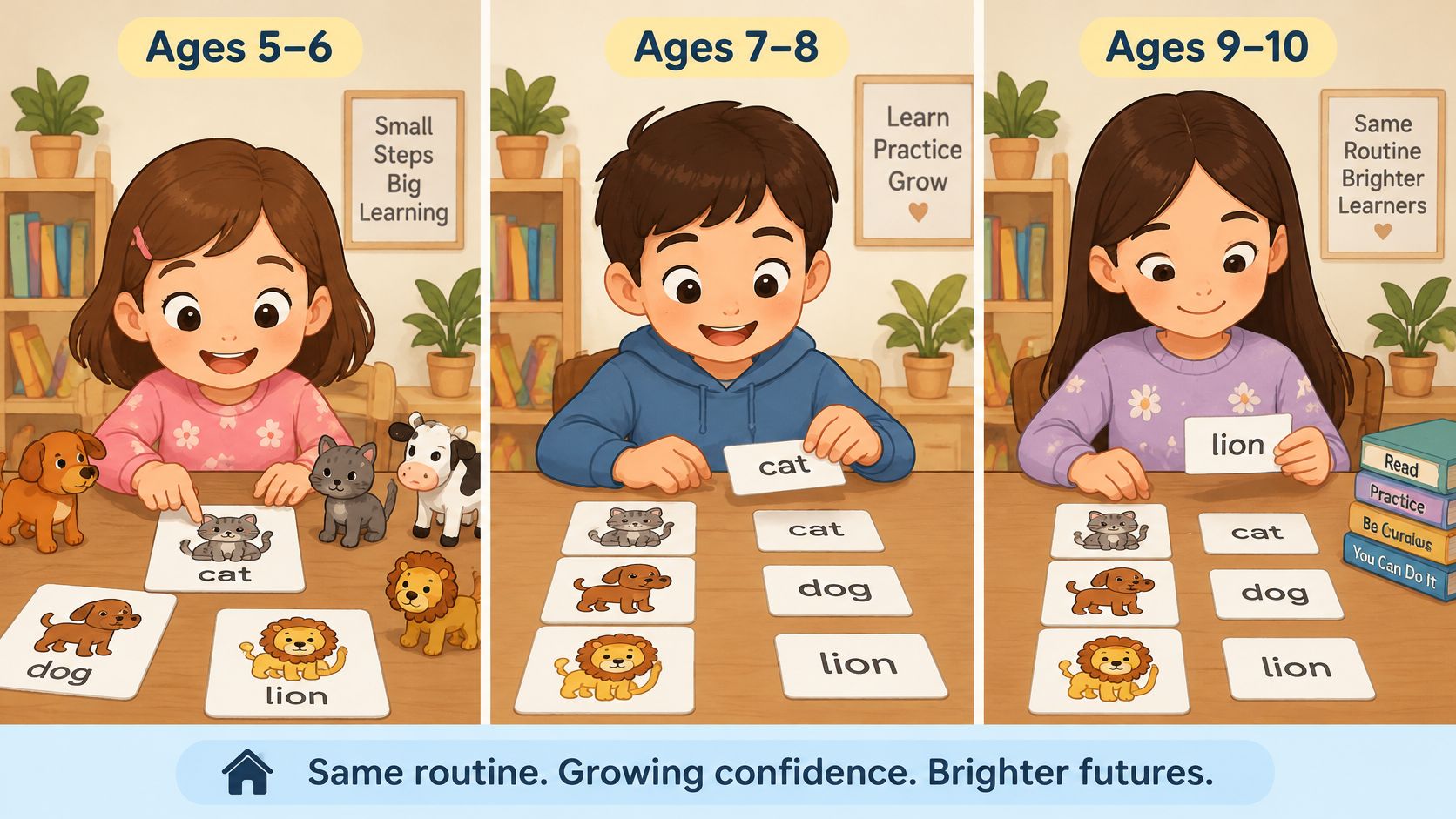
Ages 5 and 6 Learn Through Objects and Movement
Young children learn a word by moving toward it. Line up three toy animals, say one English name, and let your child pick it up. Add a movement version where they jump to something red or touch something blue. A five-year-old who is hopping and laughing is still learning; the body is part of the memory.
Try this tonight: put a toy cat, dog and bird on the floor, say "cat", and see which one gets grabbed.
Ages 7 and 8 Move to Paper Cards
Seven and eight-year-olds enjoy a bit of structure. Make ten cards from folded paper, a picture on one side and the word on the other, then play memory pairs by matching a picture with its spoken name. Sorting cards by colour or size adds a second pass over the same words without feeling like repetition. The British Council's parent support pages suggest labelling about ten objects in one room each week, which pairs neatly with a card game on the same theme.
Start with pairs: lay the cards face down, say the target word, and let your child flip two cards hunting for the match.
Ages 9 and 10 Work With Words and Privacy
Older beginners can often read in their home language, so use that. Write sticky-note labels for ten objects in one room, match written words to pictures, and build short two-word phrases that pair something the child can see with one simple describing word. Keep practice private. A nine or ten-year-old may feel exposed doing beginner work in front of siblings or friends, and a quiet ten minutes at the kitchen table protects their dignity.
Their game: hand them the sticky notes and let them label the room while you read the words aloud.
A beginner app that introduces new words in small steps and needs no previous English knowledge suits a true beginner at any of these ages, whether that child is six or ten. More word lists by topic are collected in this guide to English vocabulary for kids.
Early Sounds and Letters at Home
Reading starts with sounds, not long texts. A seven or ten-year-old complete beginner can begin there even before they read English comfortably. The British Council's home learning activities give a clean example: sound out the three-letter word "bat", then change the first or final sound to make "cat", "sat" or "mat". Your child hears that letters are movable parts, not a fixed picture.
Three five-minute activities carry that idea:
- A letter treasure hunt. Choose one letter, such as c, and find a cup, a cat and a car around the room. Say each word slowly and let your child point.
- Letters from pipe cleaners or plasticine. Shaping a letter with the hands connects its form to its sound before any writing happens.
- One sound, three objects. Pick a sound, gather three pictures, and let your child match them without it turning into a quiz.
Explain the meaning of each word in your home language as you go. You're not teaching phonics rules; you're giving a child a reason to care what letters do.
A nine or ten-year-old can do all of this at a table without fuss, and a picture or a short audio clip can introduce the word before any text appears on the page. Present these as optional extras once the ten-minute routine is running smoothly, not as homework stacked on top. Printable practice ideas sit in this collection of English worksheets for kindergarten, and many of them adapt well for older beginners who need the same sounds at a faster pace.
Fixing a Routine That Stalls
A quiet or resistant child in the first weeks is ordinary. It isn't a verdict on you, your accent, or your child's ability. Most stalls fall into four patterns, and each has a simple adjustment.
The child refuses to speak English at all. Drop to one word and pictures only for three days. No sentences, no audio, no questions. Then bring the audio back and let a recording do the modelling while you point. Refusal usually comes from pressure, and removing the pressure restores the willingness.
The child answers only in the home language. Accept the answer, say the English word yourself, and carry on. That isn't a detour. In 2025, 88% of nearly 1,400 Latino parents surveyed by Abriendo Puertas and UnidosUS said they wanted their children to be bilingual, according to The Century Foundation. A child who keeps a strong first language has more to build on, not less.
The child is bored. Change the game rather than the words. Swap matching for hide-and-seek, where you hide a picture and say its English name until it's found. Or cut the session to five minutes. Short and lively beats long and dutiful every time.
A nine or ten-year-old feels too old for the game. Offer a choice of two activities and let them run one round themselves. Older beginners need agency more than they need novelty, and being the one who says the word aloud gives them a role that doesn't feel babyish.
For shared devices, keep the session at a fixed time each day, which works without any reminder feature. If a daily reminder helps, a parent can enable one in Talkio Kids and it is scheduled locally on the device; it can be switched off in Parent corner or in device settings.
At the end of each week, count the English words your child used without help. That number is the measure that matters. How much English the parent knows is not.
Start Your First Week of Practice
Seven days is enough to see whether a routine will hold.
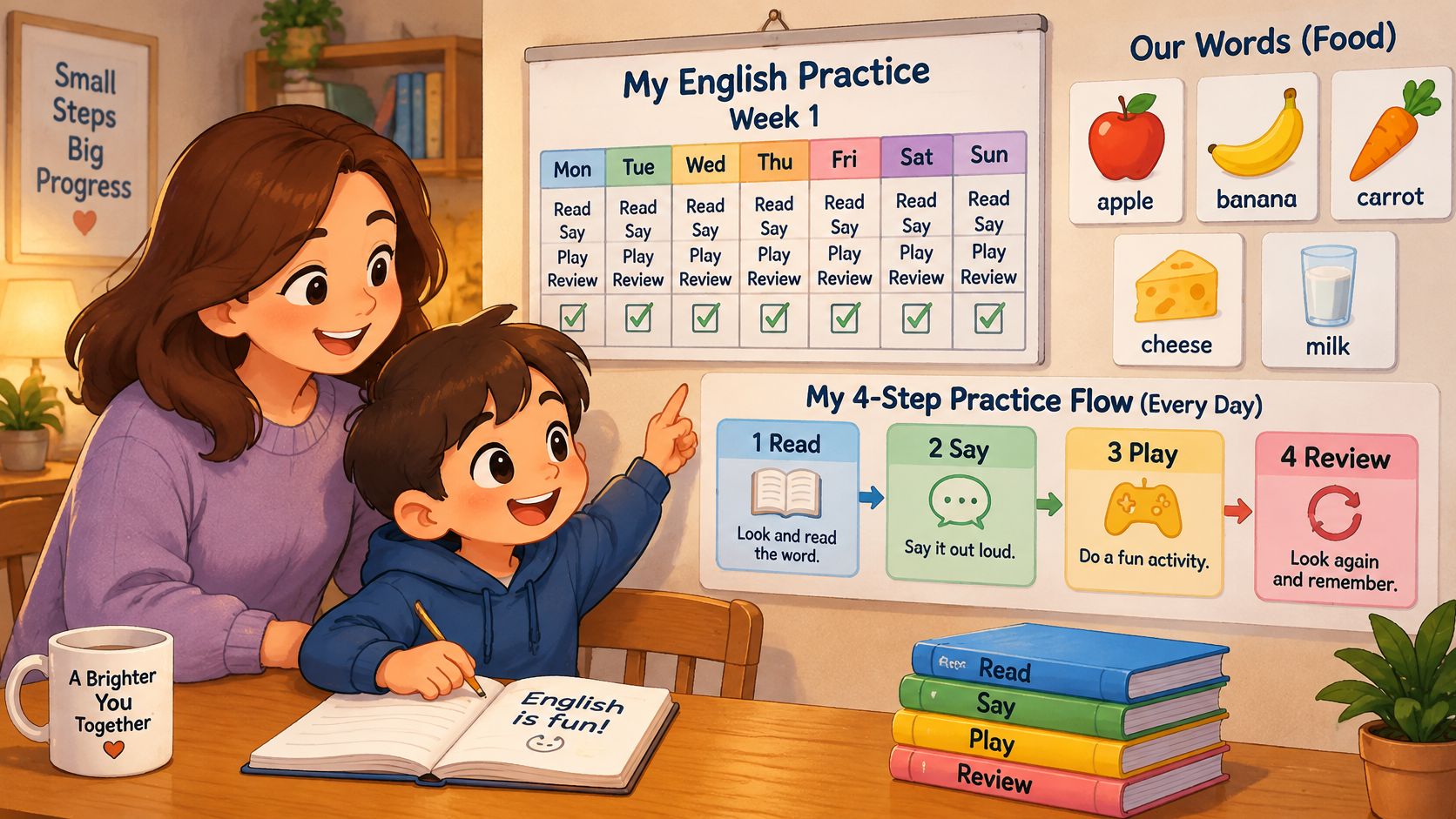
Pick one time of day and one everyday topic, such as food, animals or colours. Choose five words from that topic and write or draw them on cards. Run the four parts each day at the same time, and on day seven ask the two check questions. If the answers are yes, add three new words the following week. If not, repeat the same five.
The picture below is the shape of a good week: one parent, one child, five words on the wall, ten minutes a day.
If you'd rather the English came from somewhere other than you, Talkio Kids is an iOS and Android app for complete beginners aged 5 to 10, with short listening, picture-matching, speaking and review activities and a space companion called Nox. The app around the lesson speaks English, Spanish, German, French, Italian and Danish, and new words are explained in whichever of those languages your family speaks at home. Every lesson, picture and recording ships inside the app, progress stays on the device, and no account or sign-in is needed. Talkio Kids is an educational aid, not a school or a tutoring service, and it doesn't guarantee a particular learning outcome. Subscriptions are available as monthly or annual plans, and eligibility for trials and current prices are shown in the app.
Explore it at talkiokids.com, or download from the App Store or Google Play. More routines for the same age group sit in the Talkio Kids blog.
Your own language and ten minutes a day are the foundation. Everything else is support.
Learning English at home doesn't depend on how much English you speak. Talkio Kids gives a five to ten-year-old a beginner course they can run while you set the ten-minute slot, supply the pictures and the high five, and let the audio handle the words. It's a gentle way to teach your child English when you do not speak English, with no account, no ads and practice that works offline. Visit Talkio Kids to see what the first week looks like.