
English learning at home
10 Simple English Words for Beginners: Home Activities
Simple English words for beginners aged 5–10: ten warm, practical home activities, from picture matching to bedtime review, plus tips for choosing an app.
By Talkio Kids ·
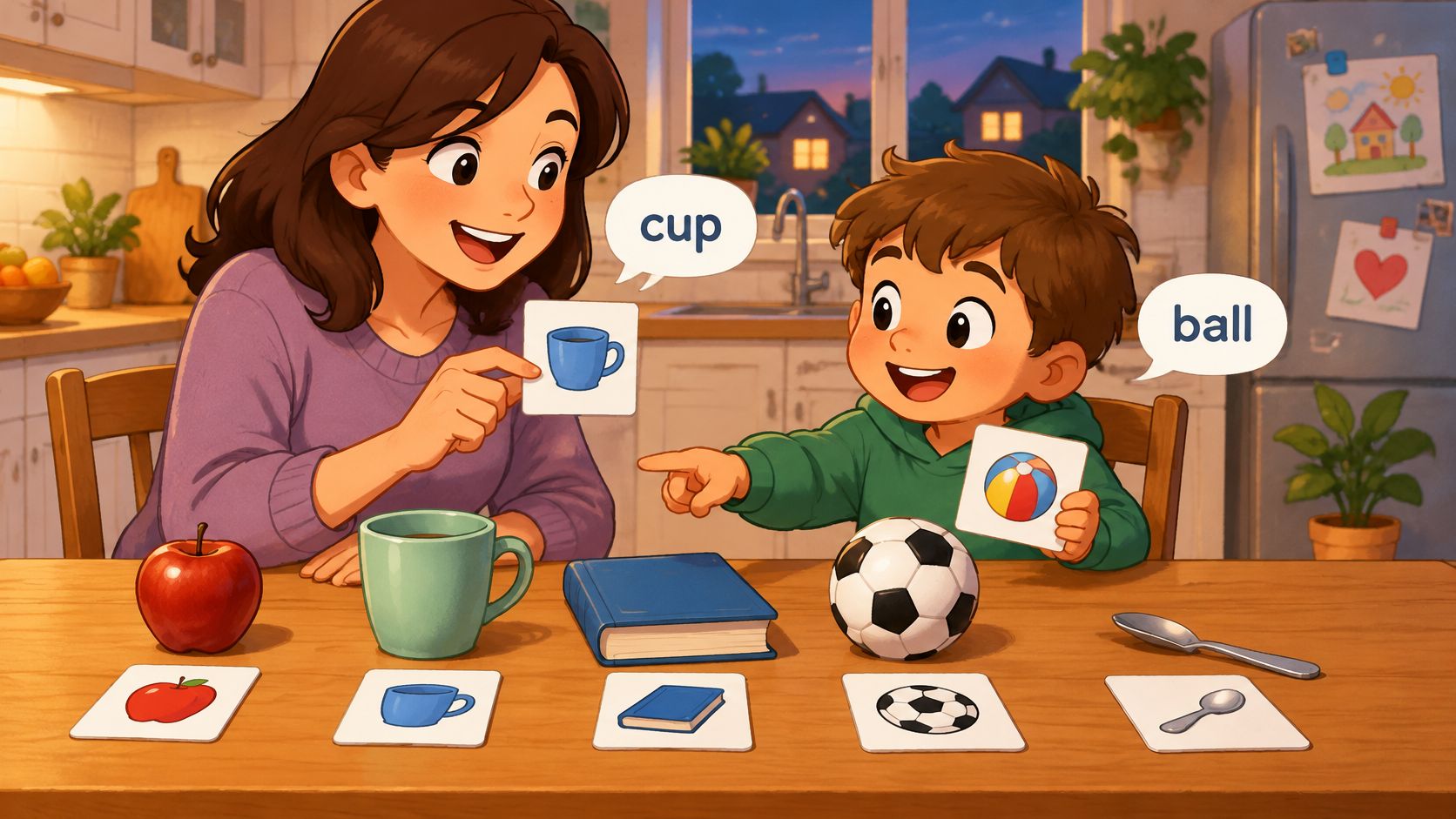
Dinner is nearly ready. A seven-year-old asks for a snack, a parent reaches for a cup, and another chance to practise English passes without anyone knowing where to begin. A lesson can feel like too much work at the end of a busy day.
A small shared routine is easier to start. The parent holds up the cup, says cup, and offers a choice: Water or milk? The child can point before trying a word aloud. Nobody needs a worksheet, special equipment, or perfect pronunciation.
Simple English words for beginners become useful when children connect them with something happening around them. A word for a drink, a school object, or a familiar action gives a child something practical to understand and say.
A useful starting point is a familiar moment, not a long vocabulary list.
For children aged 5–10, the activity should match both English knowledge and personal interests. A child who reads confidently in another language may still need pictures and spoken English. An older beginner deserves age-appropriate tasks, even when the vocabulary is very simple.
The following activities fit around meals, school preparation, walks, and bedtime. Each offers a way to begin with things already available at home, plus a reason for choosing that routine. Parents can start tonight without planning a formal lesson.
1. High-Frequency First Words (Dolch and Fry Word Lists)
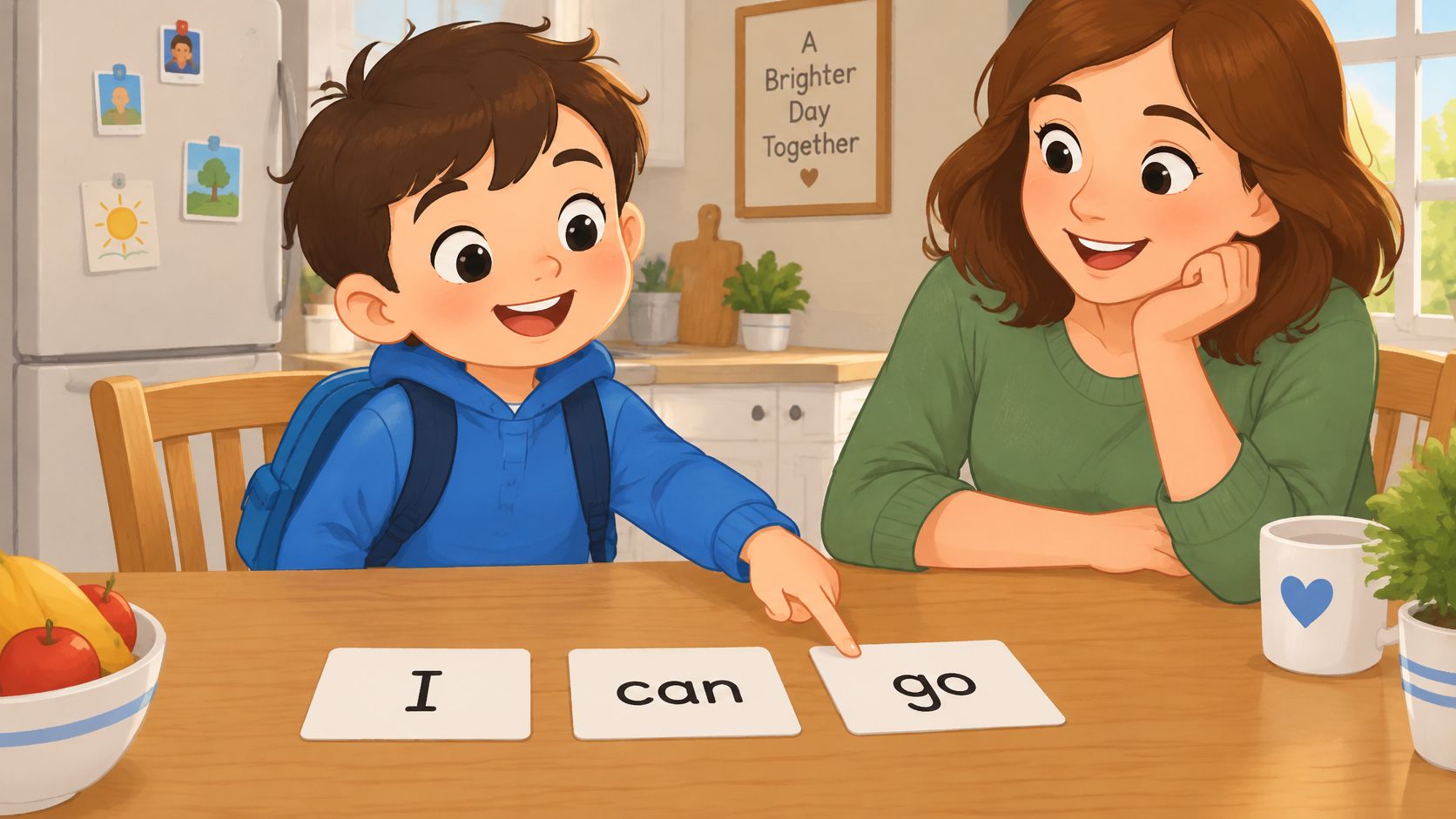
Small words such as I, can, the, is, go, look, and and help children put familiar vocabulary together. Dolch and Fry word lists can serve as starting points, but parents don't need to teach a whole list or begin with spelling tests.
At breakfast, a parent can point to a cereal box and say The box is red. On the walk to school, Let's go and Look! give short words an immediate purpose. These examples connect words with meaning rather than asking a child to remember isolated shapes on paper.
Turn a familiar phrase into an activity
For ages 5–6, the parent can say Look! while pointing to something interesting. Children aged 7–8 can take turns choosing what everyone looks at. For ages 9–10, a short instruction hunt can feel more suitable than flashcard drilling.
- Choose a small set. Five words for the week is a manageable starting plan, not a required learning target.
- Use whole phrases. Pair go with Let's go and can with A bird can fly.
- Add print when helpful. Readers can move handwritten word cards beside matching objects or pictures.
The English vocabulary guide for kids offers further starting points. Tonight's simplest version is to choose look and use it during a shared activity.
2. Picture-Word Matching Games at Home
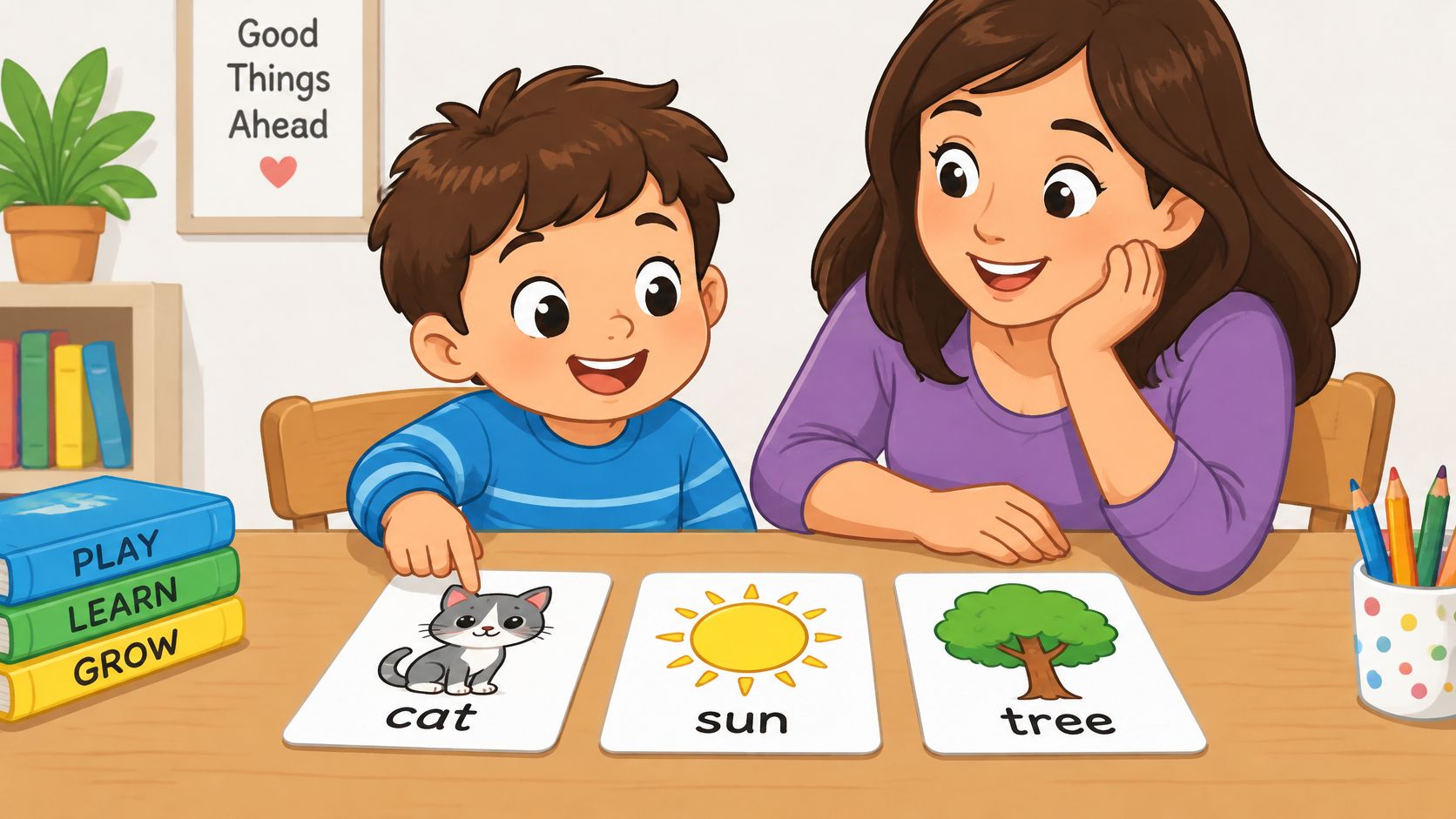
A parent draws a sun, a tree, and a cat on scrap paper. After naming each picture, the parent says cat and waits while the child points. The child can participate without reading or producing an answer aloud.
That makes matching a practical choice for early readers and older children beginning English. NAEYC's guide to early language and literacy explains that children can understand spoken language beyond what they can read independently, and that adults' comments and explanations support comprehension.
Start with recognition, then invite speech
For ages 5–6, clear drawings or real objects keep the task straightforward. Children aged 7–10 can choose pictures related to animals, sports, or places they enjoy. The English can remain simple without making the activity look preschool-like.
- Say the word first. Let the child point before asking for a spoken answer.
- Change the positions. Move the pictures so the child listens for meaning rather than remembering a location.
- Swap roles. The child names a picture and the parent points.
Three pictures make an easy opening game; more can be added when the child seems comfortable. Tonight, a spoon, cup, and book can replace drawings entirely.
3. Move and Say: Body Words and Simple Actions
Before dinner, a parent says Hands up, raises both hands, and lets the child copy. Next comes Hands down, followed by Clap. Movement makes the meaning visible without a long explanation.
Useful starting words include head, hands, feet, up, down, sit, stand, and jump. Parents can show each action before expecting the child to respond to the spoken instruction alone. Clear a safe space and choose movements that suit the child.
Keep the pressure low. Following an instruction is a valid response before a child feels ready to speak.
For ages 5–6, copying the parent may be enough. Children aged 7–8 can arrange action cards into a sequence. A nine- or ten-year-old can become the leader, give commands, and enjoy catching a parent making a harmless mistake.
Make the child the leader
Start tonight with stand, sit, and clap. After a demonstration, the parent follows the child's commands, offering the word softly if needed. Add freeze as a playful signal to pause.
Teachers and tutors can use the same activity as a movement break, with pairs taking turns leading. The English speaking activities guide offers other ways to invite short spoken responses without demanding a conversation.

4. Kitchen and Mealtime Words
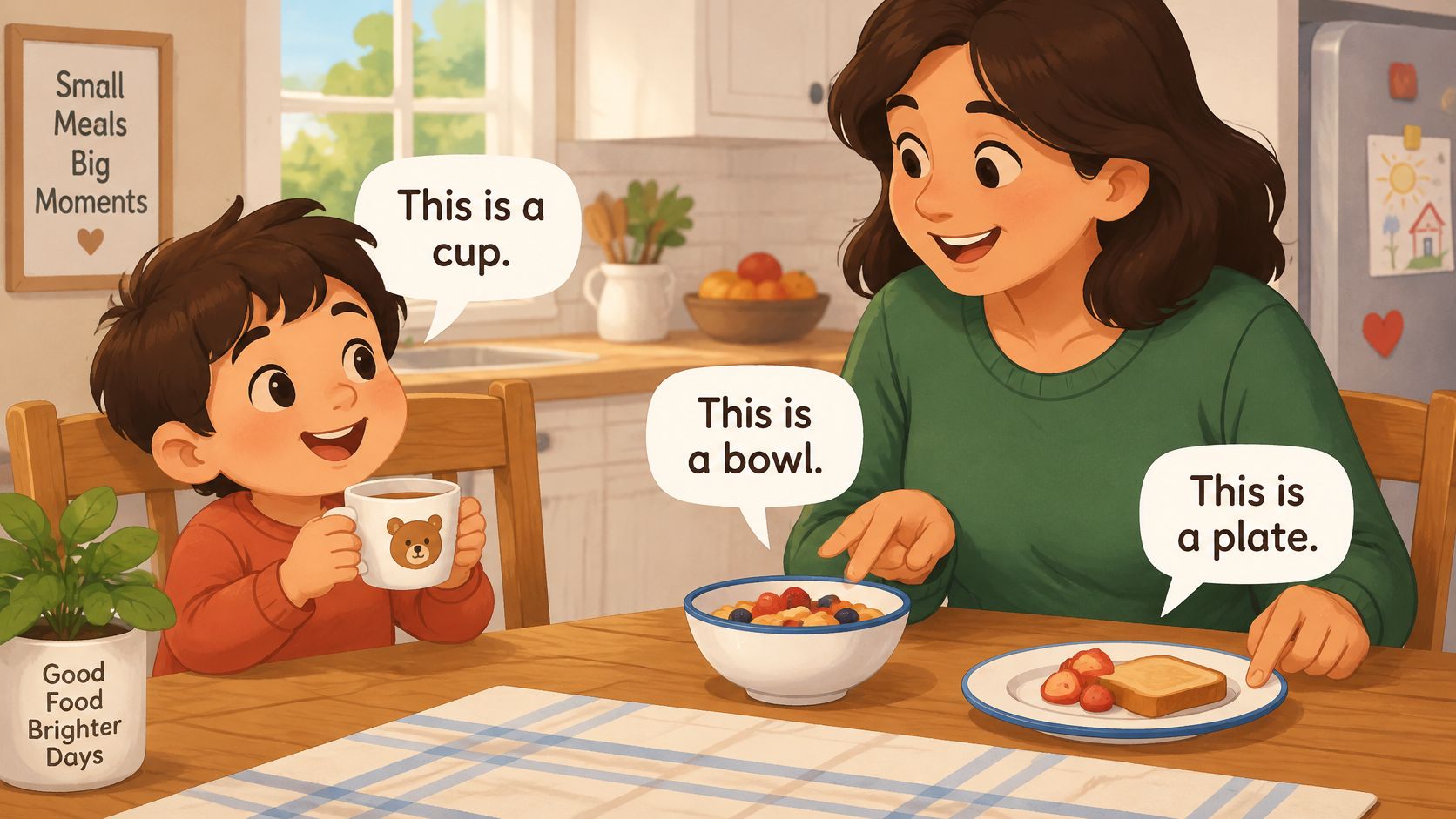
Cup, plate, bowl, water, milk, and more belong to moments that already happen every day. A parent doesn't need to create a pretend situation when a child genuinely wants a drink or needs a plate.
At snack time, the parent can hold up a bowl, say bowl, and place fruit inside. Then comes a useful choice: Water or milk? A point, a single word, or a short phrase can all keep the exchange going.
Use the word to accomplish something
For ages 5–6, naming and choosing are enough. Children aged 7–8 can help set the table. Older beginners aged 9–10 can take snack orders or explain what belongs on a tray.
- Choose a focus. Practise cup during a meal rather than naming everything in the kitchen.
- Offer a real choice. Ask Water or milk? only when either answer is possible.
- Model instead of interrupting. If a child says wa, the parent can reply Water. Here is the water while serving it.
The reason this routine is useful is simple: the word changes what happens next. Tonight, start with a drink choice and allow plenty of time for the child to respond.
Meals don't need to become lessons. If the child is tired or hungry, the parent can model the phrase and move on.
5. Daily Routine Phrases (Chunks for Everyday Life)
Wash your hands, Get your shoes, Put it away, and Time for bed are immediately useful. Parents can introduce them as whole phrases without explaining every word or grammar rule.
The action helps explain the language. A parent says Wash your hands beside the sink, demonstrates if necessary, and uses the same phrase at the next suitable moment. Later, the child may say it to a sibling or toy.
Research involving young English learners described in the International Journal of Applied Linguistics found that English narration alone didn't necessarily produce effective vocabulary learning or story comprehension; the authors recommended repetition and encouraging children to speak.
Keep the moment predictable
For ages 5–6, use gestures alongside the phrase. Children aged 7–8 can arrange homemade picture cards showing the morning routine. Older beginners aged 9–10 can choose phrases they want to use independently, including Ready?, Not yet, and All done.
- Match language to action. Use Get your shoes when shoes are actually needed.
- Invite, rather than require. A child can try the phrase before the action, but speaking shouldn't become a condition for continuing.
- Keep home-language support. A brief explanation in the family's familiar language is fine.
Tonight, Time for bed can become the shared phrase, with OK as an optional reply.
6. Feelings Words for Older Beginners (Ages 7–10)
A ten-year-old can be new to English while having plenty to say about a school day. Short words such as happy, tired, worried, proud, bored, and excited respect that experience.
After school, a parent can draw simple faces or write feeling words beside symbols. The child chooses a face first, then hears a model such as Feeling tired? or Today was exciting. There's no need to turn a personal feeling into a vocabulary test.
Let the child choose the situation
For ages 7–8, matching a face to a story character gives some distance from personal feelings. Children aged 9–10 may prefer discussing a game, a difficult task, or an upcoming outing.
- Offer a gentle choice. Tired or excited? is easier to answer than a completely open question.
- Allow privacy. The child can describe a fictional character instead of discussing themselves.
- Accept the answer. A parent shouldn't correct which feeling the child chooses.
This routine gives simple vocabulary a meaningful purpose: expressing an opinion or need. It also separates English proficiency from maturity.
Tonight, introduce tired and excited through familiar situations. A parent might point to a picture of someone yawning, say tired, and invite the child to choose another situation where that word fits.
7. School-Day Words for Ages 7–10
Packing a school bag provides a practical vocabulary game without adding another homework task. Place a book, pencil, ruler, and bag on the table, then name each object while handling it.
A parent can ask Where is the pencil? The child may point, say Here, or try In the bag. The answer serves a real purpose because the objects need to be packed.
An older beginner needs simple English, not babyish topics or materials.
For ages 7–8, a pencil-case sorting game can work well. For ages 9–10, ask the child to prepare a bag, identify a missing item, or make a short packing note. Reading ability in another language doesn't remove the need to hear unfamiliar English words.
Add phrases without adding pressure
Move from book to The book is here, or from pencil to Find the pencil. Words such as teacher, friend, break, and homework can follow when a conversation makes their meaning clear.
Teachers and tutors can use a similar missing-object game as supplementary practice. A learner looks at the objects, closes their eyes while an item is removed, and then identifies what's missing.
Tonight, the parent can name objects during normal bag preparation. Stop when the bag is ready rather than extending the activity into a test.
8. Outdoor and Travel Words for Offline Practice
A bus window, a park bench, and a station sign offer plenty to notice. Useful outdoor words include bus, tree, bird, map, ticket, hungry, and thirsty.
Before leaving home, a parent can choose words likely to appear on the route. At a safe stopping place, the parent points and says bus. The child can spot another bus later or add a phrase such as A red bus.
Give older children a real task
For ages 5–6, pointing from a seat or safe pavement is enough. Children aged 7–8 can draw discoveries in a notebook. Beginners aged 9–10 can become route helpers, finding a map, spotting the station, or checking who has a ticket.
- Choose before leaving. A small set of likely words keeps the activity manageable.
- Let the surroundings help. Point to a real tree rather than explaining tree in abstract terms.
- Keep safety separate. Road instructions should stay in the language the child understands most reliably.
This routine works without a device, internet access, or printed materials. The objects and actions make the meaning available immediately.
For the next outing, tree, bird, and bus make a possible starting set. If none appear, there's no need to force the activity; another familiar word can take their place.
9. Short Daily Review: Spacing and Recalling Words
A child pointing correctly during a game doesn't mean the word will be available later. A brief review gives the child another opportunity to remember it and tells the parent when a reminder would help.
In a classroom study of 39 fifth-grade children learning unfamiliar English words, Sobel, Cepeda, and Kapler found that practice spaced a week apart produced better recall five weeks later than massed practice. That supports revisiting words rather than treating an introduction as the end of learning.
Ask first, help second
At bedtime, a parent can show yesterday's cat drawing and pause. If the child remembers cat, the parent confirms it; if not, the parent supplies the word and invites another try.
- Start briefly. A three-to-five-minute review is a practical routine, not a scientifically required duration.
- Return later. A possible schedule is the next day, a few days later, and the following week.
- Record useful observations. A notepad can distinguish words recognised by pointing from words spoken without help.
For ages 5–6, offer picture choices. Children aged 7–10 can hide the labels, name objects, or lead the review themselves.
Teachers and tutors can revisit familiar words at the beginning of supplementary sessions. The purpose is successful remembering, not scoring children against each other.
10. Choosing a Beginner English App for a Child Aged 5–10
A beginner app should make the meaning clear and give the child something to do. During an initial shared session, a parent can watch whether the child understands the audio, connects it with pictures, and gets an opportunity to respond.
The American Psychological Association's guidance on children and screens recommends that adults initially watch with children, discuss the content, and gradually step back as children become familiar with it. A useful home check is whether the child can connect an on-screen word with an object or action afterward.
Consider learning and practical fit
Talkio Kids by Aidia ApS offers complete beginners aged 5–10 short listening, picture-matching, speaking, and review activities, guided by Nox, an alien companion in a space adventure. Its content works offline, progress stays on the device, and no account signup is needed. There are no ads, social features, open chat, or open-ended AI conversations; purchases sit behind a parent gate.
Monthly and annual subscriptions are available, with current prices and eligible trials shown in the app. An active Premium subscription is required before a new profile begins the course. It doesn't include a school dashboard, family plan, multi-profile support, cloud sync, emailed reports, or parent-controlled time limits.
For younger beginners, the guide to English lessons for six-year-olds offers age-specific guidance. For older beginners, parents should also consider whether the presentation suits the child's interests and growing independence.
How each home activity fits your child and your day
| Activity | Age focus | Materials needed | Best for |
|---|---|---|---|
| High-Frequency First Words (Dolch and Fry Word Lists) | Ages 5–6 for core words; 7–10 for first-reader practice | No special materials; paper or sticky notes optional | Beginners building a useful foundation of common words |
| Picture-Word Matching Games at Home | Ages 5–6 for matching; 7–8 for adding sentences | Paper and pen, picture cards, or household objects | Practising listening and speaking with visual support |
| Move and Say: Body Words and Simple Actions | Ages 5–6 for body words; 9–10 for command games | No materials needed | Building listening confidence through movement |
| Kitchen and Mealtime Words | Ages 5–6 for food names; 7–8 for requests and choices | Everyday meal items | Practising useful words and phrases during meals |
| Daily Routine Phrases (Chunks for Everyday Life) | Ages 5–6 for simple phrases; 7–10 for longer phrases | No materials needed; phrase cards optional | Learning predictable phrases in everyday routines |
| Feelings Words for Older Beginners (Ages 7–10) | Ages 7–10; suitable for beginners at any reading level | Faces chart or simple drawings | Talking about emotions and daily experiences |
| School-Day Words for Ages 7–10 | Ages 7–10 | School items, books, or a pencil case | Learning vocabulary connected to school and classroom life |
| Outdoor and Travel Words for Offline Practice | Ages 5–10, adjusted for age | No materials or devices needed; notebook optional | Practising English during outings, travel, and outdoor activities |
| Short Daily Review: Spacing and Recalling Words | Ages 5–10, with age-appropriate questions | No materials needed; notepad optional | Strengthening recall through short, regular reviews |
| Choosing a Beginner English App for a Child Aged 5–10 | Ages 5–10, including complete beginners aged 7–10 | Compatible device and English-learning app | Comparing apps and finding a suitable beginner option |
Five Words This Week, One Routine Tonight
A family doesn't need to introduce every activity at once. The easiest starting point is a moment that already happens: preparing a snack, packing a school bag, leaving home, or getting ready for bed. Choose the routine that requires the least extra effort.
Five words can provide a manageable focus for the week. A kitchen set might include cup, plate, water, milk, and more. A school set could use book, bag, pencil, ruler, and desk.
A small plan for tonight
The parent can name the objects, connect them with an action, and invite a response. Using each chosen word at least three times in real moments is a practical plan, not a required dose or a promise of progress.
- Make meaning clear. Hold the object, point to the picture, or demonstrate the action.
- Accept an easy response. Pointing and choosing can come before speaking.
- Offer a phrase. Turn water into More water? or book into Find the book.
- Return another day. Give the child a chance to remember before supplying the answer.
Children aged 7–10 deserve as much thoughtful support as younger beginners. An older child may want to lead the game, make the cards, choose the topic, or practise privately before speaking. Simple vocabulary can sit inside a task that feels capable and age-appropriate.
For children still learning to read, spoken language and clear pictures can keep the activity accessible. Parents who aren't confident English speakers can choose phrases they feel comfortable modelling and use replayable audio when available. Explanations in the family's home language can help keep the meaning clear.
A useful sign of progress is a word the child recognises or uses in a real moment, not simply a longer completed list.
Some evenings will allow a playful exchange; others won't. A missed practice session doesn't need to become extra work the next day. Families can return to the same familiar routine when it fits.
Teachers and tutors can support these habits by suggesting vocabulary connected to home life rather than sending a large list to memorise. A short note about which words were practised, and how to use them, gives parents a clearer starting point.
For families considering app-supported practice, the Talkio Kids download page provides a place to explore the available options. The best next step remains small: a familiar object, a clear word, and a relaxed chance to respond.
Talkio Kids offers short listening, picture-matching, speaking, and review activities that connect everyday English words with meaning. Parents can visit Talkio Kids to explore the iOS and Android app, where Nox makes practice playful, and review subscription options in the app.