
English learning at home
10 English Speaking Activities for Kids
Try 10 English speaking activities for kids aged 5–10, with playful listening, speaking, reading and no-purchase ideas for confident family practice.
By Talkio Kids ·
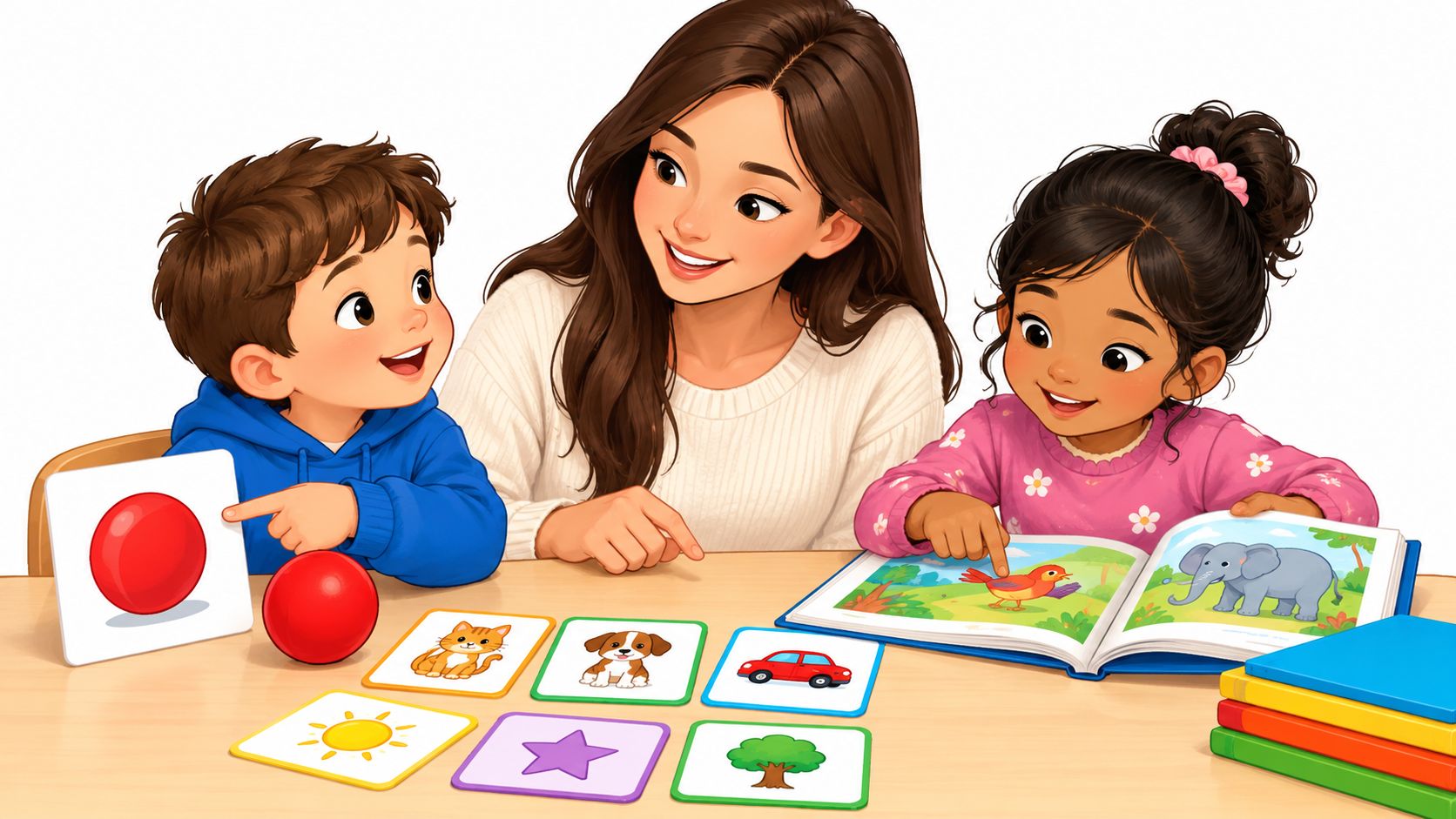
A parent says “Touch the red ball,” and a child looks, reaches, and touches it. No English sentence has been spoken yet, but learning has started. The child has connected sound, colour, and meaning, and that connection makes “red ball” easier to recognise and eventually say.
That small step shapes these English speaking activities for kids. They move from listening and pointing to repeating short phrases, shared reading, role-play, and retelling. A five-year-old might answer with a gesture, a seven-year-old with one or two words, and a complete beginner aged nine or ten with a short sentence. Age and English level aren't the same thing, so older children don't need babyish tasks just because they're new to the language.
Most activities need no purchases and take two to ten minutes. Parents don't need advanced English either, because pictures, actions, home objects, and familiar routines carry much of the meaning. The aim isn't perfect grammar or accent. It's frequent, understandable chances to hear English, respond, and gradually speak.
That early practice matters since the British Council estimates approximately 1.4 billion people want to learn English or are already learning it. For beginners, a small daily starting point is more useful than waiting for a long lesson.
1. Simon Says and Action Commands
Total Physical Response, often called TPR, puts understanding before speaking. A parent says “Touch your nose,” “Jump twice,” or “Turn around,” and the child responds with the body. There's no pressure to produce a sentence before the words make sense.
How to play
Start with three to five commands. Demonstrate each action, do it together, then let the child try alone. After several rounds, add the “Simon says” rule so children listen for that phrase before moving.
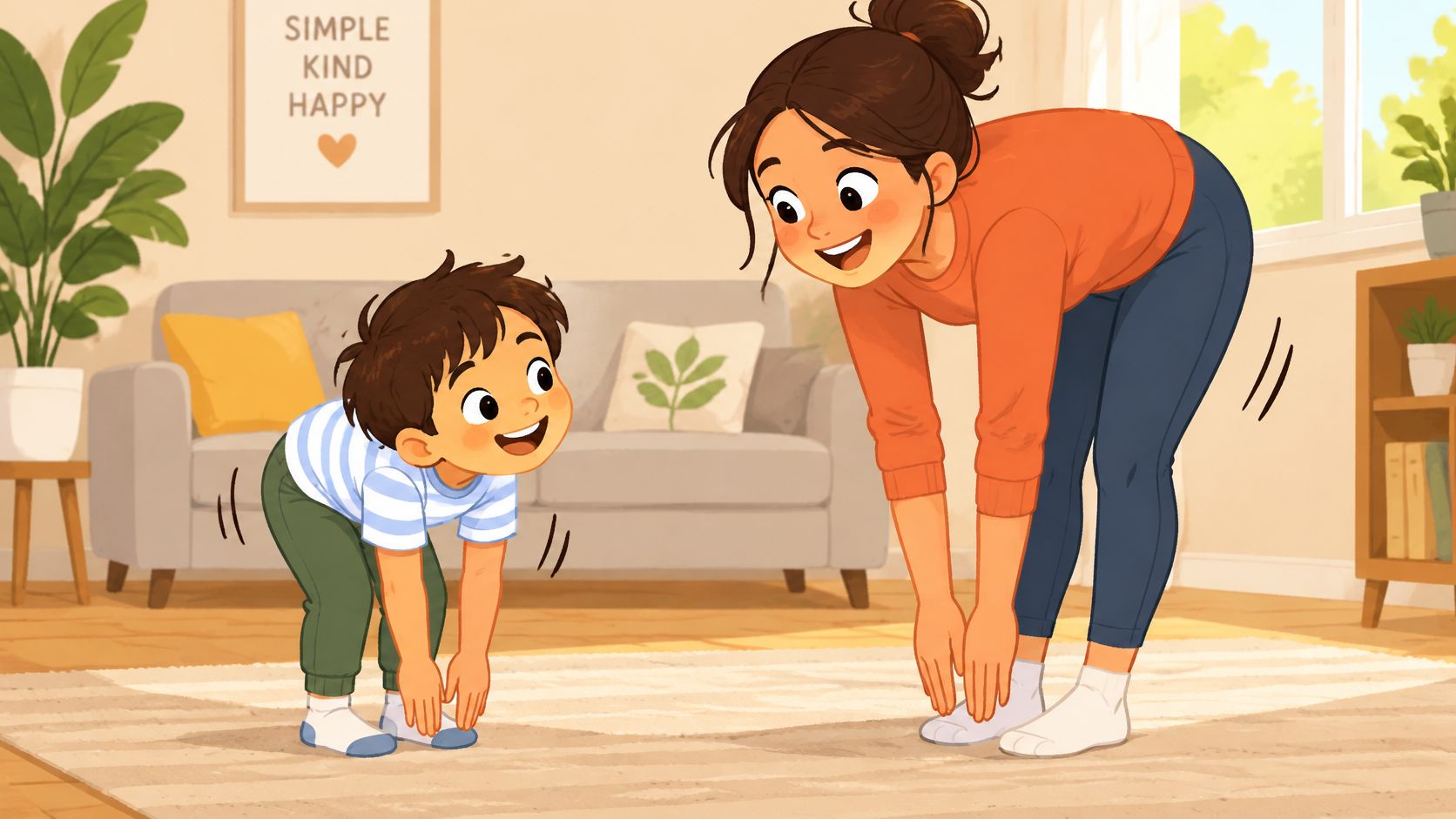
A six-year-old might practise head, nose, feet, and hands during bath time. A shy nine-year-old beginner can join by moving first, then take charge and give commands to younger siblings once the phrases feel familiar. Being the leader adds speaking without turning the game into a test.
- Reuse commands: Keep the same small set across several days.
- Change one detail: Move from “Touch your nose” to “Touch your ear.”
- Finish with choice: Let the child pick the final silly command.
Two minutes before dinner is enough. Repetition across ordinary moments helps the language become familiar.
2. Point-and-Find Picture Listening Game
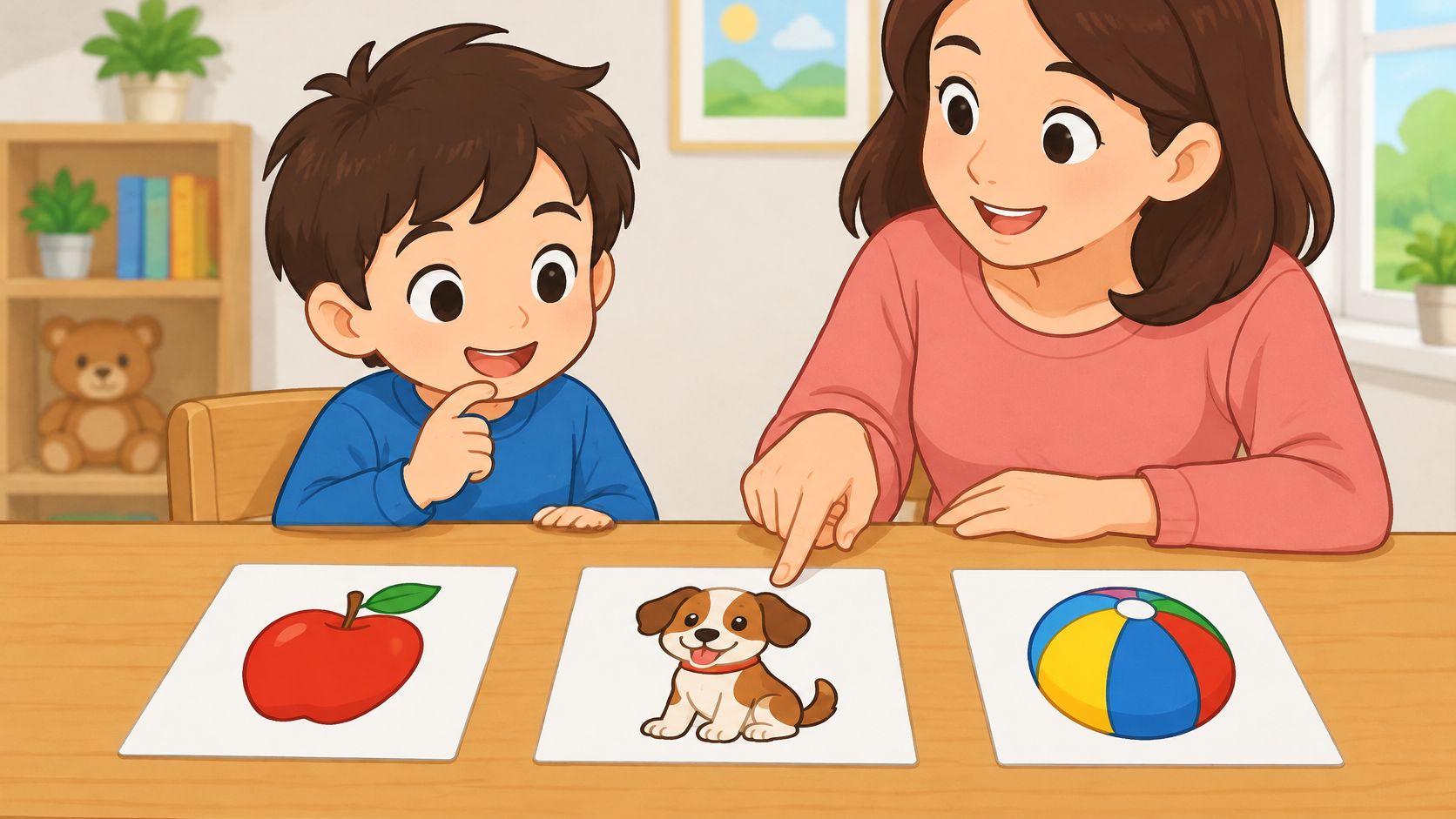
This game begins with a simple question in action. A parent names an object or picture, and the child points, picks it up, or brings it over. Listening comes first, then pointing becomes one word, and one word can become a short phrase.
Place four or five picture cards, toys, or household objects on a table. Say “Find the red ball” twice, pause, and let the child respond. A seven-year-old might find the ball among three toys and repeat “red ball.” A nine-year-old who's new to English can match picture cards to simple labels on kitchen items, which respects stronger reading skills while keeping English beginner friendly.
Home interaction can provide substantial language input, since a 2019 study of 202 English and Chinese bilingual preschoolers found children received 3.16 hours of English input from family members each day and spoke English with family for 2.67 hours daily. Families don't need to copy those exact patterns. The useful lesson is simpler: short, frequent interaction counts.
Watch for output: Pointing shows understanding, while repeating or naming the item shows the next step toward speaking.
For children who enjoy speed, a gentle “Find it!” challenge works. Others may prefer calm choosing without a timer.
3. Chants and Rhythmic Repetition
A chant turns a useful phrase into a beat. “Shoes on, coat on, let's go out” can accompany the morning routine, with clapping on the strong words. The rhythm gives children a pattern to copy, so they don't have to build every sentence from the beginning.
Carolyn Graham's Jazz Chants are a well-known example of rhythmic language practice, but families can easily make their own. A household might chant “Brush, brush, brush your teeth” for a week, then change one part to “Wash, wash, wash your hands.” Changing a single word keeps the structure stable while adding vocabulary.
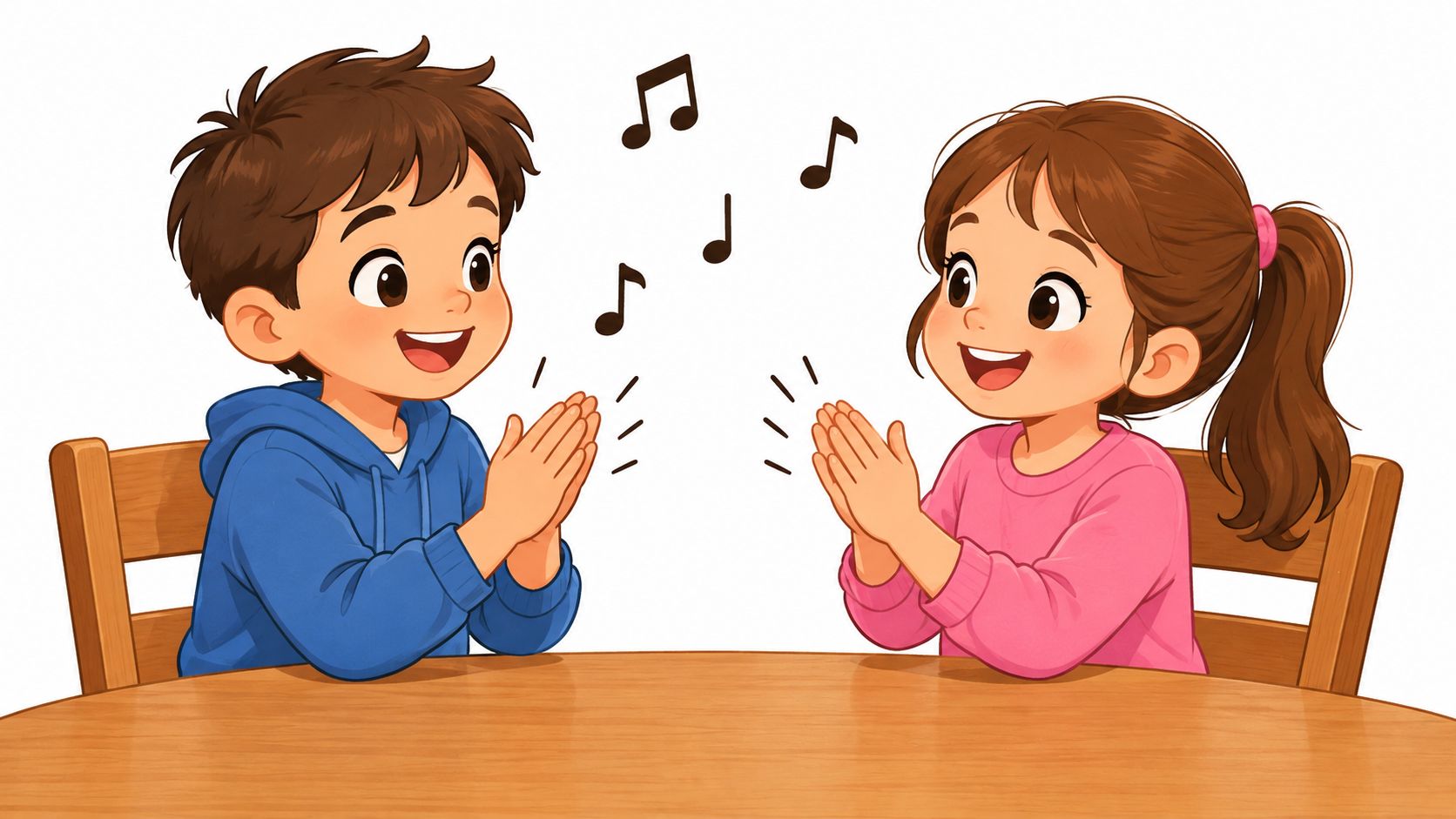
Younger children can tap, stamp, or march as they repeat. Children aged seven to eight can choose the actions and swap in words for clothes, food, or school objects. A ten-year-old might write a short chant about planets, football, or animals and perform it for a sibling. That older version still supports beginner English, but the topic and independence feel age appropriate.
Keep the chant short enough to repeat several times. Once it sounds comfortable, pause before the final word and let the child finish it.
4. Songs with Actions
Action songs give beginners three supports at once: melody, repetition, and movement. A child singing “Head, shoulders, knees and toes” hears each word while touching the matching body part. Even when every word isn't clear yet, the action makes participation possible.
Choose one or two songs for a whole week instead of introducing many songs at once. Sing the same chorus daily, pause before a familiar final word, and let the child fill the gap. That tiny pause turns listening into a spoken response.
Adapting by age
- Ages 5 to 6: Use big movements and repeat the same verse.
- Ages 7 to 8: Let the child choose an animal, vehicle, or weather song and name what appears.
- Ages 9 to 10: Add a challenge, such as singing faster, changing an action, or teaching the song to someone else.
Ordinary play can support vocabulary when NAEYC notes that children learn more words when adults introduce unfamiliar vocabulary, repeat it naturally, ask questions, and provide chances to use words in context. A song does that without formal teaching. Parents with limited English can sing along with a recording and use the home language for encouragement between verses. Library collections can provide recordings without extra purchases.
5. Shared Reading with Simple Questions
Shared reading works best as a conversation, not a reading test. A parent reads a short picture book, pauses, and asks “What is that?” or “What colour?” The child can point, gesture, say one word, or try a phrase.
This approach relates to dialogic reading, which encourages children to talk about a book rather than only listen. The PEER sequence offers a simple structure: prompt, evaluate, expand, repeat. If a child says “dog,” a parent can respond warmly, expand it to “a brown dog,” and later invite the longer phrase again.
NAEYC recommends pausing during read-alouds to ask questions, explain ideas, share reactions, and invite children to participate with their current language skills. That makes shared reading accessible for early readers and for older beginners who can't yet decode English independently.
A six-year-old might name animals after hearing each one. A ten-year-old beginner could listen while following pictures, predict what happens next, and retell one scene. Reading the same favourite book several times helps because familiar pictures free attention for new spoken words. Letting older children choose the book also gives them control and keeps the topic interesting.
6. Story Sack Retelling
A story sack is a bag or box containing objects that represent parts of a story. The child pulls out one item at a time and uses it as a prompt to retell what happened. Holding something real makes the sequence easier to remember than speaking from memory alone.
Start with a story the child already knows in the home language. A five-year-old retelling “The Three Little Pigs” might use a toy pig, a piece of straw, and a small brick, then say “pig,” “house,” or “big bad wolf.” A nine-year-old could build a sack about a park visit with a ball, a leaf, and a toy dog, then use complete sentences and describe the characters.
What happened first, and what happened next? Two steady questions can turn single words into a sequence.
Read-alouds can build vocabulary and world knowledge, and NAEYC guidance supports discussing material in the home language so children connect unfamiliar English words with concepts they already understand. Parents can therefore explain the story in the home language, then return to a few English words for the retelling. Letting the child choose the objects makes the story more personal and gives reluctant speakers a reason to talk.
7. Shop and Café Role-Play
Role-play answers a common problem with speaking practice: children need a reason to talk. In a pretend shop or café, the reason is clear. Someone asks for an apple, hands over play money, and says “Thank you.”
Set out toy food or draw simple items on cards. Practise only three or four phrases at first, such as “Hello,” “Can I have a banana, please?”, “How much is it?”, and “Here you are.” Write them on a card for children who benefit from seeing the words. Audio and gestures can support younger or early reading children.
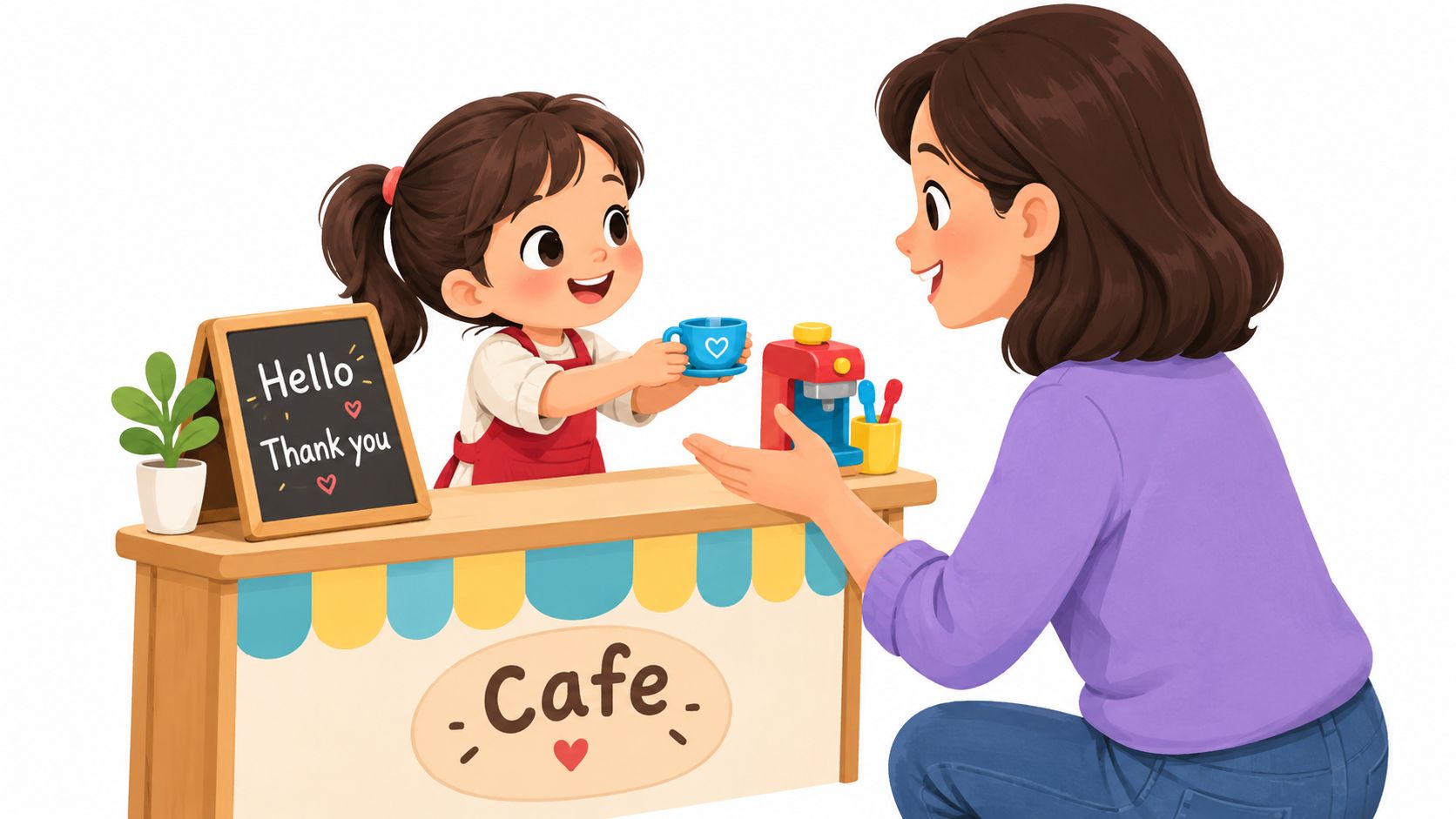
A six-year-old might sell fruit toys and repeat the greeting and thank-you phrases. A ten-year-old can design an English menu, take family orders, and handle a missing item by saying “Sorry, no cake today.” Swapping roles matters because the child practises both asking and answering.
For teachers and tutors, the same scene provides supplementary practice without worksheets. A simple prop, such as a paper money note or a menu, makes the exchange feel real while keeping language demands manageable.
8. Home Object Hunt in English
The home becomes the teaching material in this activity. A parent names a colour, shape, or object in English, and the child searches for it. Moving toward a real object links the word with something visible and familiar.
A five-year-old might find three yellow things and say “yellow banana, yellow pencil, yellow cup.” An eight-year-old can play “I spy” in the kitchen with clues such as “Can you see something round?” Older beginners aged nine or ten can give the clues themselves, hide an object, and answer questions about its location.
Useful language to reuse
- Where is the cup? Practise finding one named object.
- On, under, next to: Add location words after the object is found.
- I can see something red: Let the child lead the next round.
Model the question first, then hand over the leader role. Keep each round to about one or two minutes, especially for younger children. The activity can happen while tidying, cooking, or packing a school bag, so English attaches to routines families already have. No special cards are needed, and children who dislike sitting still often join more willingly when searching is part of the task.
9. Daily Greeting and Feelings Routine
Some English speaking activities for kids work because they're attached to a moment that already happens every day. At breakfast, a parent says “Good morning. How are you?” and the child points to a feelings face or answers “I'm happy” or “I'm tired.”
Keep the exchange to two minutes or less and use the same time daily. Predictability helps beginners because they know what comes next and can focus on the words. Add only one new phrase each week, such as “I'm hungry,” “I'm excited,” or “How was your day?”
A family feelings chart with simple faces supports children aged five to six who need picture cues. Children aged seven to eight can choose between two answers and begin asking the question. A nine-year-old might greet family members in the evening, ask about their day, and add a short reason, such as “It was good. I played football.”
Parents who aren't confident English speakers can use the home language around the routine while keeping the target greeting in English. Families looking for more home routines can read about ways to teach a child English at home and adapt one idea at a time. Success means the child understands, responds willingly, and gradually produces familiar phrases.
10. Space Adventure Mission Game with a Companion Character
A mission gives repetition a purpose. The child follows a friendly companion, completes a small task, hears a phrase, matches a picture, and says the words to move forward. Instead of practising a list, the child is helping a character continue a journey.
Talkio Kids uses this structure with Nox, an alien companion in a space adventure for complete beginners aged 5 to 10. Its short activities combine listening, picture matching, speaking, and review, with basic everyday vocabulary and simple phrases. Learning content works offline, progress stays on the device, and there are no ads, social features, open chat, open-ended AI conversations, or account signup. It doesn't promise guaranteed fluency.
Mobile practice still needs structure. A 2024 meta-analysis of 18 studies involving 932 foreign-language learners found a statistically significant, large overall effect for mobile-assisted language learning on speaking development compared with traditional instruction. That evidence isn't a promise for every child, but it supports short listening followed by spoken responses rather than quiet tapping.
A seven-year-old might practise a phrase during a mission and repeat it at dinner. A nine-year-old beginner can review picture vocabulary before bed, then use the words in a shop role-play the next day. Parents should check current trial eligibility and subscription prices inside the app.
10 English Speaking Activities for Kids: Side-by-Side Comparison
| Activity | Implementation Complexity | Resource Requirements | Expected Outcomes | Ideal Use Cases | Key Advantage |
|---|---|---|---|---|---|
| Simon Says and Action Commands (TPR) | Low; give and demonstrate simple commands | None | Listening comprehension and action vocabulary | Beginners, shy children, or quick movement breaks | Children can participate without speaking |
| Point-and-Find Picture Listening Game | Low; name items for the child to locate | Household objects, picture cards, or books | Recognition of spoken words and basic phrases | Beginners and children who are not yet reading | Quickly reveals what the child understands |
| Chants and Rhythmic Repetition | Low; repeat short phrases to a beat | None; optional clapping or tapping | Vocabulary recall, rhythm, stress, and intonation | Daily routines or group speaking practice | Makes repetition memorable and low-pressure |
| Songs with Actions | Low; choose and repeat a suitable song | Optional recordings or music player | Familiarity with vocabulary and phrases through listening and movement | Beginners, transitions, and short daily routines | Melody and actions support recall |
| Shared Reading with Simple Questions | Moderate; choose a suitable book and pause for prompts | Picture book or audiobook | Vocabulary, listening, early reading, and simple responses | Early readers and beginners who benefit from visual context | Combines story, pictures, and interaction |
| Story Sack Retelling | Moderate; prepare story objects or cards | Three to five household objects or picture cards | Story sequencing, vocabulary, and speaking confidence | Children ready to retell familiar stories | Objects provide structure for speaking |
| Shop and Café Role-Play | Moderate; set a scene and practise short phrases | Optional toys, play food, menu, or paper money | Functional phrases, turn-taking, and conversational practice | Especially useful for children aged 7–10 | Gives speaking a practical purpose |
| Home Object Hunt (I Spy in English) | Low; name objects, colours, or shapes to find | Everyday household items | Object vocabulary, descriptive language, and movement-based practice | Active learners and short games at home | Free, flexible, and easy to repeat |
| Daily Greeting and Feelings Routine | Low; use a consistent short script | None; optional feelings chart | Familiarity with greetings, emotion words, and routine phrases | Busy families and daily morning or bedtime practice | Fits easily into everyday life |
| Space Adventure Mission Game with a Companion Character | Low to moderate; follow short app or home missions | App-enabled device, or cards for a home version | Listening, picture matching, basic vocabulary, and simple phrases | Beginners who enjoy stories, independent practice, or offline travel use | Story-based practice can make repetition engaging |
Build a Small Routine You Can Keep
The best activity is the one a family can repeat without stress. Rather than trying all ten, choose one listening game, one movement activity, and one speaking or storytelling activity. Simon Says might fit Monday, a home object hunt Wednesday, and a story sack at the weekend. Shared reading can stay at bedtime because the routine already exists.
Small word sets deserve several encounters. The U.S. Institute of Education Sciences recommends teaching selected vocabulary intensively through varied activities, concrete representations, questions, and structured opportunities to talk. At home, that could mean meeting cup, red, open, and more in a picture game one day, hearing them in a chant the next, and using them during snack time later in the week.
Progress also needs to be visible. A 2022 comparative study reported mobile-group speaking rater means from 3.70 to 4.25, compared with 3.00 to 3.21 for face-to-face instruction. Those learners weren't specifically children aged five to ten, so families shouldn't treat the result as a guarantee. The practical point is to watch observable changes: understanding a command without a gesture, naming a familiar picture, repeating a phrase more clearly, or using a word during play.
Screen practice needs the same care. Research on young children and generative AI warns that technology should not displace embodied, outdoor, and unmediated play. A short digital session can therefore end with an offline action: hear “red ball,” say it, then find something red in the room. That listen, respond, retrieve, and use sequence moves English beyond passive screen time.
Adapt the routine to the child, not only the birthday. Children aged 5 to 6 usually need short prompts, gestures, pictures, and familiar songs. Ages 7 to 8 can make choices, lead familiar games, and build two or three word phrases. Ages 9 to 10 may read confidently in another language while still being complete English beginners, so they can handle menus, clues, explanations, and more detailed retellings without being treated like preschoolers.
Parents who don't feel confident in English still have an important role. Research on dual-language children shows children use gestures, home-language words, and other linguistic resources to communicate meaning. The home language can explain, encourage, and connect ideas while the English target stays small and repeatable.
For families wanting structured beginner practice at home or while travelling, it's worth exploring Talkio Kids and its app download options. Nox guides children through listening, picture matching, speaking, and review. Monthly and annual subscriptions are available, with current prices and trial eligibility shown in the app. Parents can find it through the Talkio Kids App Store listing or the Talkio Kids Google Play listing.
Talkio Kids gives complete beginners aged 5 to 10 short listening, picture matching, speaking, and review activities that turn English speaking activities for kids into a playful space mission with Nox. Families can pair its offline, audio-supported practice with the games and routines above to help children hear, repeat, and use everyday phrases. Visit Talkio Kids to explore the app and choose the download option that fits the family device.