
English learning at home
How to Teach My Child English at Home: Practical Tips
Learn how to teach my child English at home with short, playful routines, simple activities, and parent-friendly tips designed for complete beginners aged 5-10.
By Talkio Kids ·
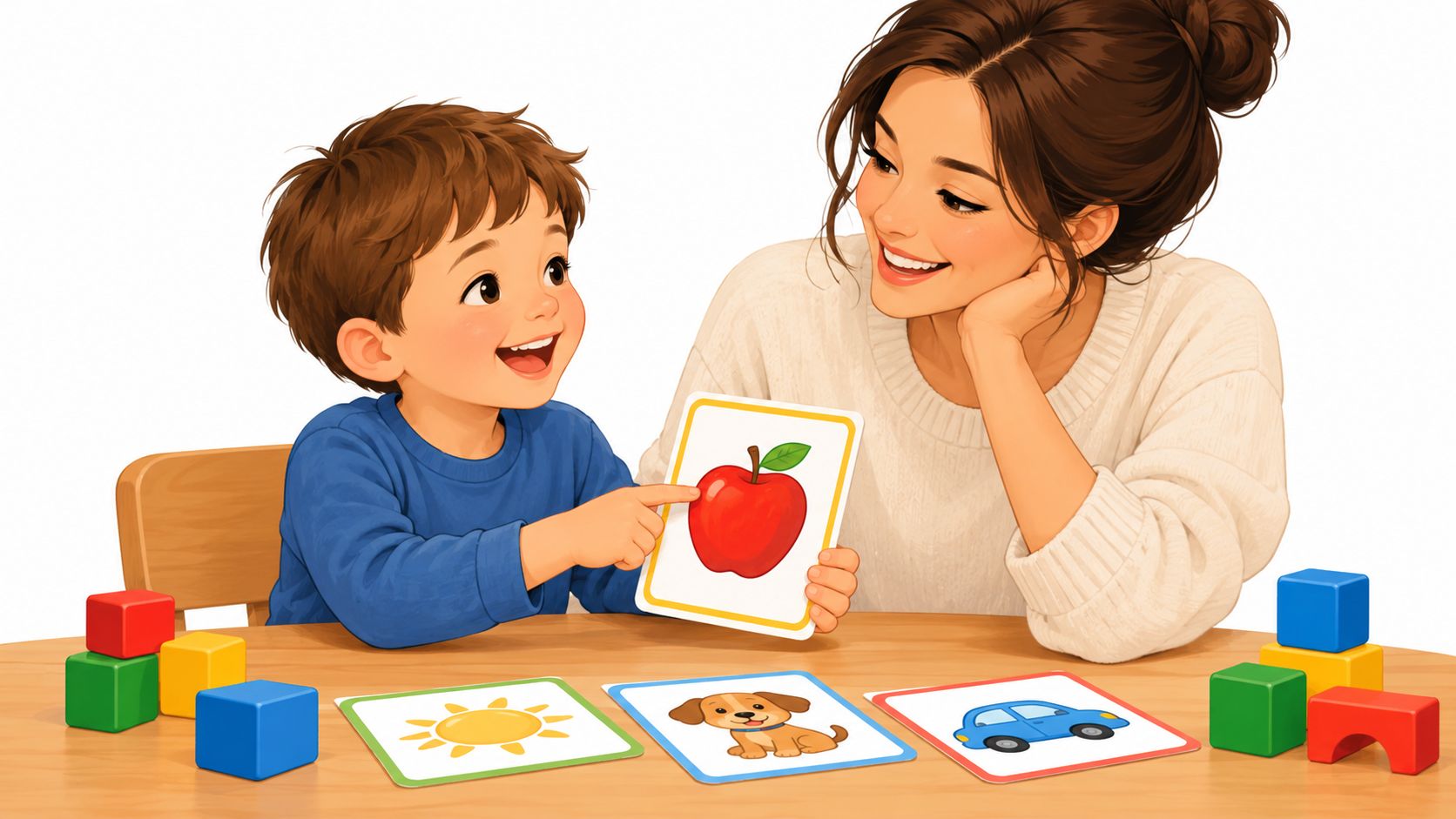
A parent sits on the floor after dinner, phone in one hand, a child leaning against a knee, wondering how to teach my child English at home without fluent English, expensive books, or an hour to spare. That uncertainty is normal. A calmer answer exists. Short, repeated moments with pictures, clear audio, and a response from the child can build a real beginning.
Why Short Home Routines Matter
Home practice isn't a backup plan for families who can't afford classes. It's a recognized foundation for early learning. UNICEF describes early learning activities as reading books, telling stories, singing songs, playing, going outside, and naming, counting, or drawing things with a child, and its global estimates indicate that approximately 4 in 10 children aged 2 to 4 do not engage in enough stimulating activities with caregivers at home, while about 1 in 10 engage in none of these activities, according to UNICEF data on the home environment.
That finding points to a useful shift. A parent doesn't need to run a formal lesson at a desk. Naming colors while drawing, counting toys during clean-up, or singing a short song turns an ordinary routine into language exposure a beginner can absorb.

What changes with a small daily habit
Children aged 5 to 10 who are complete beginners need to connect sound and meaning before independent reading or grammar makes sense. A brief routine, repeated often, gives them that connection. The child begins to expect the activity, recognizes familiar sounds, and slowly tries to copy them.
UNICEF's 2024 Global Report on Early Childhood Care and Education, covering 99 countries and 36% of the world's child population, found that only 56% of children aged 24 to 59 months received early stimulation and responsive care, as documented in the 2024 UNICEF global report. The same report notes that only about 1 in 10 children under age 5 lived in a household with three or more children's books, with 21% in the richest households versus 4% in the poorest.
A strong home routine shouldn't assume English books, reliable internet, or a fluent reader in the house.
Audio, pictures, gestures, and songs fill that gap. Five calm minutes, most days, gives a child far more useful repetition than one long, tiring session each week.
What Realistic Beginner Progress Looks Like
Progress arrives in layers, and confusing those layers causes most frustration. Exposure means a child has heard a word. Recognition means the child can point to the right picture when asked. Production means the child says the word without being shown it first. Each layer is genuine progress, and each takes longer than the one before it.
A typical sequence looks modest. On Monday, a child hears "apple" and touches the apple card when prompted. On Wednesday, the child finds that card among four others. A week later, during a snack, the child whispers "apple" without any card at all. That unprompted word is the payoff, but the pointing days built it.
Three signs worth watching for
- Faster pointing: The child finds the matching picture with less hesitation than last week.
- Next-day recall: The child remembers a word after a night's sleep, not only minutes after hearing it.
- Voluntary attempts: The child tries a word during play or meals, even with approximate pronunciation.
Pronunciation stays approximate for a long time, and that's expected. Confidence usually grows faster than accuracy in the early years. A child who happily attempts ten words, imperfectly, is better placed than a child who stays silent waiting to be perfect.
Parents also shouldn't treat one correct repetition as mastery. A word is secure when a child recognizes and uses it across several spaced sessions, in more than one context. More screen time doesn't speed that up. Shorter, repeated encounters do, because each return visit asks the memory to work a little harder.
The Input Interaction Retrieval Rhythm
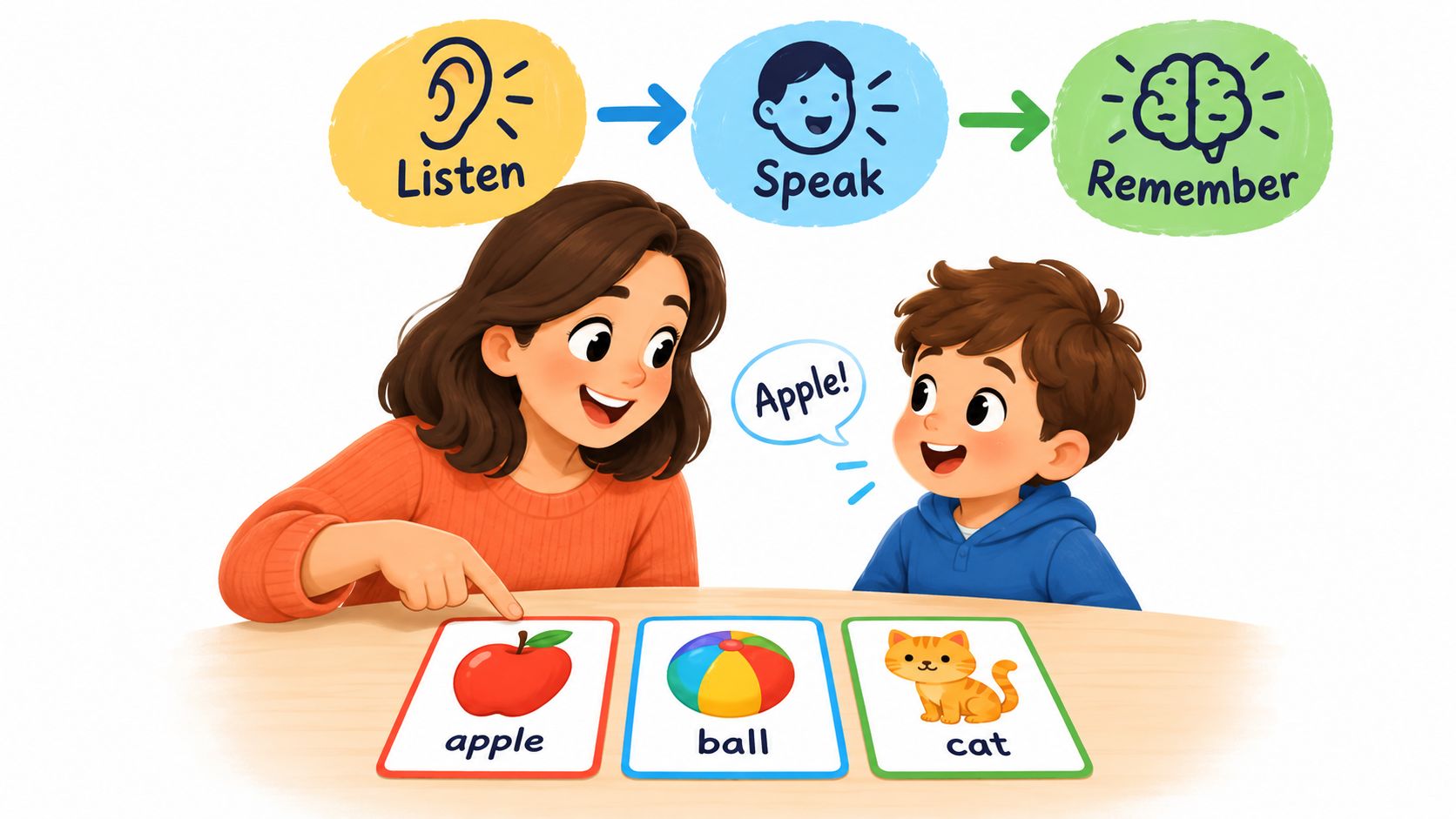
One simple rhythm can carry almost every beginner session. First comes input, a small set of words presented with clear audio and a picture. Next comes interaction, where the child points, touches, or acts out the answer. Last comes retrieval, revisiting those words later without showing the answer first.
A systematic review of early childhood foreign language programmes found that explicit vocabulary teaching was more effective than implicit instruction for both receptive and productive vocabulary, with a stronger advantage for productive vocabulary, and it identified repetition, elicitation, feedback, and scaffolding as recurring practices that supported learning, as summarized in a Cambridge review of pre-primary foreign language studies. Stories were especially effective for vocabulary in that same review.
A worked example with colors
A parent draws three rough circles, red, blue, and yellow, on scrap paper. Recorded audio or the parent's voice says "red" while a finger taps the red circle. Then the question becomes "Where is red?" and the child points. The next day, the parent holds up a red sock and asks, "What color?" Pointing still counts as success early on. Spoken answers come later, once recognition feels easy.
The same shape works for greetings, food, body parts, or numbers. Teach only a few related items per session. Model the sound before requesting speech, and resist correcting every error in the moment.
Practical rule: End the session while the child would still happily do one more round.
Brief, frequent practice also matches how listening develops. The British Council recommends introducing vocabulary with picture flashcards, drilling the words, then using a quick game with the cards, as described in British Council guidance on kids and listening. Five minutes done consistently beats thirty minutes done once, because retrieval needs spacing, not marathons.
Five Minute Activities You Already Own
No shopping list is required. Household objects, scrap paper, and movement cover most of what a beginner needs. Each activity below keeps the parent's job small and the child's job active.
Color naming while drawing takes almost no setup. The parent names a color, the child picks up that crayon, and both say the word once. After a few rounds, roles swap and the child names the color of a crayon the parent holds up.

Counting during clean-up turns a chore into review. Toys go into a box one at a time, counted aloud in English. A missed number gets repeated together, without turning tidying into a test.
Three more to rotate through the week
- Label cards on furniture: Tape a hand-drawn card reading "door" or "table" to the object, and say the word whenever passing it.
- I spy indoors: The parent says "I spy something red," and the child runs to touch a matching object.
- Missing card game: Lay out five picture cards, remove one while eyes are closed, and ask the child to name what's gone.
British Council guidance suggests grouping words by topic, saying a word aloud, drawing it, hearing it in context, and later recalling it without looking, alongside games such as bingo, Memory, Simon Says, and mime, as outlined in British Council guidance on child learners. That mix of recall types matters more than polished materials. More activity ideas in this vein appear in further home learning guides for parents, all built around the same principle. Movement plus retrieval, repeated across days, does the teaching.
When You Are Not Confident in English Yourself
Many parents assume their own English disqualifies them. Research on home-based English learning identifies low parental English proficiency, limited exposure, time pressure, and financial constraints as recurring barriers, along with a capability gap involving limited time and low English self-efficacy, as discussed in a 2025 study of home-based English learning. Feeling unsure is the common case, not a personal failure.
The helpful reframe is a change of job title. The parent isn't the teacher who must model every sound and explain grammar. The parent is the facilitator who starts the activity, sits nearby, points, pauses, and praises effort.
Tactics that remove the pressure to perform
Recorded audio from a trusted source can carry pronunciation, so the parent never has to improvise a model. Learning three fixed phrases at a time, such as "What is it?" and "Where is the ball?", gives the parent reliable scripts. Gestures and pictures replace long explanations, and a deliberate pause gives the child room to answer instead of the parent filling every silence.
Evidence supports that active presence. A quantitative study of 65 parents of children aged 4 to 6 found parental involvement correlated with English development at r = 0.6909, compared with r = 0.5238 for gadget use, with the two variables together explaining 65.36% of variance, according to a study of parental involvement and gadget use. Those figures are correlational, not causal, but they favor guided use over unattended viewing.
Participation, not performance, is the parent's actual job.
Using the home language is also legitimate. Translanguaging and heritage language storytelling can support biliteracy and cognitive flexibility, so a quick explanation in the family's language doesn't undo the English practice. On low-energy days, an audio-led activity can carry the session while the parent offers encouragement.
Choosing an App That Fits Your Routine
An app earns its place only if it strengthens the rhythm already described. Marketing claims matter less than whether a child hears a clear model, responds, speaks, and reviews earlier words. The checklist below turns that idea into quick store page tests, and the Talkio Kids website shows how one option presents this kind of information.
Beginner English App Checklist
| Feature to check | Why it matters | Quick test at the store page |
|---|---|---|
| Short audio models | Beginners copy sounds before reading | Look for listen and repeat in the description |
| Picture prompts | Non-readers need meaning without text | Check screenshots for image-led activities |
| Speaking turns | Tapping alone doesn't build speech | Confirm children say words aloud |
| Built-in review | Retrieval needs spaced repetition | Look for revisiting of earlier words |
| Offline use | Practice survives travel and weak signals | Check whether content works without internet |
| No ads or open chat | Young children need a closed environment | Read the safety and privacy notes |
British Council guidance recommends a progression from listening with support, to reading with audio off, to retelling a story using only pictures, plus short listen-and-record activities for comparing pronunciation, as described in British Council advice on speaking confidence. Useful apps mirror that gradual path rather than opening with free conversation.
One option built on these criteria is Talkio Kids, an iOS and Android app for complete beginners aged 5 to 10 with short listening, picture-matching, speaking, and review activities, a space adventure, and an alien companion named Nox. Its content works offline, progress stays on the device, and there are no ads, social features, open chat, open-ended AI conversations, or account signup. It targets everyday vocabulary and simple phrases rather than guaranteed fluency. Parents should still run it through the same checklist as any competitor.
Building a Week You Can Actually Keep
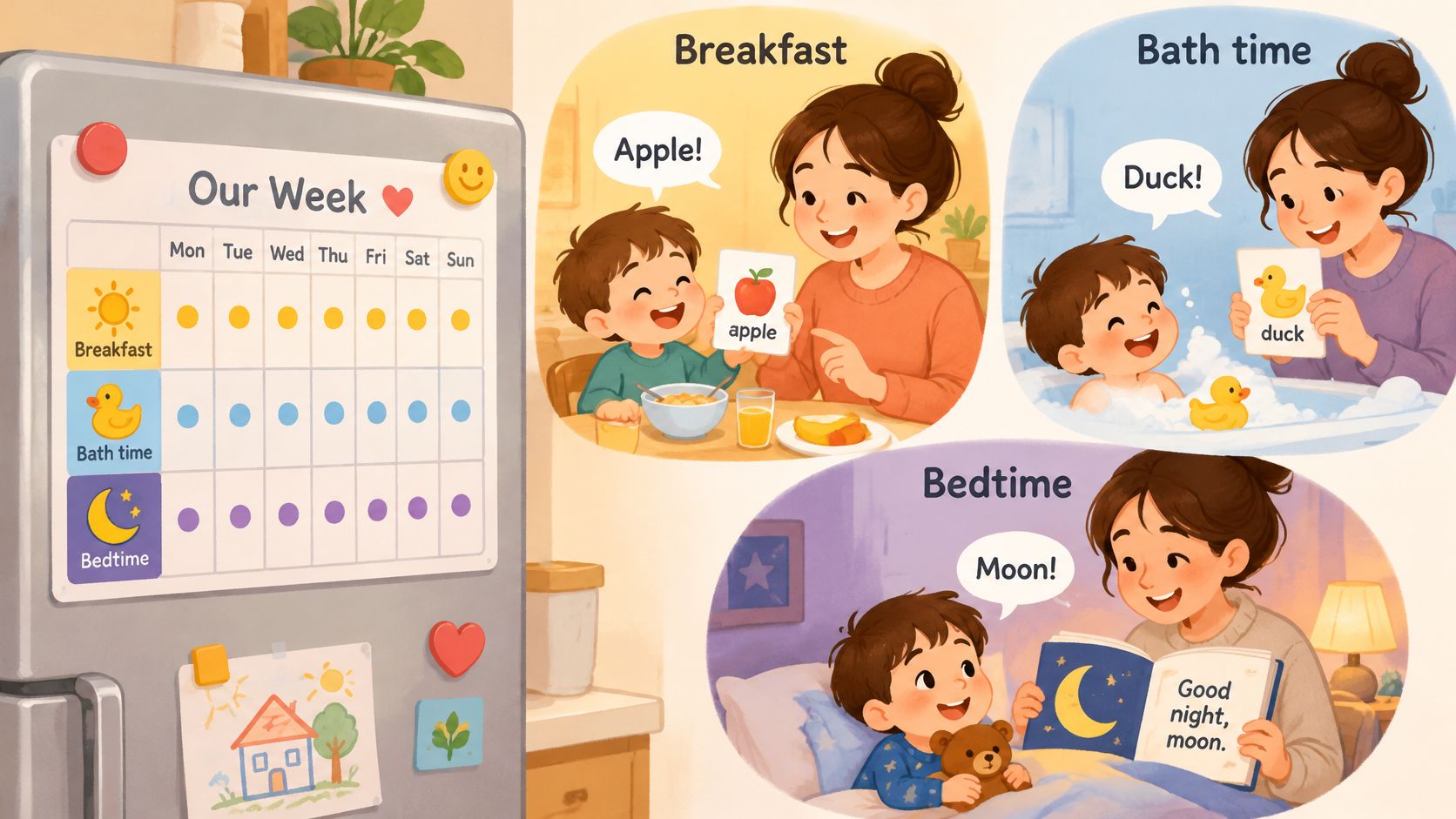
A sustainable week needs anchors, not appointments. Attaching practice to breakfast, the after-school snack, or bath time means the routine survives busy days because the trigger already exists. Three short sessions a week is a realistic starting point.
A simple starter week might review familiar words on day one, introduce a small new set on days two and three, and replay a favorite game on day five. Each session stays near five minutes. The parent's role stays limited to starting, encouraging, and stopping before the child disengages.
Time pressure is the main threat to that plan. In a 2025 mixed-methods study involving 517 parents and focus groups with 60 participants, parents described difficulties balancing work, digital-literacy demands, and teaching responsibilities, as reported in a 2025 study of parents supporting home learning. Another study in the same body of research reported lack of time as the most common challenge, affecting 56% of respondents, alongside limited English proficiency affecting 47%. Short sessions directly answer that constraint.
Travel and unreliable internet don't have to break the streak either. Offline content and on-device progress remove setup friction, and parents can check options through the app download page, the App Store listing, or the Google Play listing. The British Council identifies songs, stories, vocabulary games, pronunciation practice, and phonics as suitable resources from about age five, as shown on the British Council page for kids learning English, so a missed app day can become a song day.
For families who want those five minute routines ready-made, Talkio Kids offers short listening, picture-matching, speaking, and review activities for complete beginners aged 5 to 10, with audio and pictures that support early readers and content that works offline. Parents who aren't confident English speakers can start a session and encourage, while Nox the alien companion keeps practice playful. Explore it at Talkio Kids and see whether it fits the week already taking shape at home.