
English learning at home
7 Short English Practice Routines for Children That Work
Discover 7 short English practice routines for children aged 5–10. Fun, no-cost activities families can try today, plus a playful app option for beginners.
By Talkio Kids ·
Dinner is late, the homework folder is finally empty, and the English practice that was meant to happen after breakfast never did. Nothing has gone wrong. Most families who add a language to an already full day lose the long lesson first, because a 40-minute session needs a clear table, a willing child and a free adult all at once.
Short routines ask for far less. A child aged 5 to 10 can pick up everyday words and simple phrases from a handful of repeatable moments, and a 9- or 10-year-old who is a complete beginner needs the same playful start as a five-year-old, not a watered-down exam course.
Age alone predicts very little. The Eurydice review of early language learning reports that in the BAF project, learners who began English at 8, 11, 14 and over 18 were compared after roughly 200, 416 and 726 hours of instruction, and the total number of hours of exposure mattered more than the age at which learning began.
Seven short English practice routines for children follow, each sized to a real slot in the day, from one minute to ten.
1. Simon Says Action Commands
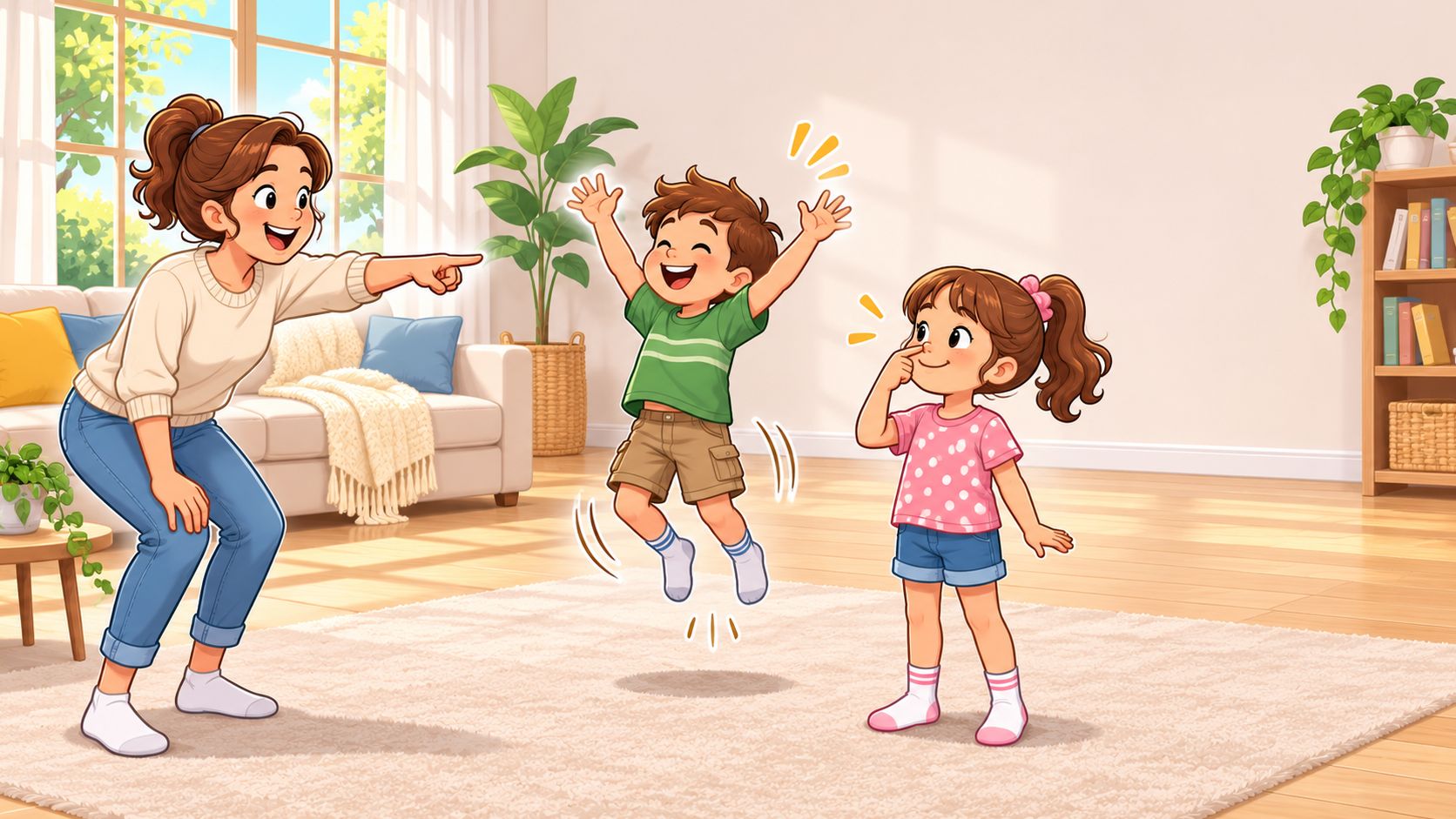
Children understand English through movement before they can produce it. Simon Says uses that gap well: the adult calls an instruction such as “touch your nose” or “jump twice,” and the child acts only when the sentence opens with “Simon says.”
The scene is familiar: one adult, one or two children, and a lot of jumping between the sofa and the door.
Where it fits. A three to five minute slot, anywhere. The kitchen while the kettle boils, the last stretch of a car journey, the few minutes before a bath. Nothing to print and nothing to buy.
A parent might say “Simon says hop,” then “Simon says touch the window,” then slip in “touch the door” without the opener. That last one is the check. It shows whether the child is hearing the words or copying the person.
Practical rule: start with three commands you can say slowly, and keep the same three for a week. New verbs can wait.
Older children gain more from leading than from following. A 9-year-old who gives the commands has to retrieve the vocabulary, speak clearly and watch for mistakes, which is harder work than obeying them.
- Pause before the action. A second of silence lets the child process the word instead of guessing from a raised hand.
- Model instead of repeating. If a child freezes, do the action once with them, then say the same command again.
- Stop at five minutes, while it's still fun and before anyone tires of it.
Short sessions aren't a compromise. A systematic review of oral-language interventions in Language, Speech, and Hearing Services in Schools found that sessions of roughly two minutes, two or three times a week, performed well on some composite language measures, as did a single weekly session of 20 minutes, although only 13 studies had tested dosage experimentally.
For more listening-first games that need no materials, this collection of English listening games for kids at home pairs well with this routine.
2. Daily Picture Hunt
Pick one room and five words. That's the whole setup. A kitchen hunt might use “cup,” “bowl,” “fork,” “spoon” and “blue,” and the child's job is to find, touch or bring each one while the adult says the word clearly.
The object isn't the point. The link between a sound the child has just heard and a thing already in their hands is the point. Concrete nouns stick faster than abstract ones because there's something to look at while the word is still in the air.
A kitchen table, a mug and a bowl are enough to start.

A worked week. Monday, the adult points and says each word. Tuesday, the adult says the word and the child points. Wednesday, the adult asks “What's that?” and accepts a single word back. The British Council's guide to teaching kids English at home sets out that same progression, from pointing and naming toward asking the child to identify an item and then to produce the word, and it recommends folding vocabulary practice into tidying, cooking and shopping.
Ten-year-olds need a harder version or they switch off. Give them a two-minute timer, or send them to the bedroom for five objects plus their colours, then have them test a younger sibling. The vocabulary stays simple; the task grows up.
- Five words a week, not fifteen. Repetition across days does more than a wide net.
- Hold the same words for several days. Swap one out only when the child names it unprompted.
- Count as you go. “One cup, two spoons” slips numbers in without a lesson.
3. Picture Memory Match
Eight cards on the floor, four pairs: dog, apple, bus, hat. The child turns two over, and whoever finds a match says the word aloud. One sheet of paper and a pair of scissors cover the materials.
The memory element matters more than it looks. A pair only comes back to the child after several failed turns, which is retrieval after a delay, exactly the pattern that holds vocabulary. A review of spacing research in Cogent Education describes an elementary-school study where children learned unfamiliar words either in one concentrated block or across three consecutive sessions, then were tested seven and 35 days later; the spaced group remembered more. A middle-school study in the same review found better delayed recall when two sessions sat a week apart rather than back to back.
The design lesson is short. Recycle a small set of words across several brief sessions instead of introducing ten new ones in one sitting.
Six pairs is plenty for a beginner. Move to eight when the child wins without help, then stay at eight for a few weeks.
- Say each word twice when a pair is found, once as the child flips and once as they repeat.
- Hide the picture occasionally. Say the word and let the child find the matching image, so the task isn't only recognition.
- Note the misses. The words a child keeps failing to pair are the ones to bring back tomorrow.
A 9-year-old can run the game for a 5-year-old and act as the one who says the words, which gives them a genuine reason to repeat the vocabulary out loud.
4. Sing-and-Move Warm-Up
Same song, same time, every day. “Head, shoulders, knees and toes” works, and so does a short counting song, because the tune carries the words until the child can carry them alone.
Repetition feels dull to adults and reassuring to children. After a fortnight a 5-year-old joins in on the body words. A 10-year-old is more likely to rewrite the verses, swapping in “elbows, ankles, fingers, thumbs” and checking whether the adult keeps up.
What the numbers say about repetition. A study of Grade 3 children by Goossens and colleagues on spaced vocabulary practice taught 15 unfamiliar words through massed practice and 15 through spaced practice. A week later the children recalled 55.96% of the spaced words against 46.46% of the massed ones, and on a final cued-memory test they answered 65% of prompts for spaced items but only 34% for items studied in one block. The spaced sessions were days apart. That's what a daily song provides.
Make the Song Do the Work
- Sing it slowly first, then at normal speed once the actions are secure.
- Let children choose the actions after a week. Ownership keeps a song alive longer than novelty does.
- Keep the time of day fixed. Before school, after lunch, before teeth. The slot becomes the reminder.
- Cut it short. One verse sung with energy beats four sung under protest.
5. Bedtime Picture-Book Echo Reading
The adult reads one line, then pauses. The child repeats it. Pictures carry the meaning, so a child who can't read a word of English can still follow a story about a big dog and a small cat.
A calm book at bedtime does most of the work on its own.

What to choose. One short sentence per page, large pictures, and a repeated phrase. Repetition is the mechanism: “a big dog” on four pages is four retrievals, not four sentences.
Echo reading isn't just a bedtime trick. The Education Endowment Foundation's early years toolkit identifies reading aloud, asking children questions and talking about the story with an adult as an effective communication and language approach, which matters for children who can't yet read independently because meaning arrives through voice and pictures.
The three-night rule. Read the same book three nights running. Night one is listening. Night two adds pointing, such as “where's the fox?”. Night three, the child says one phrase before the adult does, or reads a single line aloud while the adult echoes it back.
For a 9- or 10-year-old beginner, swap the picture book for a short illustrated story or an audio story with simple text on screen. The echo structure still holds; the content just has to feel their age. More titles and read-aloud ideas sit in this guide to English learning stories.
6. Pretend Shop Role-Play
A fruit stall built from toy food, or a café built from paper and crayons. The adult is the customer first: “Hello, can I have two bananas, please?” The child answers, hands over the goods, and the phrases get used because the game needs them.
Role-play lowers the stakes of speaking. A child who freezes in a question-and-answer session will often chat happily to a pretend customer, because the customer is a character and mistakes belong to the game rather than to the child.
A market stall takes five minutes to set up and can be packed away in one.

For parents who don't speak much English. Write three phrases on a card and read them. That's the entire adult script: “Hello,” “Can I have an apple, please?” and “How much is it?” The adult's job is to start the game, encourage the attempt and keep it moving, not to correct grammar.
That distinction shows up in parent research. A 2025 study of 65 parents of children aged 4 to 6 found parental involvement correlated with early English acquisition at r = 0.6909, against r = 0.5238 for gadget use, with the combined variables explaining 65.36% of the variance. Guided participation, not fluent teaching, is what to aim for.
“Praise the attempt, then say the phrase back naturally. ‘Yes, two bananas. Here you are.' That models the form without turning the game into a correction.”
- Swap roles so the child gets to be the shopkeeper and ask the questions.
- Add one phrase a week. “Here you are,” then “Thank you,” then “That's three pounds.”
- Let a 10-year-old write the menu in English and run a café for a younger sibling.
More structured phrase practice sits in this guide to English conversation for kids.
7. Morning Question of the Day
One question, asked at the same moment every morning. “How are you?” from Monday to Friday. “What's the weather?” as the curtains open. “What colour is your shirt?” at the breakfast table.
The answer can be a single word. A child who says “happy” has answered the question, and the adult's reply models the fuller sentence: “You're happy today.” Over a few weeks the child takes the model over without being taught it.
Keep the Question Small
A beginner can't answer “What did you dream about?” The questions that work are the ones with a tiny set of possible answers, repeated until they're automatic. Once a child answers before the adult finishes asking, that question has done its job and a new one can be added.
Spoken routines carry real weight. The Education Endowment Foundation's oral language interventions guidance reports that oral-language approaches typically produce strong benefits for young children, particularly when they include purposeful dialogue, explicit vocabulary teaching and active use of new words. One question at breakfast is small, but it is dialogue with a purpose.
- Wait before helping. Three or four seconds of silence is often all a beginner needs.
- Model, don't correct. Repeat the answer as a full sentence rather than asking for a repeat.
- Put a weather chart on the fridge with sun, rain and cloud pictures, and let the child point while answering.
- Let a 9-year-old ask the questions. Reversing roles builds listening and gives them a reason to speak.
All 7 routines at a glance
Scan the Time column first if your schedule is tight. Four of the seven routines take three minutes or less, so they fit inside slots that already exist, such as the walk to school or the wait for dinner. The two longer ones, echo reading and the pretend shop, are better saved for evenings or weekends when nobody is watching the clock.
The Materials column shows how little preparation this needs. Three routines use nothing at all, and the rest run on household objects, a picture book, or cards you can make from scrap paper. For the ages column, read it as the range where the routine works as written: the adaptation notes show how to stretch it for a 9-year-old beginner, usually by speeding it up or adding a step rather than finding a different activity.
| Routine | Time per day | Materials needed | Main skill practised | Best ages |
|---|---|---|---|---|
| Simon Says Action Commands | 3–5 minutes | None | Listening comprehension; verbs and body vocabulary | 5–8; adaptable for 9–10 |
| Daily Picture Hunt | About 5 minutes | Household objects | Vocabulary: nouns and simple adjectives | 5–10 |
| Picture Memory Match | 3–5 minutes | Picture cards, homemade or ready-made | Vocabulary recall and listening | 5–8; faster version for 9–10 |
| Sing-and-Move Warm-Up | 2–3 minutes | None | Vocabulary through rhythm and movement | 5–8; more complex songs for 9–10 |
| Bedtime Picture-Book Echo Reading | 5–10 minutes | Picture book | Listening, speaking, and early reading | 5–10 |
| Pretend Shop Role-Play | About 10 minutes | Household items for products and play money | Conversational speaking and requests | 5–10 |
| Morning Question of the Day | 1–2 minutes | None | Speaking confidence and answering questions | 5–10 |
Build Your Family's Routine (and Where an App Fits In)
Two routines are enough to start. Pick one for a busy slot, such as Simon Says while dinner cooks, and one for a calm slot, such as echo reading at bedtime. Anchor each to something that already happens in the day, and keep every session under ten minutes.
Missed days are normal. The value of a routine is that it resumes. After a gap, restart with familiar review rather than doubling the workload, and keep a three-minute version ready for days when nothing fits. A 2025 study of how families manage children's screen time found parents setting limits, choosing content carefully, preparing offline materials and monitoring progress. Offline backup matters because weak connections are a real barrier in many homes, so a practice option that works without internet earns its place in the travel bag.
Media guidance points the same way. The American Academy of Pediatrics advice summarised in Apple's screen time guidance emphasises age-appropriate media, shared viewing where possible and protecting time for play, shared reading and family activities, with a family media plan covering device-free times and bedtime routines.
Age says less than proficiency. A 9- or 10-year-old complete beginner deserves the same playful start as a five-year-old: pictures, audio, movement and small wins, rather than a grammar worksheet handed over because a birthday is approaching.
English practice also shares the week with swimming, football and dance. Parents mapping a crowded activity calendar can find practical pointers in guides like these dance class safety tips for parents when deciding what realistically fits.
For families who want one screen session to be practice rather than a cartoon, Talkio Kids is an option. It is an iOS and Android app for complete beginners aged 5 to 10, built around short listening, picture-matching, speaking and review activities inside a space adventure with Nox, a friendly alien companion. Lessons work offline, there is no account and no ads, chat or social features, and eligible new subscribers can try the complete course free for seven days. Monthly and annual subscriptions are available, with current prices and any trial eligibility shown in the app. Readers can explore Talkio Kids, download it from the App Store or Google Play, and find more home-practice guides on the Talkio Kids blog.
Talkio Kids turns the routines above into a single short session a child can run alone: hear a word, match it to a picture, say it aloud, then meet it again in review. There are no hearts, lives or harsh buzzers, so children can try again, get help and keep learning without getting stuck. Every lesson, picture and recording sits inside the app and works offline, so practice survives a weak connection or a long car journey. Visit Talkio Kids to see how the space adventure with Nox fits the ten minutes you already have.