
English learning at home
English Conversation for Kids: 8 Everyday Dialogues
English conversation for kids made simple: 8 everyday dialogues with age-appropriate practice ideas parents can try at home today.
By Talkio Kids ·
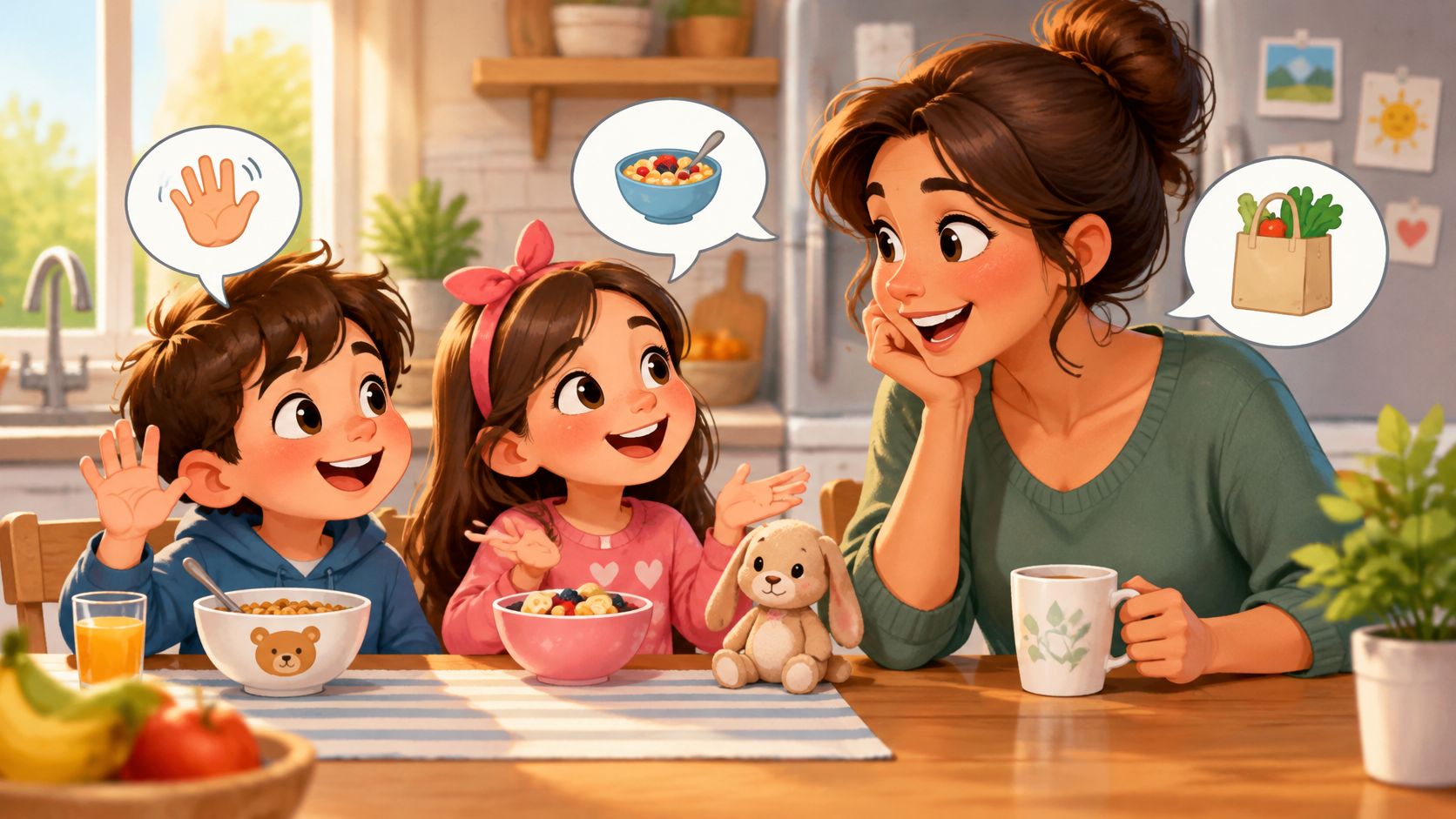
A parent sits beside a child after school, ready to practise English. The child knows a few words, but a simple question brings a shrug. The parent isn't sure what to say next, especially when English isn't the family's home language.
English conversation for kids starts with familiar exchanges, not grammar drills. Greetings, meals, getting dressed and asking for help give children a clear reason to understand and use a phrase. The adult can show what the words mean through objects, gestures and actions rather than translating every sentence.
The eight dialogues below each offer a fixed phrase pattern, an age guide, a no-cost role-play and a realistic limitation. A complete beginner can be any age from 5 to 10. Older children need beginner language without being treated like preschoolers.
For families focused on encouraging communication in everyday moments, the starting point is an ordinary moment that already happens at home. A child can listen, point, copy or take a speaking turn when ready.
Small daily routines are a more manageable starting point than long, occasional lessons. A comfortable exchange matters more than finishing a lesson.
1. Greetings and Introductions With Hello and a Name
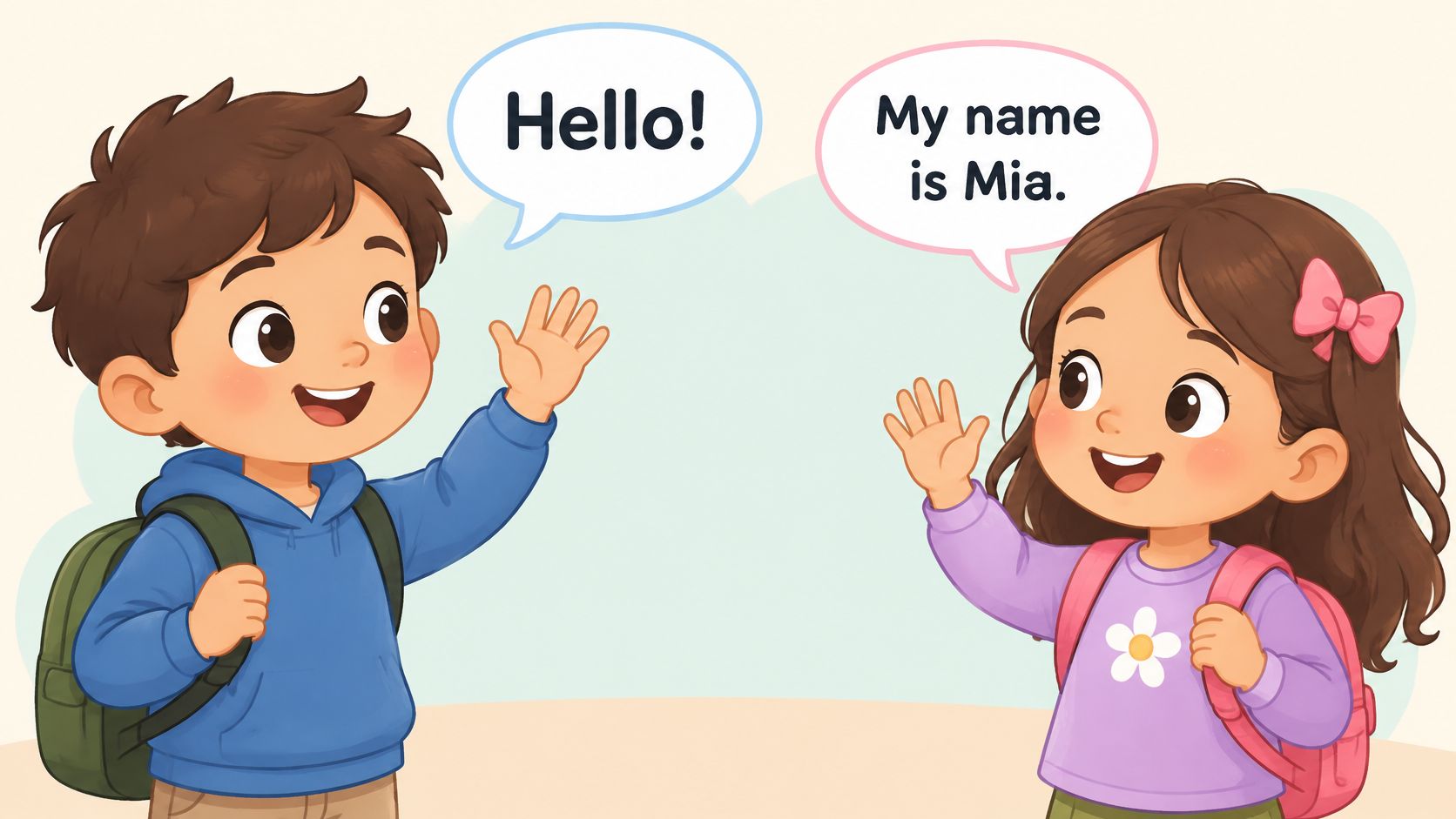
Suggested age band: 5–6. A wave makes the meaning of hello visible before a child understands every word. A parent can greet a soft toy first, then invite the child to take the toy's place.
The British Council's guidance on children's learning explains that children may spend time listening and thinking before they begin producing English. A wave or attentive look can therefore be an acceptable first response.
A greeting to repeat
- Adult: Hello! What's your name?
- Child: Hello! My name is Mia.
- Adult: How are you?
- Child: I'm fine, thank you.
The fixed pattern is My name is + name. The adult models the child's answer while pointing towards the child, then pauses rather than repeating the question more loudly.
For a no-cost role-play, a parent becomes a teacher greeting a new student at the doorway. After a familiar round, the child becomes the teacher and greets the adult or a toy.
Keep the limitation clear: introducing a name is practice, not a requirement during every greeting. A grandparent on a familiar video call already knows the child's name, so Hello, Grandma! is more natural there.
Praise the attempt specifically, such as noticing a clear hello or an independent wave. Perfect pronunciation isn't the condition for continuing.
2. Talking About Feelings With Happy and Tired
After school, a child drops a bag and settles onto the sofa. That moment offers a clearer meaning for tired than a vocabulary list does.
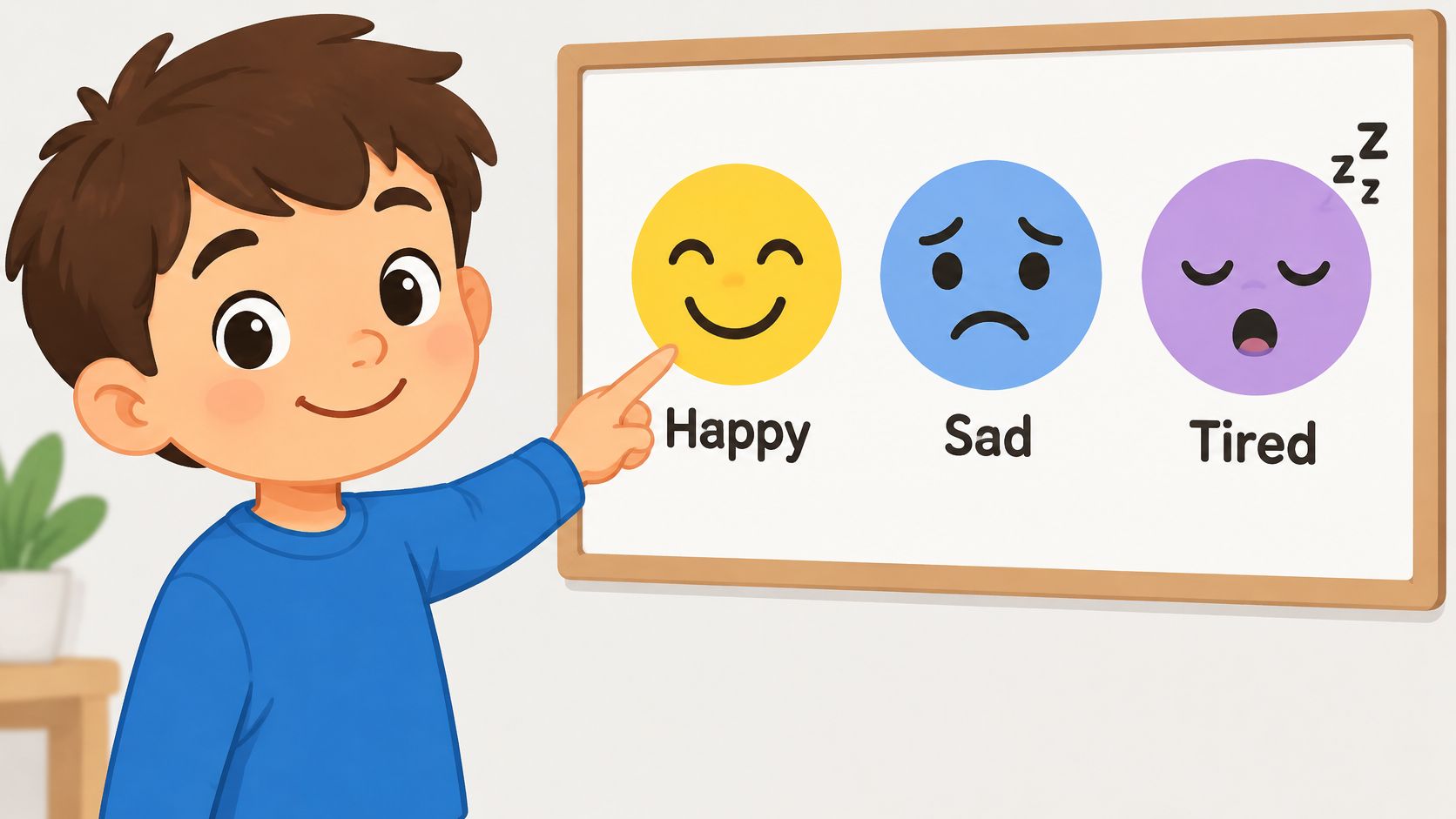
Suggested age band: 7–8. Start with a small choice of feelings, such as happy, sad and tired, using faces drawn on scrap paper. The fixed pattern is I'm + feeling, with I am available as a slower model.
- Adult: How are you feeling? Happy or tired?
- Child: Tired.
- Adult: You're tired. I'm tired, too.
- Child, optionally: I'm tired.
The adult accepts the short answer before offering the fuller phrase. If the child answers in the home language, the parent can acknowledge the meaning and model the English without demanding a translation back.
Let the child choose the meaning
For role-play, family members take turns selecting a drawn face and acting it out. A mirror also works: the adult makes a sleepy expression, says I'm tired, then lets the child choose another expression.
The British Council's advice on speaking confidence supports playful opportunities to use English without making children feel pressured. The adult's response should keep this exchange conversational rather than turn it into a quiz.
The limitation: a feelings activity isn't an invitation to correct a child's emotions. If the child doesn't want to explain, pointing is enough; more demanding questions can stay in the home language.
3. Mealtime Requests With Can I Have Some Water, Please?
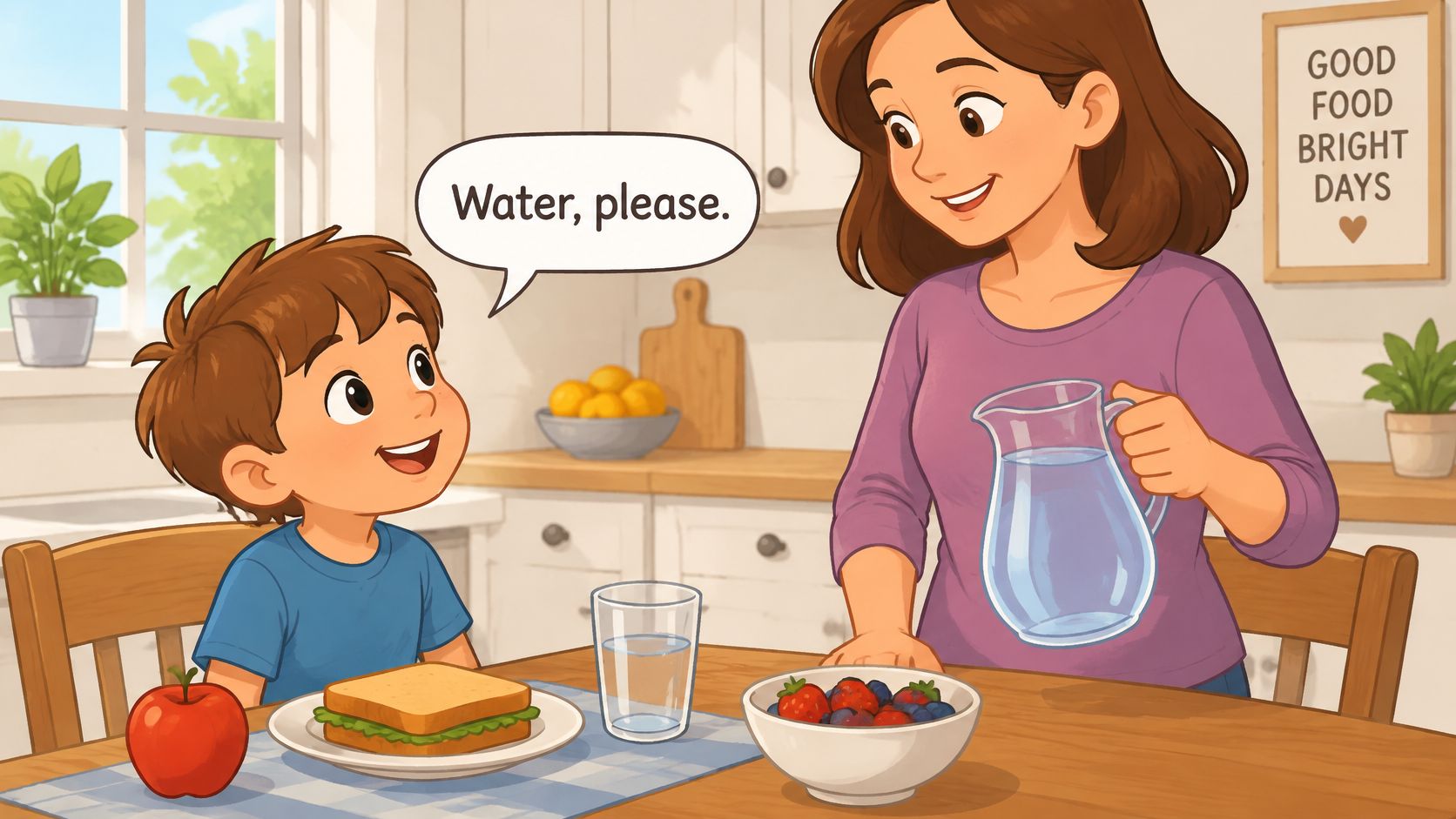
Suggested age band: 7–8. At breakfast or dinner, the object supplies the meaning. A child can see the water, hear its name and receive it during the same exchange.
The reusable pattern is Can I have some + food or drink + please? Begin with something already on the table rather than introducing unfamiliar foods and unfamiliar sentences together.
A complete table exchange
- Child: Can I have some water, please?
- Adult: Here you are.
- Child: Thank you.
- Adult: You're welcome.
The parent models the request first, pointing towards the water. A beginner might initially say Water, please, while the adult replies naturally and repeats the longer version later.
For a no-cost role-play, family members pretend they're serving a café meal using their usual cups and plates. Swap water for milk, or practise More rice, please when another serving is wanted.
The guide to basic English phrases offers related language for familiar situations. Keep the table practice focused on the phrase the child can use during that meal.
Practical boundary: food and drink should never depend on producing English. A gesture or home-language request still gets an appropriate response.
The limitation: a hungry child may not welcome language practice. Pause briefly to invite a request, but pass the item without turning it into a test, and return to English when everyone is comfortable.
4. Getting Dressed and Talking About the Weather
Looking through the window gives the conversation a shared subject. Nobody needs a worksheet to explain rain when both speakers can see it.
Suggested age band: 5–6, with more independence for older beginners. The fixed patterns are It's + weather word and Put on your + clothing item.
- Adult: What's the weather like?
- Child: It's cold.
- Adult: Put on your coat, please.
- Child: OK. A coat.
The adult points outside while saying cold, then holds up the coat. If the child only reaches for the correct item, the parent can acknowledge the understanding without asking for an immediate sentence.
Make the child the weather reporter
Draw a sun and a rain cloud on reused paper and leave them near the door. The child selects the matching picture, reports the weather and chooses an appropriate item from clothes already available.
An older beginner can take the reporter role independently and add It's rainy. An umbrella, please. A teacher or tutor can use the same pictures for paired practice, with one learner reporting and the other choosing clothing.
The National Association for the Education of Young Children's principles describe how guided play gives adults opportunities to introduce vocabulary and support its use in context.
The limitation: getting out of the house takes priority. On a rushed morning, the adult can say the phrase while helping, leaving the role-play for a calmer time.
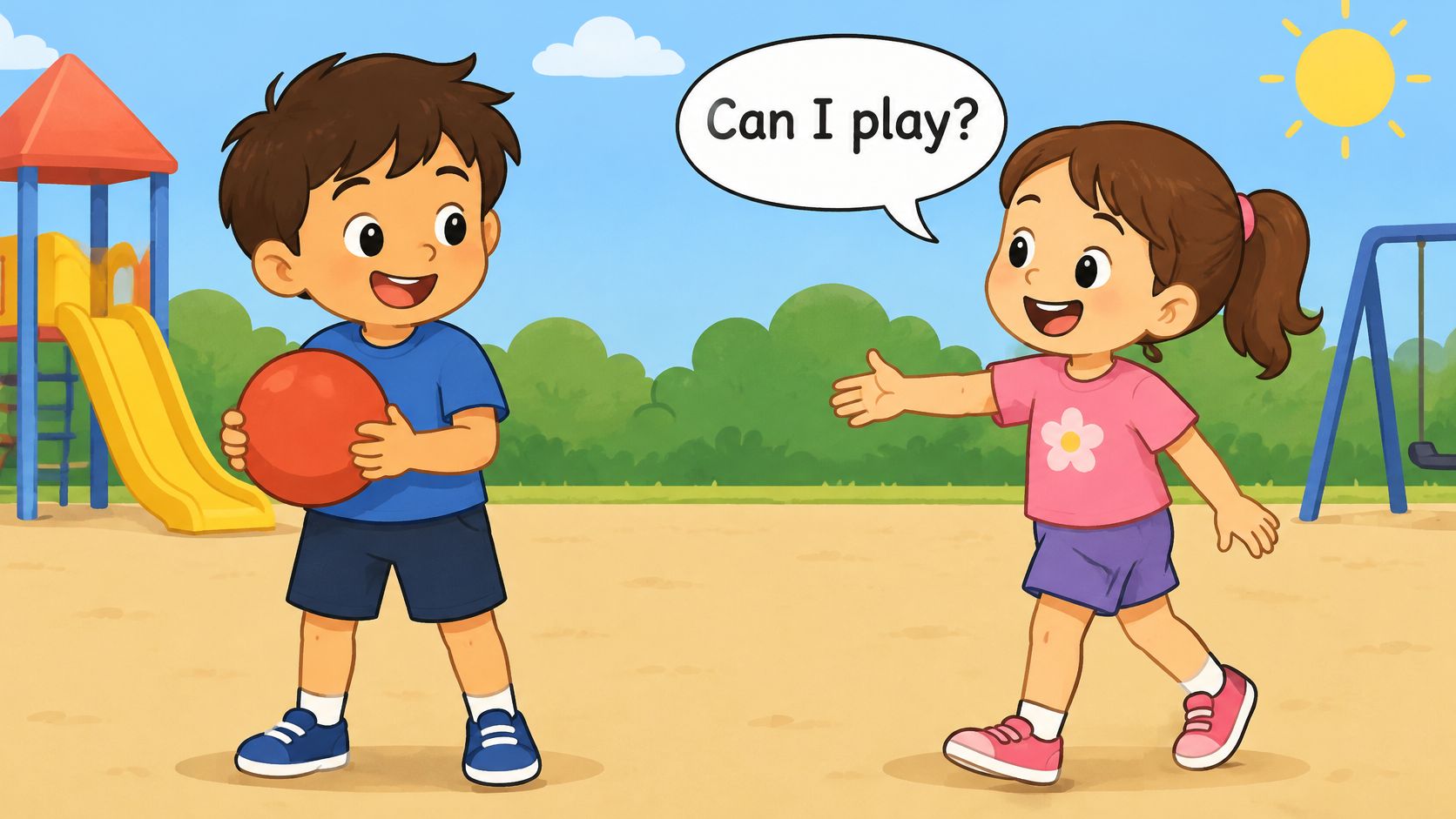
5. Playground Talk With Can I Play and Your Turn
Suggested age band: 7–8, also useful for beginners aged 9–10. Children who want to join a game need language for joining and taking turns, not necessarily a long introduction.
A familiar ball game or card game makes a useful rehearsal. The fixed patterns are Can I play? and Your turn, followed by My turn when needed.
Rehearse the opening, then play
- Child: Can I play?
- Adult acting as another player: Yes!
- Adult: Your turn.
- Child: My turn.
- Adult: Good job!
The parent first demonstrates both roles, then hands over the ball or cards. Once the child recognises the exchange, the game continues normally rather than stopping for correction after every turn.
For an older beginner, choose an activity that fits the child's interests, such as football, a board game or building a shared model. A sibling can become the partner, provided both children understand that practice isn't a competition over pronunciation.
The English speaking activities for kids guide provides further ways to connect short phrases with play. Teachers can also rehearse these exchanges with pairs before a classroom game.
The limitation: other children won't always give the practised answer. Rehearse a calm OK if a game is full, and explain in the home language how to seek another activity or adult support.
6. Asking for Help With Can You Help Me, Please?
A child may read confidently in the home language yet understand very little spoken English. For beginners aged 9–10, asking for help deserves practice without making the child feel younger than classmates.
Start with Can you help me, please? and a visible problem. A closed pencil case, unfamiliar game instruction or tricky shoelace gives both speakers something concrete to discuss.
- Child: Can you help me, please?
- Adult: Yes. Show me.
- Child: Here.
- Adult: Like this.
- Child: Thank you.
Practise getting clarification
Once that exchange feels familiar, introduce Can you say it again, please? The adult deliberately gives a quiet pretend instruction, the child requests repetition, and the adult repeats it clearly without pretending that confusion is a mistake.
A Frontiers in Education study of scaffolded speaking used supported oral tasks with 30 Ecuadorian learners aged 8–9 across a 12-session intervention and found improved speaking performance. Its small school-based sample doesn't predict an individual child's results, but it offers a useful example of practising supported speaking turns rather than exposure alone.
A tutor can rehearse the same request during ordinary tasks, then honour it whenever the learner uses it. At home, pointing can complete the message when the child lacks the object word.
The limitation: memorising a help request doesn't mean a child will understand the answer. Adults should demonstrate, simplify or use the home language when needed.
7. Bedtime With Brush Your Teeth and Good Night
Suggested age band: 5–6, adaptable for independent beginners aged 9–10. Bedtime practice works best as familiar language attached to an existing routine, not an extra lesson after a tiring day.
The fixed pattern combines a short instruction + a simple response. The adult uses gestures or the relevant object so that reading isn't required.
- Adult: Brush your teeth, please.
- Child: OK.
- Adult: Time for bed.
- Child: Good night, Dad.
- Adult: Good night.
Let the child finish the routine
For a playful rehearsal before bedtime, a younger child can prepare a toy for bed and supply the final Good night. An older child can direct the adult through a pretend routine or choose the closing phrase without using toys.
The British Council's practical tips for home English recommend predictable sessions, familiar activities and revisiting language later. Families can borrow that predictability without turning the whole evening into English time.
A book already at home can supply a closing activity. The adult points to a familiar picture, models a short phrase and leaves space for optional participation; the guide to English-learning stories offers related ideas.
The limitation: tiredness changes what feels manageable. If the child becomes frustrated, keep only the familiar good-night exchange and leave any new vocabulary for another day.
At bedtime, understanding an instruction and responding with an action can be enough. Speaking doesn't need to delay sleep.
8. Shopping With Please and Thank You
For beginners aged 9–10, a pretend shop offers a practical role without preschool-style materials. The child can arrange household items, become the shopkeeper and decide what the customer needs.
The fixed pattern is I'd like + item + please. The fuller I would like can be modelled slowly before using the everyday contraction.
Open a shop at home
- Child acting as customer: I'd like this apple, please.
- Adult acting as shopkeeper: Here you are.
- Child: Thank you.
- Adult: You're welcome.
Use fruit, pencils or empty food packages already available. Scrap-paper labels and pretend money can make the scene feel complete without buying a play set.
Once the opening is comfortable, add How much is it? separately. If numbers are unfamiliar, the shopkeeper can point to a price label while saying the answer, and the child can practise matching rather than calculating.
An audio-based pronunciation intervention published in Intens combined audio input, shadowing and communicative role-play with 11 third-grade learners. It reported a short-term pronunciation improvement, but its one-day, single-group design doesn't establish lasting language gains.
The limitation: a real cashier may speak quickly, ask another question or be busy. Before an actual visit, agree that the accompanying adult can take over whenever needed; thanking the cashier can be the child's entire speaking contribution.
8 English Conversations for Kids at a Glance
| Conversation | Age focus | Core phrases | Best practice setting |
|---|---|---|---|
| Greetings and Introductions | Ages 5–6 and 7–8; complete beginners | Hello; My name is…; How are you?; I am fine, thank you. | At breakfast, by the front door, or with a family member |
| Talking About Feelings | Ages 5–6 and 7–8; beginners | I am happy; I am sad; I am hungry; I am tired | Daily check-ins at home or school, using a feelings chart |
| Mealtime Requests | Ages 5–6, 7–8, and 9–10; beginners | Can I have… please?; More, please; Thank you | During meals with real food and drink |
| Getting Dressed and Talking About the Weather | Ages 5–6 and 7–8; beginners | What is the weather?; It is rainy; Put on your coat | Morning dressing routine, by a window or weather chart |
| Playground Talk | Ages 7–8 and 9–10; beginners | Can I play?; Your turn; Let's go; Good job | Playground games or role-play with family |
| Asking for Help | Ages 7–8 and 9–10; beginners | Can you help me, please?; I do not understand; Can you say it again? | Classroom activities, daily tasks, or travel situations |
| Bedtime Routine | Ages 5–6 and 7–8; beginners | Brush your teeth; Put on your pyjamas; Time for bed; Good night | Calm evening routine with repeated instructions or a picture book |
| Shopping and Saying Please and Thank You | Ages 7–8 and 9–10; beginners | I would like this, please; How much is it?; Thank you | Toy-shop role-play or a supervised shopping trip |
Choosing One Conversation to Start With and Where an App Can Help
Pick the exchange the child will meet within days. A family expecting English-speaking guests at the weekend starts with greetings, while a child joining a new club gets more from "Can I play?" and "Can you help me, please?" Practise that one exchange where it will happen: by the front door for greetings, at the table for mealtime requests, beside the toy shelf for sharing turns. Once the words feel easy there, change one thing at a time, a different speaker, a different object, a different room.
A complete beginner aged 9–10 still needs simple language; only the role grows up. Let the child run the pretend shop, direct the game or choose which phrase to try. Reading fluently in another language does not replace hearing and saying beginner English out loud. Treat the age labels as a starting point too: a confident six-year-old can borrow an older dialogue, and an older beginner can stay with the younger set until the sounds feel easy.
Key takeaways
- Start with a single dialogue. Choose an exchange the child has a genuine reason to use this week.
- Repeat daily for a week. A short, steady habit teaches more than one long session.
- Add another routine gradually. Keep the familiar exchange alive while a new one settles in.
- Keep each exchange under five minutes. A practical starting limit; stop sooner if attention fades, and keep the phrases on a card near the routine.
When parents feel unsure about modelling pronunciation, an app can carry the listening load. For choosing apps for daily language practice, useful priorities include replayable audio, pictures rather than heavy text, offline access, child-safe design and brief review activities.
Talkio Kids offers short listening, picture-matching, speaking and review activities for complete beginners aged 5–10. A companion called Nox guides a space journey that gives children a reason to keep exploring while lessons stay calm and easy to follow. Every word and instruction is spoken aloud and can be replayed with one tap; lessons work offline, progress stays on the device and no account or sign-in is needed. There are no ads, social features, open chat or open-ended AI conversations, and no hearts or lives, so a child can try again without getting stuck.
Monthly and annual subscriptions are available, and eligible new subscribers can try the complete course free for seven days, with current prices and eligibility shown in the app. Families can explore the app, download it from the App Store or find it on Google Play.
The aim remains basic vocabulary and simple phrases rather than guaranteed fluency. After any guided practice, a parent can bring one familiar word back into an ordinary meal, greeting or game the same day.
Talkio Kids gives young beginners audio-led practice with pictures, simple speaking turns and short reviews. Families looking for support between everyday dialogues can visit Talkio Kids and explore whether its guided activities fit their child's routine.