
English learning at home
8 English Learning Stories for Kids: Starter Books
Discover 8 English learning stories for children aged 5–10, with easy home activities to build first words, listening and speaking confidence.
By Talkio Kids ·
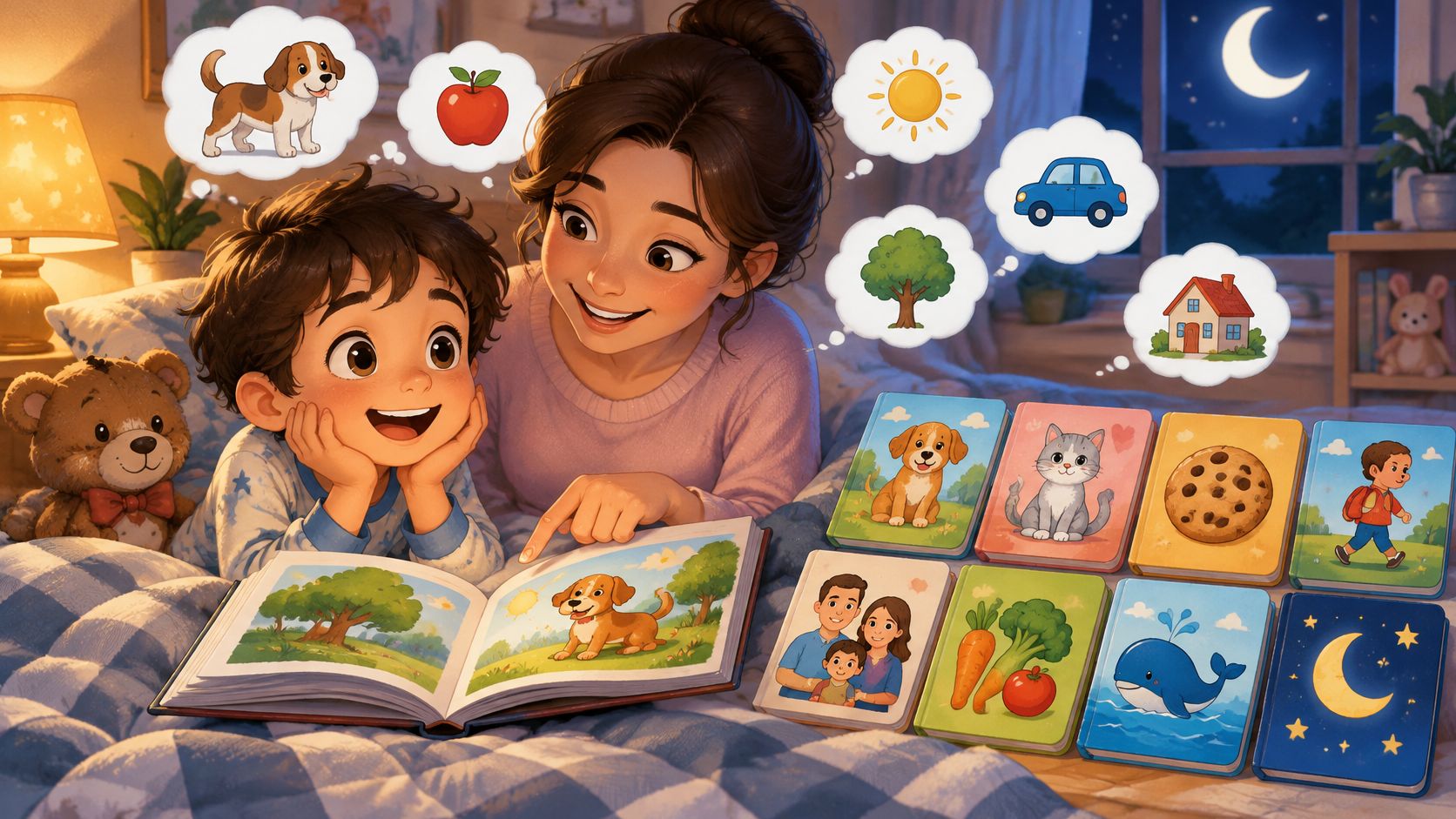
A Tuesday evening often looks the same. The bath is done, the lights are low, and a parent wants a few minutes of English that feels like a treat rather than a lesson. A short picture book can carry simple words into that moment when the speaking job stays small.
English learning stories sit inside a much larger habit. The British Council's 2024–25 corporate plan estimated that approximately 2.3 billion people were learning English worldwide, including about 2 billion learners in non-English-speaking countries. Those figures are an estimate of people learning English, not a count of fluent speakers. For a child aged 5–10, they are a reason to treat beginner words as a real skill, not a school extra.
A book earns its place by the speaking routine it creates at home, not by its reading level alone.
The Very Hungry Caterpillar and Brown Bear, Brown Bear, What Do You See? suit a child who knows no English yet. Dear Zoo and Where's Spot? suit listeners who still need flaps. Goodnight Moon is the quiet bedtime option. I Am Going! and Frog and Toad Are Friends suit a 7- or 8-year-old who can read a few words. The Gruffalo suits a 9- or 10-year-old complete beginner who needs a plot that doesn't feel too young. Age and English proficiency aren't the same thing.
Each entry gives one routine for the same night. Nothing extra has to be bought.
1. The Very Hungry Caterpillar (Eric Carle, 1969)
Crumbs are still on the table. A five- or six-year-old who is new to English watches a caterpillar eat through the week. Monday is one apple. The child doesn't need to read the sentence. A point at the fruit is a full turn.
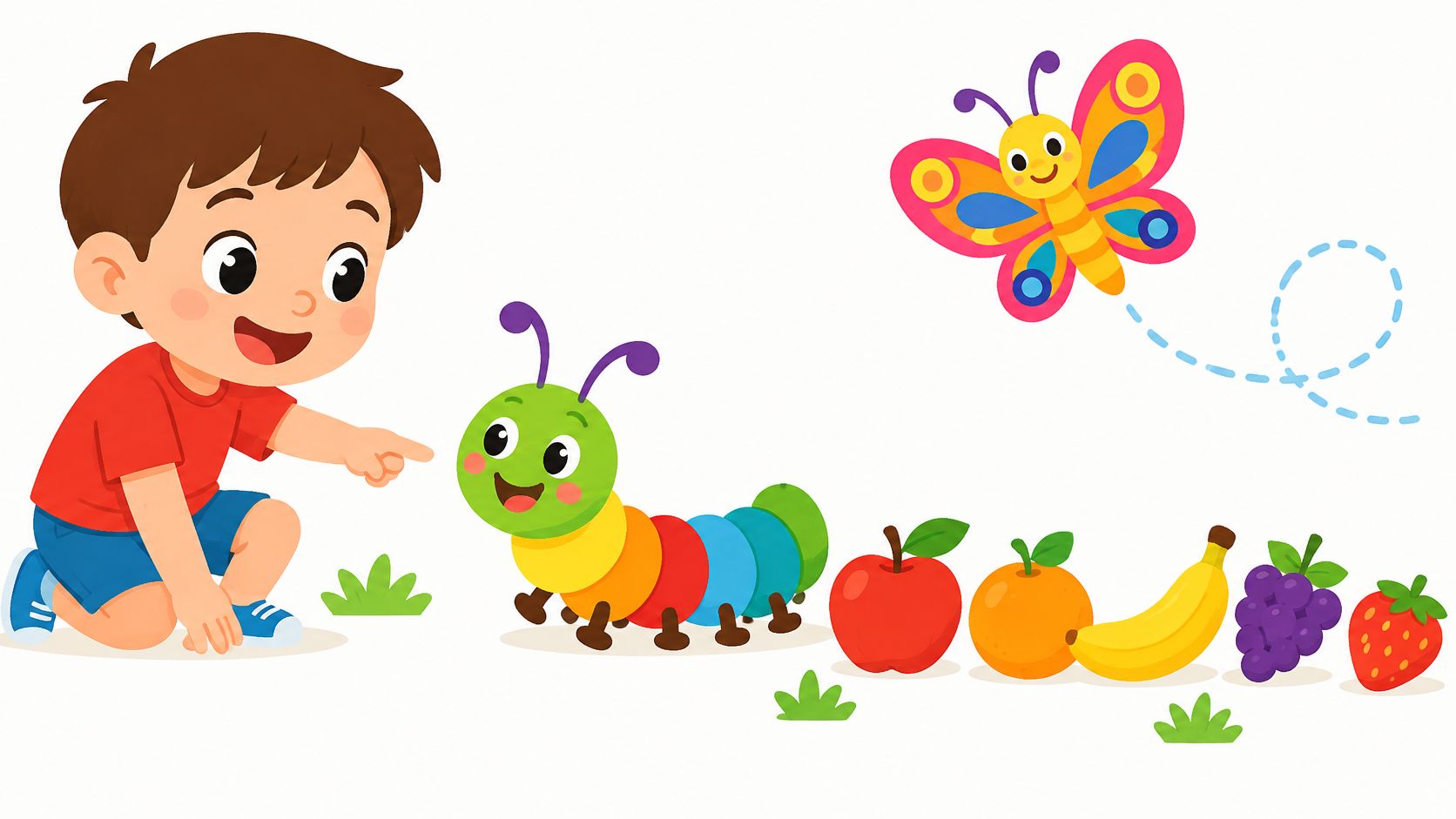
The story is short, and the word set stays visible. Days, numbers, and foods repeat, then a butterfly ends the book so the session has a clear stop. That makes it a strong first choice when a parent wants to talk through a page without much English of their own.
The National Association for the Education of Young Children explains that guided play lets adults introduce vocabulary in meaningful contexts, and that those contexts work better than memorizing word lists. A parent can set a cup or a piece of fruit beside the page, say the English word, and let the child touch it.
A food guess on the second read
Read once for the story. On the second pass, pause before each food.
- Wait for a guess: Stop before “pear” or “strawberry” and let the picture do the hinting.
- One gesture: Pretend to bite, then point back at the page.
- A sorting question: Ask “Is it a fruit?” and accept a nod or one word.
- A short stop: About five to ten minutes is enough, then close the book.
Scrap cards can become a paper caterpillar, with one food picture added each evening. Tomorrow uses the same foods. That repetition is the point, not a race to the next title.
2. Brown Bear, Brown Bear, What Do You See? (Bill Martin Jr. and Eric Carle, 1967)
A parent and a six-year-old walk past the sofa. “Blue cushion, blue cushion, what do you see?” The child answers “red ball,” or only “ball.” Either reply keeps the game going.
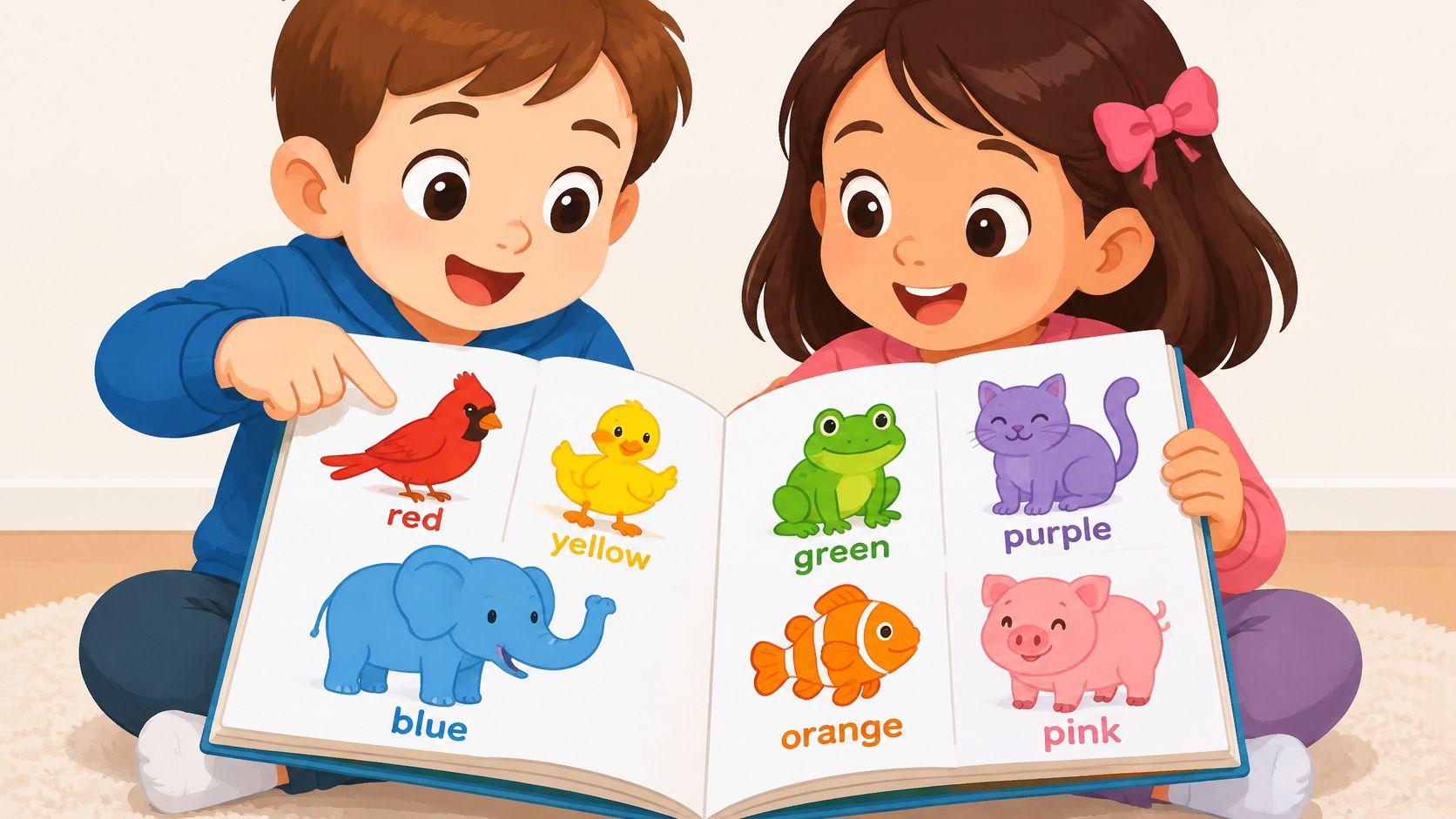
Each page of Brown Bear, Brown Bear, What Do You See? (1967) asks a question and answers it with a colour and an animal. “Brown bear, brown bear, what do you see? I see a red bird looking at me.” The pattern carries colours, animal names, and a full question-and-answer shape. A first answer can be one word.
A Cochrane systematic review of vocabulary interventions for children learning a second language up to age six found a moderate-certainty gain in narrative skills (SMD 0.37, across 487 children) and a smaller receptive-vocabulary gain of about 0.29 standard deviations. Listening comprehension wasn't clearly improved. So hearing the chant isn't the whole routine. Point, match, and let the child say the colour.
Practical rule: One word counts as an answer. A full sentence can wait.
Build a home version with objects already in the room, such as “Blue cup, blue cup, what do you see?” Use the same book for several days. More colour words for slightly older beginners sit in this guide to English vocabulary for kids. A 7-year-old who already knows “red” can add “looking at me” once the animal names feel easy.
3. Dear Zoo (Rod Campbell, 1982)
A child who can't read the letter still knows a surprise is coming. The zoo has sent something. A hand hovers over the flap. “Is it big?” comes before anyone lifts it.
Dear Zoo (Rod Campbell, 1982) turns animal words into a guessing game. A child writes for a pet, and each animal arrives with a reason it has to go back. “It is too big.” “I want a puppy.” The flaps matter most for a listener who isn't reading yet, including a 7- or 8-year-old beginner who would rather guess than decode.
Parents who aren't confident in English often get told to explain every word. That isn't the only useful role. A study of second-language stories found that children who heard brief explanations of target words learned and retained more vocabulary than children who heard the stories without those explanations, including at a ten-week follow-up. One word before the flap is enough of an explanation.
- Guess first: Ask for one describing word, such as “big” or “tall,” then lift.
- Yes or no: “Is it a cat? No. It is a lion.”
- A short greeting: Practise “Dear Zoo, please send me…” as three words, not a letter.
- Swap roles: The child lifts the flaps and asks the question.
A shoebox and a few drawn animals can be the zoo for one evening. More low-pressure speaking ideas are in these English speaking activities for kids. The session ends when the puppy stays. There is no need to retell the whole book.
4. Where's Spot? (Eric Hill, 1980)
A small ball is under the sofa. A child, maybe six and brand new to English, or eight and still a beginner, is already looking. The parent only has to ask, “Where is it?”
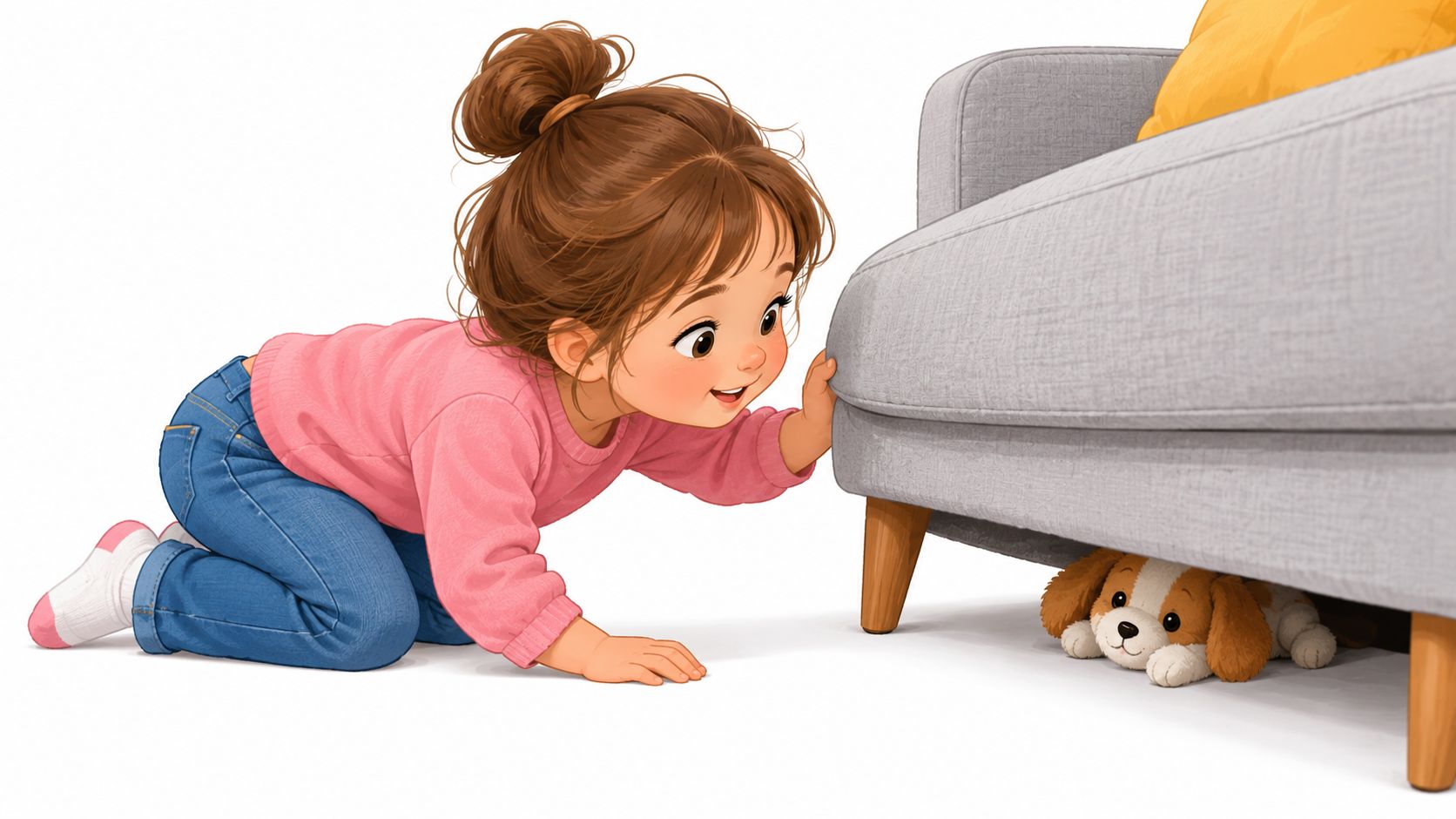
Where's Spot? (Eric Hill, 1980) follows a mother dog through familiar places. Spot is behind a door, under a bed, inside a box. The question barely changes, which is why it works for early speaking. Location words such as under, behind, and in arrive with a picture, not a grammar chart.
Listening practice can stay very short. Research with Cantonese-speaking first- and second-graders used take-home second-language listening assignments built from roughly 30 very short stories read by several native speakers, and those children showed measurable improvements in accent ratings. A flap book is in that same family. It doesn't have to be long to be worth repeating.
Hide one toy, ask one question
Model the answer with a hand. Slide a hand under the table and say "Under the table." Let the child lift the flap and answer with one word, then build toward "Spot is under the bed" on a later night. Hide-and-seek in an actual room uses the same question.
An eight-year-old beginner may find the puppy young and still want the location game. Pair the book with English learning games for 8-year-old beginners so the words move off the page. Repeat the same question across several days. New hiding places are enough variety.
5. Goodnight Moon (Margaret Wise Brown, illustrated by Clement Hurd, 1947)
The room is already dim. A rabbit in the book says goodnight to a moon, a red balloon, and a pair of socks. A parent points at the actual socks on the floor and says the same word. Nobody performs.
Goodnight Moon (1947) is a list with a rhythm. Household words arrive one by one, and the structure barely changes. It suits a 5- or 6-year-old, and it can suit a 7-year-old who likes a calm ending. A 9- or 10-year-old beginner may find the rabbit too young. In that case, borrow only the list and say goodnight to objects in their own room.
The National Association for the Education of Young Children names talking, singing, reading, writing, and playing as five practices that support literacy, and notes that children learn more words when they can talk, use unfamiliar words, and answer an adult's question. A free routine can take 5–10 minutes. Three objects are enough.
Keep the last minutes soft. A wrong word at bedtime doesn't need a correction speech.
Read slowly and pause after each “Goodnight” so the child can echo it. Point at the lamp, bed, or toy as its name appears. Let the child choose the last object and name it together. Independent reading isn't required. The adult says the word, shows the picture, and stops. Same time tomorrow is more useful than a longer reading tonight.
6. I Am Going! (Mo Willems, from the Elephant and Piggie series, 2007)
Two voices, two silly faces, one tiny problem. A 7-year-old who can read a handful of English words takes Piggie's line. A parent takes Gerald's. The speech bubble is only a few words long, so neither person gets stuck.
I Am Going! (Mo Willems, 2007) belongs to the Elephant and Piggie early readers. Pictures carry the feelings, and the bubbles carry the talk. A child who is still sounding out words can follow the joke. It also fits an 8-year-old beginner who is ready to see print but not ready for a long paragraph. A 9-year-old who already reads well in another language may move through it quickly, then use it as a script rather than a challenge.
Narrative input is a strong place to meet new words. A meta-analysis of incidental second-language vocabulary learning reported a large effect for narrative texts (g = 1.43) compared with expository texts (g = 0.61). Across comparable studies, incidental gains were about 15% through listening and 17% through reading. Gains can fade, so a reread plus a speaking turn matters more than finishing the series.
Read the face before the words
Look at the picture and ask how the character feels. Then share the bubbles, with a different voice for each friend. One short book can stay all week.
- Three words back: After a page, the child retells it in three or four words.
- Props stay simple: A chair is the stage. No costume is required.
- Stop while it's fun: When the joke lands, close the book.
Teachers sometimes use the same swap in a small group. At home, two voices on the sofa are enough.
7. Frog and Toad Are Friends (Arnold Lobel, 1970)
Bedtime, one chapter, not the whole book. Frog is cheerful. Toad is not. A 7- or 8-year-old who can read a few English words takes a page, then hands the book back. The question is small. “How does Toad feel?”
Frog and Toad Are Friends (Arnold Lobel, 1970) is a set of short chapters about two friends and ordinary days. Sentences repeat carefully, and the humour is gentle. It feels older than a flap book, which matters when a child is seven or eight and doesn't want a toddler story. It is still simple enough for an early reader. A 9-year-old complete beginner who already reads long books in a home language may prefer to listen first and read a page second.
Language familiarity changes what a child can do with a text. UNESCO reported in 2016 that 40% of people globally didn't receive education in a language they understood. In Côte d'Ivoire in 2008, 55% of Grade 5 students who spoke the test language at home reached basic reading skills, compared with 25% who spoke another language at home. A parent read-aloud, or a shared page, is one way to keep the English understandable.
- One chapter only: Stop and ask what might happen next.
- Steal the feeling words: Use “sad,” “happy,” or “worried” at breakfast the next day.
- Trade pages: The child reads one page, the adult reads the next.
- Audio is allowed: If reading aloud is tiring, the adult reads and the child listens.
“Spring” is an easy chapter to act with two lines each. The goal is another evening with the same friends, not a race to the last page.
8. The Gruffalo (Julia Donaldson and Axel Scheffler, 1999)
A nine-year-old who speaks almost no English still wants a story with a monster, not a board book. A mouse walks into the woods and invents a creature. The rhyme comes back, and the child starts to expect the last word.
The Gruffalo (Julia Donaldson and Axel Scheffler, 1999) is longer than the picture books above, but the pattern is strict. The mouse meets animals, repeats a description, and the invented monster turns out to be real. Animal and nature words stick because they return. It suits a 9- or 10-year-old beginner who can follow a plot through sound and pictures. A younger child can enjoy it too, with more of the lines left to the adult.
Play gives those words a body. The National Association for the Education of Young Children describes children shaping an elephant's trunk with their hands while learning the word “elephant,” and it describes vocabulary set inside stories. At home, “claw,” “tusk,” and “jaw” can each get a gesture. No purchase is required.
Read it straight through once. The joining-in happens on the second night.
Pause before a rhyme such as “mouse” and “house” and let the child guess. Hold up a scrap-paper animal card when that animal appears. An older beginner can retell the walk with one sentence per animal. A 10-year-old who finds the pictures young can still own the retelling. The speaking routine is the reason to keep the book, not the age printed on a level chart.
How the eight stories compare for home use
| Item | Best age fit | Main vocabulary focus | Reading needed | Best home use |
|---|---|---|---|---|
| The Very Hungry Caterpillar (Eric Carle, 1969) | Ages 5–6 for listening; 7–8 for retelling | Days, numbers, and food | No independent reading needed | Count foods and retell the sequence together |
| Brown Bear, Brown Bear, What Do You See? (Bill Martin Jr. and Eric Carle, 1967) | Ages 5–6; 7–8 with support | Colours and animals | No independent reading needed | Practise call-and-response and name things at home |
| Dear Zoo (Rod Campbell, 1982) | Ages 5–6; 7–8 for describing | Animals and basic describing words | No independent reading needed | Guess the animal before lifting each flap |
| Where's Spot? (Eric Hill, 1980) | Ages 5–6; 7–8 for full-sentence answers | Locations and household settings | No independent reading needed | Hide a toy and practise asking where it is |
| Goodnight Moon (Margaret Wise Brown, illustrated by Clement Hurd, 1947) | Ages 5–6; 7–8 for reading repeated lines | Household objects | No independent reading needed | Name room objects as part of bedtime |
| I Am Going! (Mo Willems, from the Elephant and Piggie series, 2007) | Ages 6–8; 9–10 beginners with support | High-frequency words, feelings, and dialogue | Some reading ability needed | Take turns reading character lines aloud |
| Frog and Toad Are Friends (Arnold Lobel, 1970) | Ages 7–8; 9–10 beginners with support | Everyday words, friendship, and emotions | Basic reading skills needed | Read one short chapter together and discuss it |
| The Gruffalo (Julia Donaldson and Axel Scheffler, 1999) | Ages 5–6 for listening; 7–8 for retelling | Animals, nature, and rhyming words | No independent reading needed | Read aloud, join in with refrains, and act out animals |
Turning a Story Into a Daily English Habit
Choose one book for this week. Use one routine from its entry, and repeat it for a few evenings before changing titles. Short sessions usually feel more natural than long ones. Confidence can grow at the child's pace, and no routine here guarantees a result.
The American Psychological Association summarizes research showing that young children generally learn better from a person face-to-face than from the same content on a screen alone, and that co-viewing can protect against several downsides of screen use. A parent doesn't need fluent English to sit nearby, repeat a word, and point. That habit belongs with paper books as much as with any screen.
Between story nights, some families want listening and speaking that doesn't depend on a parent reading every line. Talkio Kids is an iOS and Android app for complete beginners aged 5–10. Each short lesson lets a child hear English, connect words with pictures, answer simple questions, and practise saying words aloud. Nox, a friendly alien companion, guides every lesson in a calm space adventure and celebrates effort. Words start with greetings, animals, colours, numbers, family, and food. No previous English is needed.
The app around the lesson speaks English, Spanish, German, French, Italian, and Danish, and a new word can be explained in the language spoken at home. Every instruction is spoken as well as written. Lessons, pictures, and audio work offline, progress stays on the device, and no account is required. There are no ads, social features, open chat, or open-ended AI conversations. Speaking is recognised on the device, and microphone audio isn't uploaded or stored. If permission is declined, the child taps after speaking and judges the try. A mission lasts a few minutes and then ends, with no streak to protect.
Talkio Kids is an educational aid, not a school, a tutoring service, or a guaranteed outcome. Monthly and annual subscriptions exist. New profiles need an active Premium subscription before the course begins. Any trial eligibility and the current price are shown in the app, not as a fixed offer here. Use it beside stories and conversation.
Find it at Talkio Kids, or download it from the App Store or Google Play.
Talkio Kids gives complete beginners aged 5–10 short listening, picture-matching, and speaking practice with the alien companion Nox, so the same everyday words from these stories can be heard and said again between book nights. It works offline, needs no account, and stays a calm extra rather than a promise of fluency. Explore Talkio Kids and see whether a few minutes with Nox fits the routine already started at home.