
English learning at home
English Learning Games for 8 Year Old Beginners
English learning games for 8 year old beginners can be short, playful, and free. See home activities, what good games teach, and how to choose an app.
By Talkio Kids ·
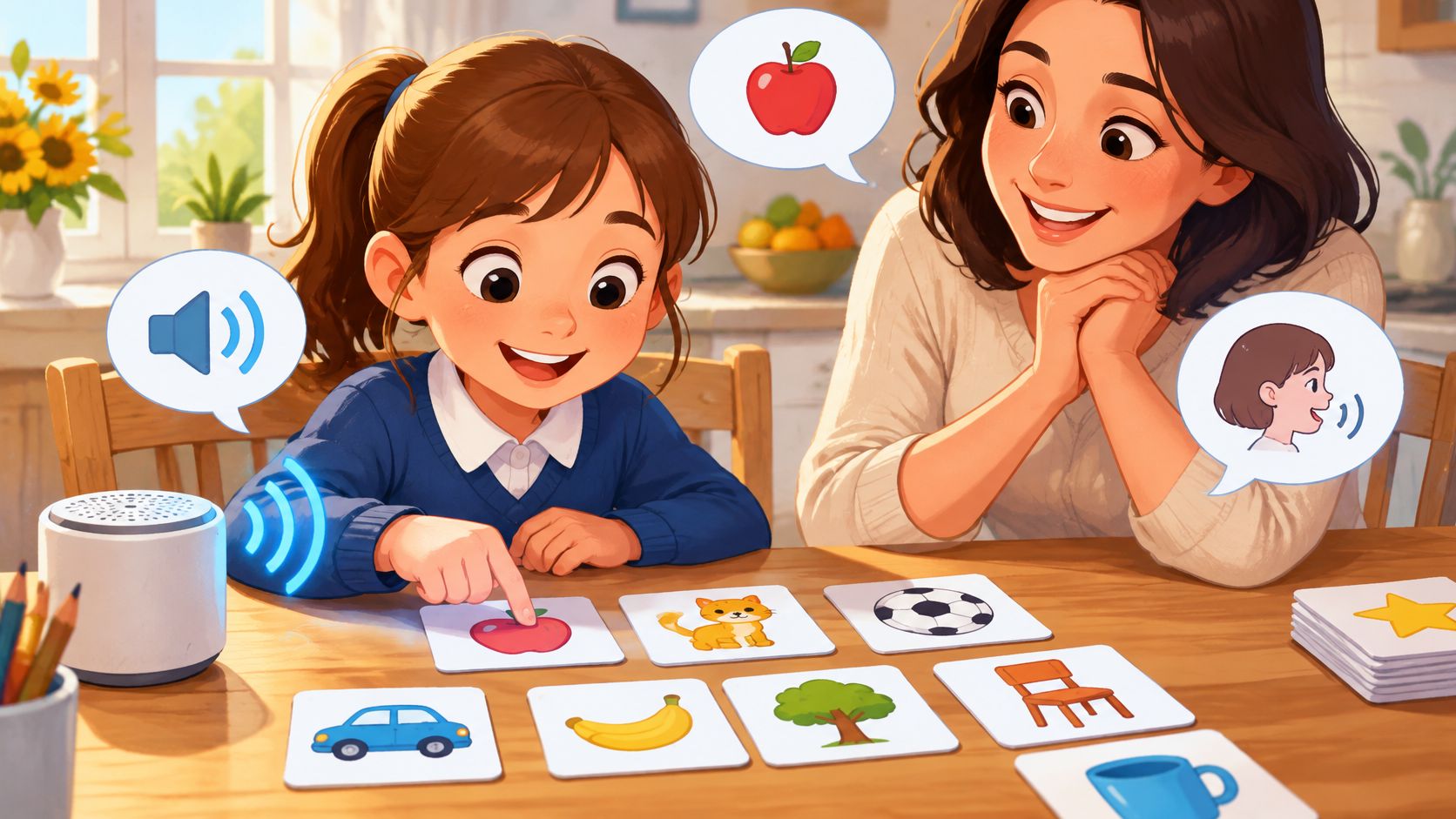
The school bag drops by the door, and an eight-year-old is already heading for a snack. The child can often read a page in the home language and still pause when a simple English word appears. That pause is common. Age and reading skill in one language do not set an English level, so a complete beginner needs sounds, pictures, and a few useful phrases rather than a preschool circle or an exam sheet.
English learning games for 8-year-old beginners help most when they stay short and ask for a real response. Parents can start with objects already in the house, then decide later whether a screen adds anything.
What Eight-Year-Old Beginners Can Learn from English Games
An eight-year-old comes home from primary school able to follow a story in the family language and still unsure what "water" sounds like in English. That child isn't behind in general learning. English proficiency is separate from age and from reading ability in another language. A complete beginner at seven, eight, nine, or ten shouldn't get only preschool tasks, and shouldn't be pushed into exam-style lessons.
Early wins worth watching
The first useful gains are small and easy to hear.
- Recognizing words by ear: The child notices "bag," "friend," or "home" when someone says them slowly.
- Matching a picture: A spoken word links to an object or drawing without a long explanation.
- Understanding a short phrase: "Where is the ball?" makes sense before the child builds a new sentence alone.
- Trying a modeled line: The child repeats a word or a short sentence after an adult says it first.
Those wins come before spelling tests and before free conversation. An early reader may understand by listening while print is still hard. A nine- or ten-year-old beginner can look like a confident primary pupil and still need that sound-first start.
Support that fits this age
Younger children often need an adult to hold every step. An eight-year-old can pick a theme, such as school, sport, food, or space, and can manage a few minutes without a quiz. A parent stays close to model speech, not to keep score. The session stays short even when the child seems ready to work alone.
Honest limit: A short game can't promise fluency, a language diagnosis, or a fixed result after a set number of days.
Design, a weekday listening habit, free play, app choice, and signs of progress each deserve a separate look. Before any download, the early wins above are the ones worth watching.
What Makes an English Game Teach Real Words
A bright game can keep a child tapping and still leave the words behind. Picture matching often feels like success because the picture is sitting there. Familiarity isn't the same as being able to bring the word back later, or to use it in a phrase.
A small set that comes back in new jobs
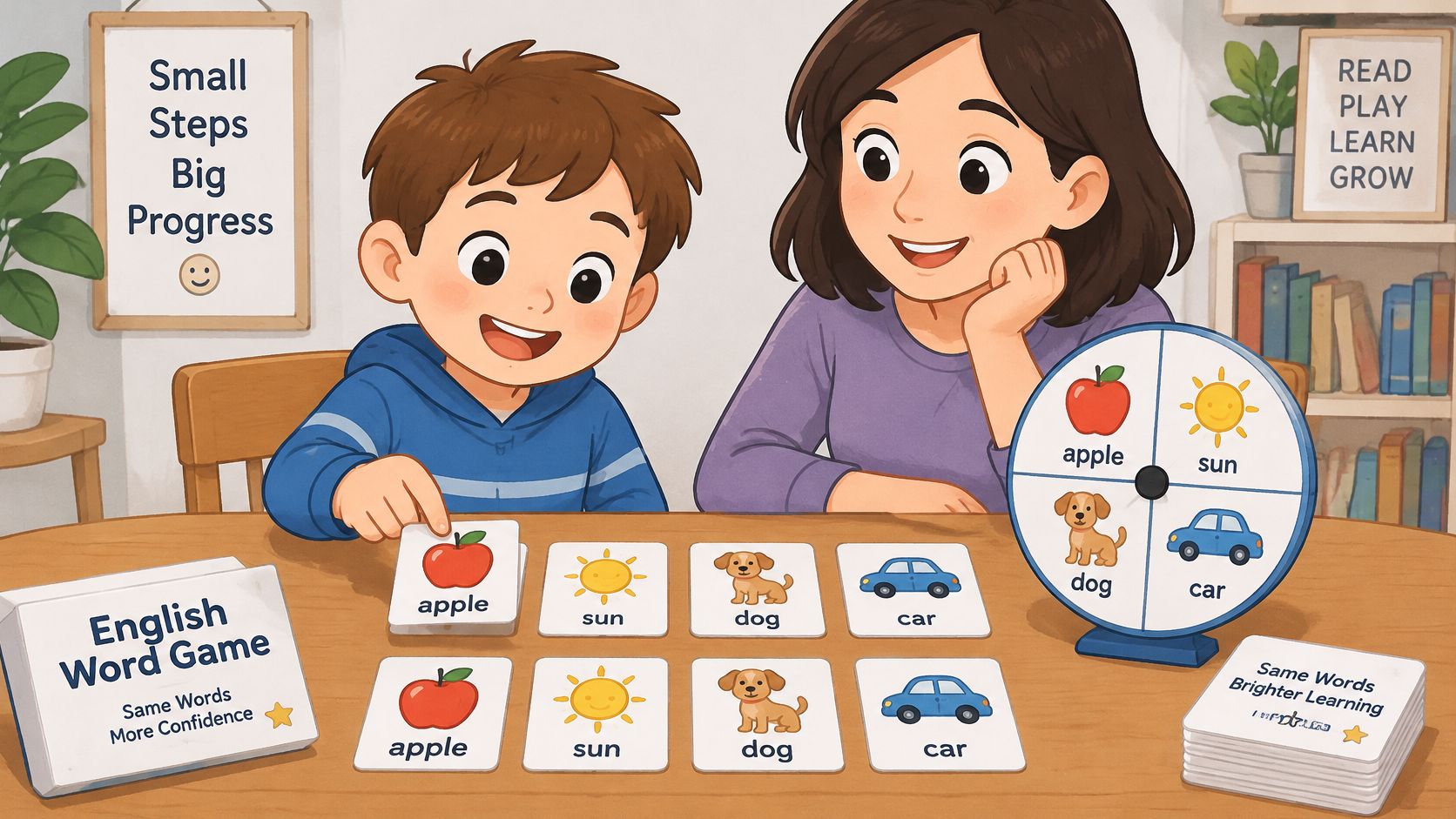
Strong beginner play recycles a handful of high-frequency words instead of flashing a huge list once.
- The child hears the word.
- The child matches it to a picture.
- The child finds it inside a simple phrase.
- The child tries to say it, with a model to copy.
That order matters. Step two can create a glow of recognition before the child can retrieve the word. The phrase step checks meaning in a slightly new place. The spoken try is low pressure, not a performance. Feedback should be immediate and specific, such as hearing the word again rather than only seeing a point total. Difficulty should rise slowly so random tapping isn't the main strategy.
For an early reader, audio and pictures lead. Printed words can stay optional support. An eight-year-old who already reads in another language may want the letters, and a parent can show them after the sound is clear. Text shouldn't be the only way in.
What the research can and can't say
A systematic review of digital game-based second-language learning among learners aged 6–18 found that vocabulary was the most frequently studied language outcome. Across 64 non-correlational outcome measures, 70% were positive. The same review reports evidence that vocabulary learned through a digital game was retained better over the long term than vocabulary learned through a textbook.
Results still depend on age, earlier gaming experience, and how the game is built.
A vocabulary game isn't a full reading program. It can support gains, memory, engagement, and some communicative ability, and it won't replace connected reading, writing, or a patient adult model. Parents can inspect any activity with one question: does a small set of everyday words return across listening, meaning, and a calm spoken try?
Short Listening Routines That Fit a School Day
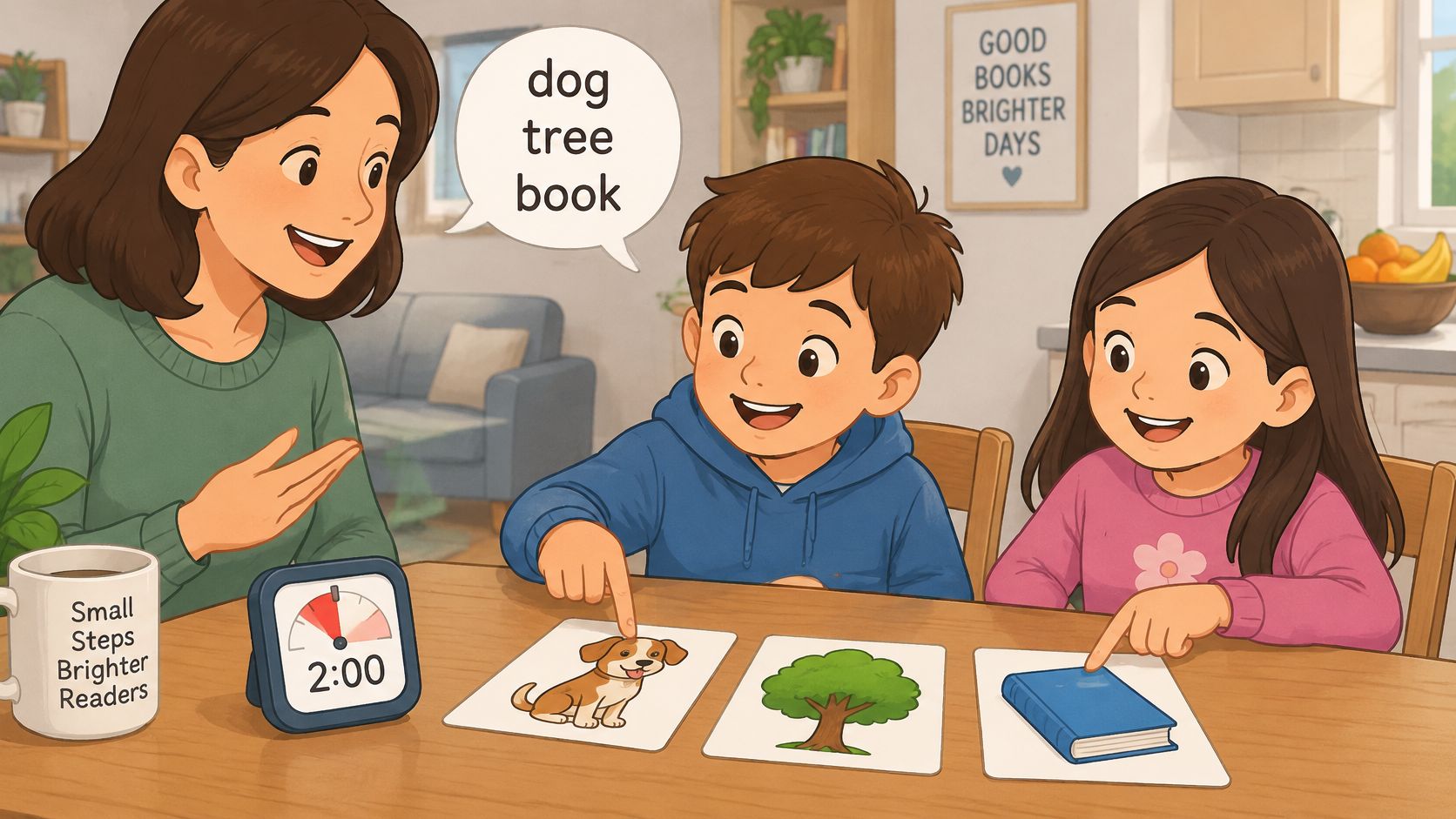
Length and order do more for a school-day habit than a pile of new features. The U.S. Institute of Education Sciences recommends a 5–7-minute auditory warm-up for children in kindergarten through grade 2 before phonics instruction. Children hear and play with syllables or individual speech sounds, which later links spoken language to letter–sound learning. An eight-year-old English beginner can borrow that length even when home-language reading is already underway.
Listen first, then look
Print can wait. A parent says a familiar word, asks for the first sound, and only then shows a picture or a letter. If the child is ready, one very short sentence can come last, read together. The child doesn't have to decode written instructions to join in.
A workable weekday pattern looks like this.
- After a snack: Five or six minutes, then a clear stop. The game doesn't stay open "for a bit longer."
- Same few words, new job: Monday the child hears them. Tuesday the child matches pictures. Wednesday the child says them after a model. The set doesn't reset into a brand-new list every day.
- Mixed checks, not cloned drills: Listening, picture choice, a short phrase, and a low-pressure spoken try rotate so the child isn't tapping the same screen forever.
- Offline audio: A downloaded clip works in a car, a queue, or a place with weak internet. The habit doesn't depend on a strong signal.
Why the stop matters
A rare long lesson is harder to keep than several calm minutes. The warm-up isn't a memory exam. If the child misses a sound, the adult says the word again and moves on. Confidence grows when the try stays short and the ending is predictable.
Parents who want more spoken ideas can look at English speaking activities for kids and still keep this slot brief. Listening leads. Print stays light. The timer, not the reward trail, ends the session.
Free English Games You Can Play at Home
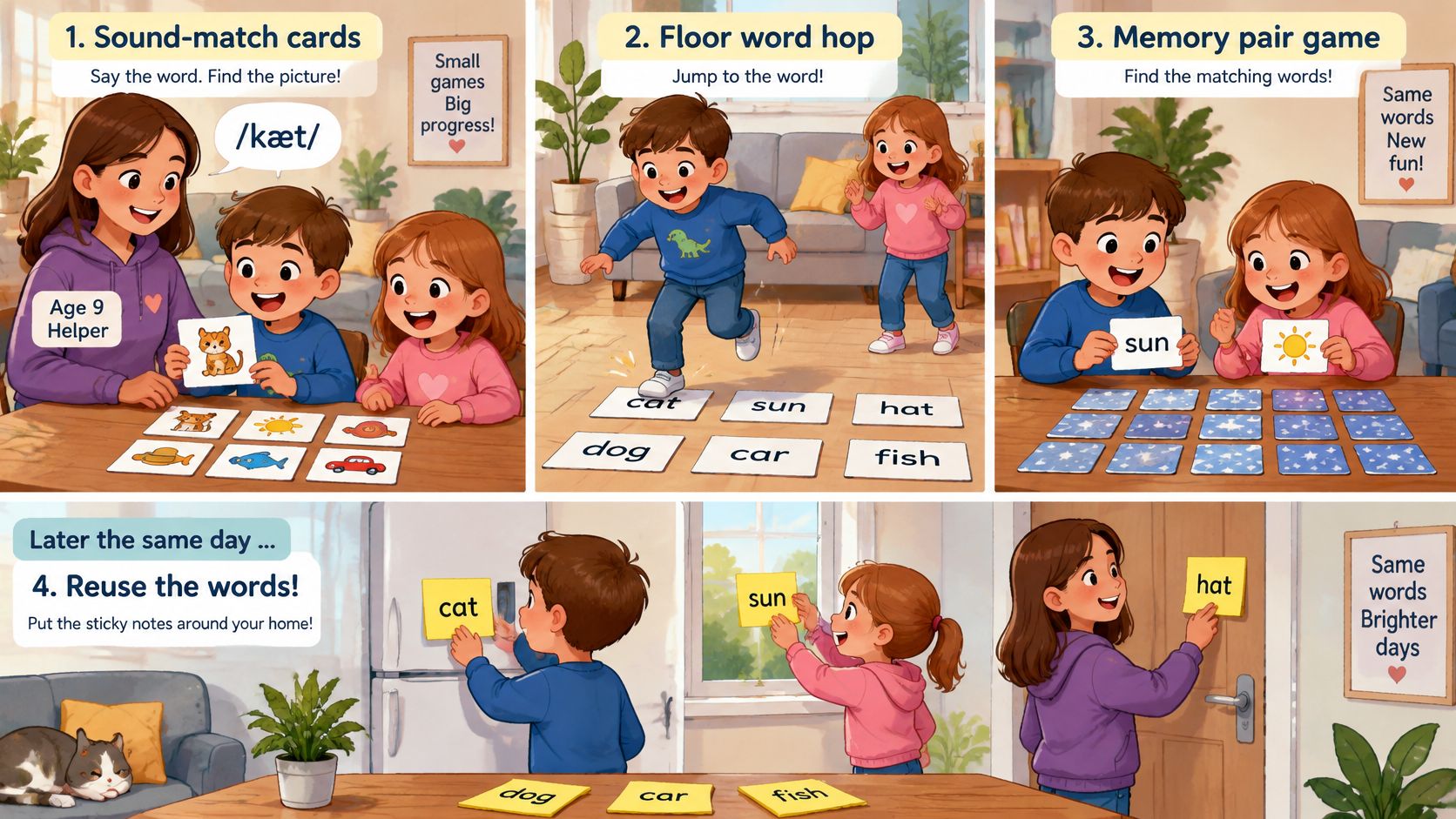
No app is required for a useful evening. Three mechanics, played with objects already at home, give an eight-year-old beginner something to hear, find, and say. A tutor can run the same games with a small group as extra practice. They aren't a full lesson plan, and they aren't speech therapy.
Same-sound pictures
A What Works Clearinghouse summary reports that two rigorous kindergarten studies tested syllable awareness and identifying pictures whose words began with the same sound as a spoken target. Those studies found positive effects on phonology and/or letter names and sounds. Parents can borrow the mechanic without buying cards.
Say "sun." Show two or three pictures or objects, such as a sock, a ball, and a spoon. Ask which one starts with the same sound. The adult models the words and accepts a spoken answer. Reading the labels isn't required. Repeat with a tiny set: sun, sock, school, then ball, bag, book.
A bag with an older theme
Drop familiar items into a bag: a water bottle, a ball, a pencil, a small photo of home. Name each one aloud. The child reaches in, finds the named object, and holds it up. Then reuse those same words in a short pretend scene about school, sport, food, or a space trip. The theme can feel like primary school, not circle time for much younger children.
A phrase echo
The parent says one everyday line, slowly: "Pass the water," or "Where is the ball?" The child repeats, then points to the matching object. One line is enough. If a sound is shaky, the adult says the line once more and continues. Correcting every sound turns play into a test.
Parents who aren't confident in English can still run all three. A slow model, a picture, and a short recording carry the language. The child copies the recording. The parent doesn't need a wide vocabulary to notice whether the child found the right object.
Use one word set across the evening: find it in the bag, match its first sound, then echo it in a phrase. That recycling is the lesson. New words can wait until these ones feel steady.
How to Choose an English Learning App
Free play already teaches the pattern. A screen is worth adding only when it asks for the same work: hear, match, say, and meet the words again later. Passive video, and games that pay out points for fast random taps, keep eyes busy without checking whether a word stuck.
What to check before installing
| Check | Weak fit | Better fit for beginners |
|---|---|---|
| Listening | A long cartoon with no pause | A few minutes of clear spoken words |
| Pictures | Decoration beside a paragraph | A heard word matched to a picture |
| Speaking | Silent play and prize bursts | A model, then a short spoken try |
| Review | One lucky match, then new words | The same words return in a new task |
| Access | Constant internet and an account | Offline audio, progress kept on the device |
| Boundaries | Ads, social feeds, or open chat | No ads and no open conversation with strangers |
One primary-school comparison shows why the design of the game matters. In a study of digital game-based English vocabulary learning, year-four pupils, commonly about ages 8–10, reached a mean score of 76.83 (standard deviation 19.62) after digital game-based learning. The comparison group, taught with an interactive multimedia method, reached a mean of 24.57 (standard deviation 11.43). Researchers reported that the difference was statistically significant after controlling for pre-test achievement. That gap belongs to that setting, method, and group. It isn't a promise that every child will land on the same score.
One app that follows the same pattern
Talkio Kids is an iOS and Android app for complete beginners aged 5–10. Activities are short and cover listening, picture-matching, speaking, and review. It builds basic everyday vocabulary and simple phrases, not guaranteed fluency. Practice sits inside a space adventure with Nox, an alien companion. Content works offline, and progress stays on the device. There are no ads, social features, open chat, open-ended AI conversations, or account signup. It also has no school dashboard, family plan, cloud sync, emailed reports, or parent-controlled time limits. Purchases sit behind a parent gate. Monthly and annual subscriptions exist. Any trial eligibility and current prices are shown in the app, so a store page shouldn't be treated as a fixed price list.
Families comparing younger beginners can read English lessons for 6-year-olds and still keep an eight-year-old's themes and independence in view. The useful test is simple. Does the app echo hear, match, and say, or does it only entertain?
How to Tell Learning from Just Having Fun
Smiles, points, and repetition are easy to mistake for progress. A child can love a minigame and still not be using the English inside it. Enjoyment is welcome. It isn't the same thing as a word the child can find again tomorrow.
A 2025 study of 125 children found that greater minigame use was associated either with successful language use during gameplay or with positive attitudes toward game-based learning, not necessarily both in the same learners. A separate 2025 systematic review, reported in that same source, found only six qualifying studies from 100 screened articles on modern games for young-learner English. The evidence base is thin. Parents need signs they can see at the kitchen table, not a scoreboard.
What to expect first
Watch in this order, and don't skip ahead because the child looks busy.
- Word recognition by ear comes before neat pronunciation.
- A short phrase understood comes before a sentence the child invents.
- A modeled speaking try comes before any spontaneous phrase.
- Spontaneous speech is a later hope, not a two-week target.
A two-week look that isn't a test
Pick three words the child has already met. After some days, set out the objects and say one word. Notice whether the child can find it. Later, with the pictures put away, listen for whether the child can say a word without the picture in front of them. Meaningful progress looks like more reliable recognition and a calmer speaking try. It doesn't look like a high score or a claim of fluency.
Screen worry is a boundary, not a reason to ban every language activity. Keep the session short, stop at a set point, and connect one on-screen word to an object in the room. Families with limited internet, and parents who don't speak much English, can use the same signs. The object was found, or it wasn't. The word was tried, or it wasn't. No dashboard is required for that check.
A Simple Next Step for Beginner English at Home
The pieces fit into one evening. A parent picks five everyday words an eight-year-old already meets, such as school bag, water, friend, ball, and home. The sound game or the object bag runs for a few minutes, then stops. The same five words can return tomorrow in a phrase echo. New lists can wait.
If a screen is wanted after that, Talkio Kids matches the same short pattern: listening, pictures, a speaking try, and review, inside a space story with Nox. It works offline and doesn't ask for an account. Parents can explore it at Talkio Kids, then download from the App Store or Google Play. Any subscription is chosen inside the app, where current monthly or annual options and any eligible trial are shown. There is no promised free period and no signup step.
Related parent guides on short home practice sit on the Talkio Kids blog. A practical starting point is how to teach a child English at home. A tutor can use the same five-word game as extra practice beside classwork. The learning comes first, from repeated words a child can hear and try. The theme, whether a kitchen bag or a space story, is only the setting. Nothing here guarantees a result, and a few steady minutes still give a beginner something real to build on.
Talkio Kids gives complete beginners aged 5–10 short listening, picture-matching, speaking, and review practice with everyday words and simple phrases, including a space adventure with Nox. That pattern fits an eight-year-old who needs brief home English rather than a long lesson. Parents can visit Talkio Kids to see the activities and choose a download.