
English learning at home
10 Basic English Phrases for Kids Aged 5-10 in 2026
Discover 10 basic English phrases for children aged 5–10, with simple meanings and playful practice ideas parents can try at home without buying anything.
By Talkio Kids ·

Breakfast is ready on a Tuesday morning, the shoes are missing, and someone needs a hug before school. English practice probably isn't the first thing on a parent's mind. Yet those ordinary moments offer a place to start, with familiar phrases attached to things the family already does.
Basic English phrases don't need a separate lesson at the kitchen table. A greeting over breakfast, a request for an apple, or a goodbye at the door gives spoken English a clear purpose. Parents can explain the meaning in the home language first, then model the English without turning the moment into a test.
Start small with phrases children hear every day. The examples below pair useful language with home activities that need no special materials. Each includes adaptations for younger children and older beginners, so practice can match the child's interests rather than their English level alone.
An older beginner needs simple English, not babyish activities.
A child who reads confidently in their home language may still need pictures and spoken examples in English. Another may prefer listening and pointing before speaking. Both can begin with the same useful phrases, while parents adjust the support and leave room for a quiet response.
1. Greetings and Goodbyes With Hello, Good Morning and Bye-bye
At breakfast, a parent can say Good morning with a wave, then pause. A returning wave counts as participation before the child feels ready to answer aloud. At the front door, Bye-bye, see you later connects another phrase to an obvious action.
Hello begins an interaction. Good morning is a greeting used in the morning, while bye-bye ends an exchange and has a playful, informal feel. Older beginners may prefer Hi and Bye.

Make the doorway part of practice
- Ages 5–6. A parent can greet a toy, wave its paw, and invite the child to answer with a gesture or greeting.
- Ages 7–8. The child can lead the morning greeting and invent a silly handshake. The parent answers rather than correcting every sound.
- Ages 9–10. Parents can compare greeting a friend with greeting a teacher. The child can choose between Hi, Hello, and Good morning for pretend encounters.
Once greetings feel familiar, parents can model How are you? followed by Fine, thank you. That response is an example, not an answer children must give regardless of how they feel.
2. Introducing Yourself With My Name Is and I Am … Years Old
A homemade character can make introductions feel less exposed. A parent might hold a teddy bear and model My name is Bear. I am seven years old. The child can then introduce another toy, a drawing, or an imaginary explorer.
My name is… tells someone what to call the speaker. I am… years old tells the speaker's age. Parents can model each complete phrase before inviting a response, without explaining every grammar rule.
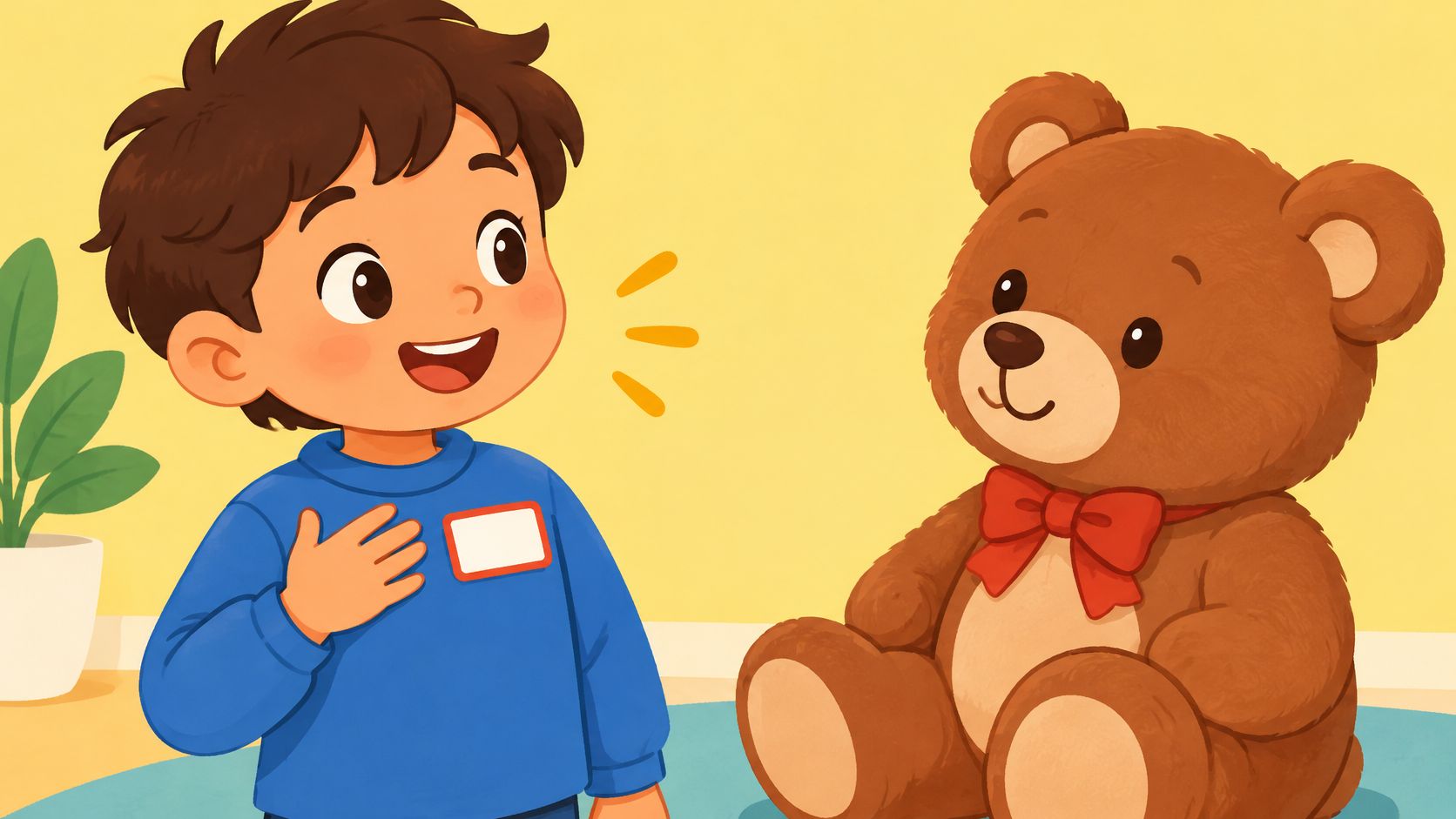
- Ages 5–6. A drawing of the child's face can prompt the introduction. The parent starts the sentence and leaves space for the name.
- Ages 7–8. Homemade character cards can show a name, age, and favourite activity. Parent and child take turns introducing their characters.
- Ages 9–10. The child can design a club membership card, write an introduction if comfortable, then say it without looking.
An optional extension is I like…, followed by something familiar such as football or drawing. A willing relative on a video call can provide a friendly audience, but a private exchange works too.
These English speaking activities for kids offer other ways to make speaking practice playful.
3. Asking for Things Politely With Can I Have and Please
Snack time provides a clear reason to speak. A parent can hold an apple and model Can I have an apple, please? before swapping roles. The phrase means that the speaker is asking someone to give them something.
The useful part is the reusable opening, Can I have…? Parents can keep that wording steady while changing the object. A child who doesn't know the object's English name can point while the parent supplies it.
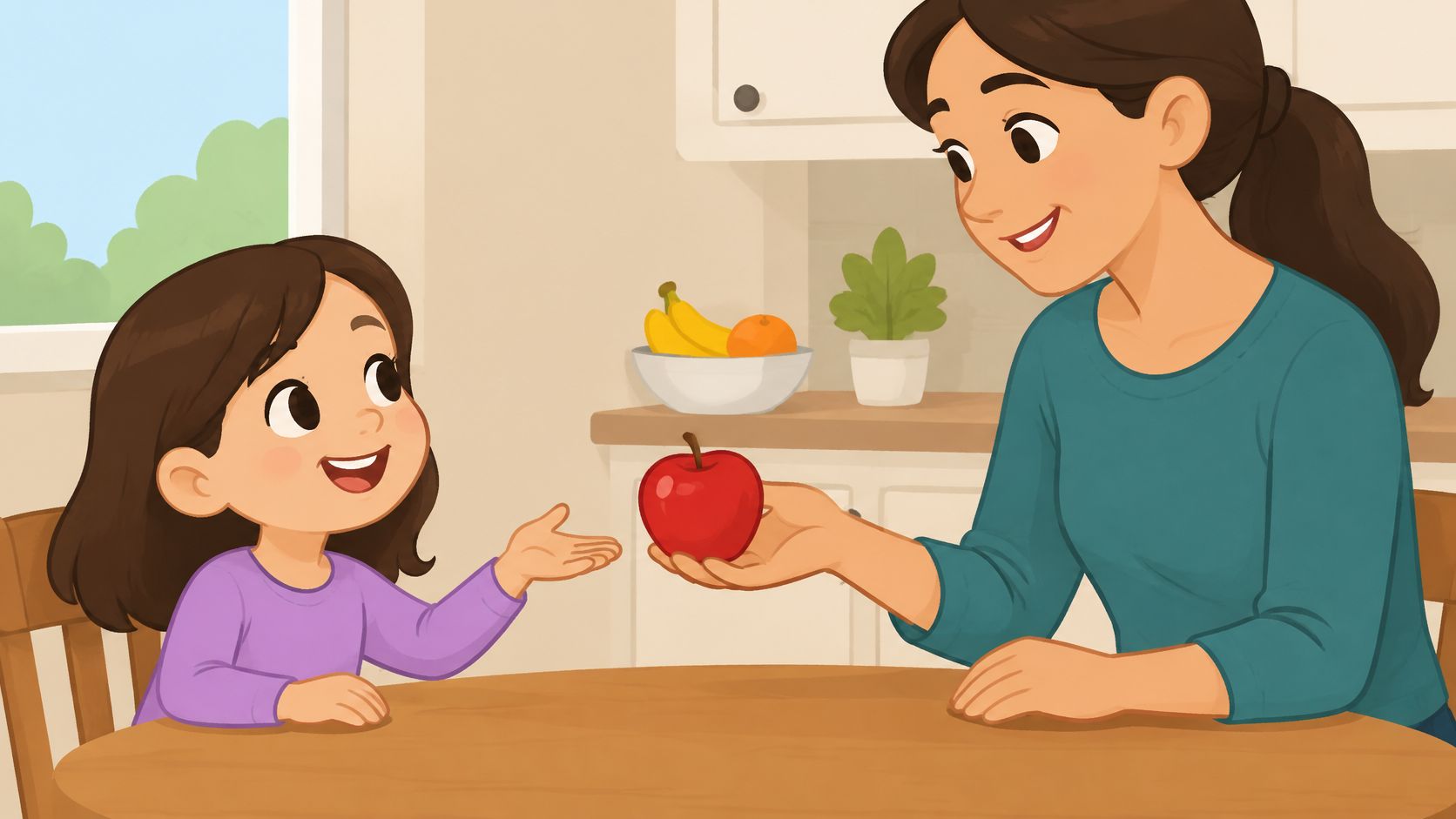
Turn the table into a pretend shop
- Ages 5–6. Familiar objects such as a cup, spoon, and apple give the child something concrete to request.
- Ages 7–8. The parent can become a shopkeeper while the child requests food or household objects. Swapping roles adds listening practice.
- Ages 9–10. The child can prepare a short shopping list and manage a pretend café order, using pictures if English reading is still new.
Parents can answer with Here you are and model Thank you after handing something over. A smile and natural tone make politeness clearer than a lecture.
Keep needs separate from practice. Food, water, comfort, and help should never depend on producing an English sentence.
4. Colours and Simple Descriptions With It's Red and I See a Blue Ball
Laundry makes a ready-made colour game. A parent can lift a red sock, say It's red, and place it beside another red item. The words describe something visible, so meaning doesn't depend on reading.
It's is the short form of it is. In I see a blue ball, the speaker names something they can see and adds its colour. Parents can begin with the shorter phrase before combining colour and object words.
The British Council's guidance on vocabulary learning recommends revisiting vocabulary through different activities, including songs, stories, and guessing games.
Use the same colours in different places
- Ages 5–6. Coloured paper or clothing can become matching targets. The parent names a colour, and the child points or brings an item.
- Ages 7–8. A colour hunt can involve finding something blue in the kitchen and something red near the door.
- Ages 9–10. The child can describe a mystery object with It's blue. It's round. The parent guesses, then supplies a clue in return.
For families choosing familiar object names, this guide to simple English words for beginners offers a useful starting point. The activity can stay brief and return naturally when laundry needs sorting again.
5. Expressing Feelings With I Am Happy, I Am Tired and I Need Help
I am tired fits naturally at bedtime. A parent can say the phrase, stretch, and respond with Good night. There's no need to ask for repetition when the child is already exhausted.
I am happy and I am tired describe how someone feels. I need help serves a different purpose: it tells another person that support is needed. Parents can demonstrate it while struggling playfully with a stuck lid.
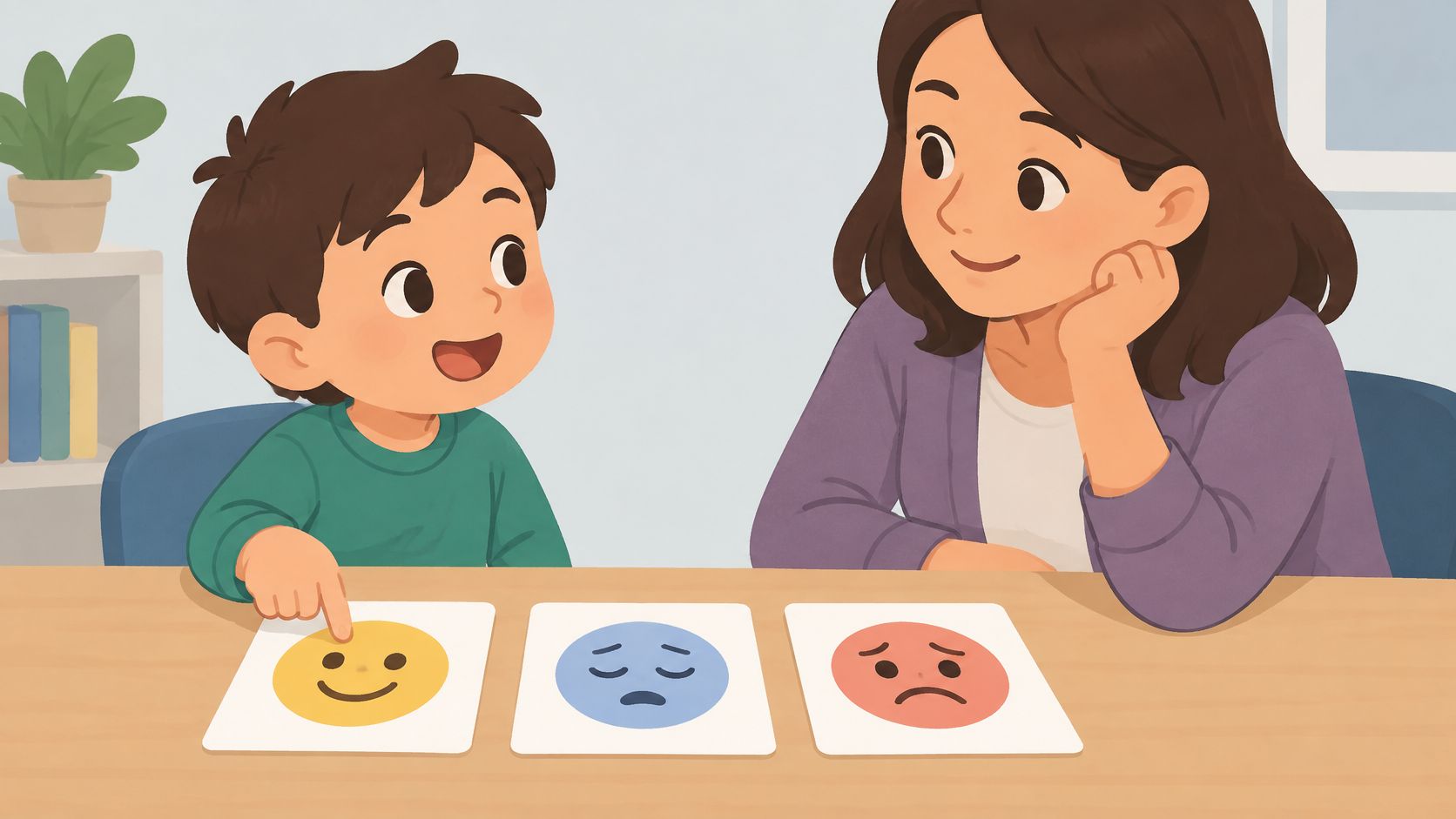
- Ages 5–6. Simple drawn faces can represent happy, sad, and tired. Pointing is enough before spoken practice feels comfortable.
- Ages 7–8. A homemade story can feature a character who loses a favourite hat. Parents can ask about the character's feelings rather than the child's private feelings.
- Ages 9–10. An optional extension is I feel… because…. Parents can provide the missing English or accept an explanation in the home language.
Feelings practice shouldn't become a demand for personal disclosure. A child can speak for a fictional character, decline the game, or use whichever language communicates their need most clearly.
6. Daily Routine Words With Wash Your Hands, Get Dressed and Time for Bed
Household phrases are especially useful for listening practice. Wash your hands asks someone to clean their hands; get dressed asks them to put on clothes. Time for bed announces the bedtime routine.
A gesture can make each phrase understandable before the child says anything. The British Council's guidance on listening with children recommends visual preparation and checking understanding through activities such as picture choices and matching.
Let actions show understanding
- Ages 5–6. A picture routine can show clothes, handwashing, and bedtime. The parent says a phrase while the child chooses the matching drawing.
- Ages 7–8. The child can direct a toy through its morning routine, with the parent acting out the instructions.
- Ages 9–10. The child can arrange a practical morning plan, adding English labels or written phrases if useful.
During a calm moment, the parent can deliberately mime the wrong action. The child can correct the performance with a gesture or the target phrase.
Parents can find familiar topics in this guide to English vocabulary for kids. For supplementary classroom practice, quick vocabulary prep for busy teachers can support preparation around the same home routines.
7. Yes, No and Basic Questions With Do You Like and Is It
A question about an apple can become a small conversation. The parent asks Do you like apples? and models either Yes, I do or No, I don't. The answer should reflect a real preference, not the response the adult hopes to hear.
Do you like…? asks about preferences. Is it…? asks whether an identification or description is correct, as in Is it a cat? The matching answers are Yes, it is and No, it isn't.
Keep each question with its answer
- Ages 5–6. A picture book offers visible choices. The parent can point to a dog and ask Is it a cat?, then model the answer.
- Ages 7–8. A hidden household object can become a guessing game. Parents supply questions such as Is it red? or Is it a spoon?
- Ages 9–10. The child can take charge of the questions while the parent answers. A small set of visible objects keeps the vocabulary manageable.
The Institute of Education Sciences' early-literacy guidance identifies interactive read-alouds and dialogic reading as research-informed practices that invite children to talk about a text.
At home, that can mean pausing over a picture rather than asking the child to decode unfamiliar English print.
8. Naming Animals and Simple Sounds With A Cat Says Meow
An animal parade can begin with drawings, toys, or folded scraps of paper. The parent moves a cat forward and models A cat says meow. A sound, gesture, or complete sentence can serve as the child's response.
The phrase names an animal and connects it with a familiar sound. Animal-sound words can differ between languages, so the English version may be new even when the animal is familiar.
- Ages 5–6. Parents can begin with animals whose sounds are easy to act out, such as cats, dogs, and cows. The child can choose the next animal.
- Ages 7–8. An animal-sound detective game lets the parent make a sound while the child identifies the matching drawing.
- Ages 9–10. The child can create a mystery-animal card using supplied words such as cat, small, and meow. Writing is optional; a spoken riddle works too.
Follow interests, not stereotypes
An older beginner may prefer wildlife, pets, or designing an imaginary creature to playing with soft toys. The English can remain simple while the activity feels age-appropriate.
Teachers and tutors can use the same game as a brief warm-up, then revisit the animal names in a picture story. Parents don't need to buy animal cards when homemade sketches will do.
9. Counting and Simple Numbers in Everyday Life
Counting becomes communication when it answers a practical question. At snack time, a parent can ask How many apples?, touch each apple while counting, and model There are three apples. Setting the table offers another useful phrase: Two spoons, please.
The number words identify quantity. How many…? asks about that quantity, while There are… introduces an answer. Parents can demonstrate the pattern with objects before expecting the child to remember the wording.
Separate English practice from maths difficulty
- Ages 5–6. Parents can count fruit or steps together, beginning with a comfortable range and extending it gradually.
- Ages 7–8. Existing dice or homemade number cards can support a turn-taking game. The child says the number and moves a matching collection of buttons or paper pieces.
- Ages 9–10. Counting in twos or tens can make the activity more interesting if the maths is already familiar. The parent can supply the English number words.
A child who understands quantity but forgets an English number word needs language support, not an easier maths task.
For a complete beginner, counting objects accurately while listening may be enough. Parents can repeat the same phrase during another everyday task rather than asking for a longer performance.
10. Using Talkio Kids for Short Daily English Practice
Talkio Kids is an iOS and Android app for complete beginners aged 5–10. It builds everyday vocabulary and simple phrases through short listening, picture-matching, speaking, and review activities. Nox, the alien companion, guides children through a space adventure.
Every instruction and word is spoken as well as written, with audio replayable in a tap. Learning content works offline, and progress stays on the device. There are no ads, social features, open chat, open-ended AI conversations, or account signup; purchases sit behind a parent gate.
Connect app practice with home moments
- Ages 5–6. A parent can stay nearby, help with navigation, and connect a familiar word to an object at home.
- Ages 7–8. The child can choose an activity, then use a related phrase during a pretend shop or colour hunt.
- Ages 9–10. Older beginners can take more responsibility for replaying unfamiliar audio while keeping the language level manageable.
The course remains usable without speech recognition. If microphone permission is declined, speaking steps become self-assessed tap when you've said it activities.
Monthly and annual subscriptions are available; current prices and trial eligibility appear in the app. Downloads are available through the App Store and Google Play. The app supports practice, not guaranteed fluency.
Which Basic English Phrases Fit Which Moments
| Item | Best for ages | Typical moment at home | Materials needed |
|---|---|---|---|
| Greetings and Goodbyes | 5–10 | Breakfast, leaving home, or bedtime | None |
| Introducing Yourself | 5–10 | Practising with a toy or talking to relatives | Toy or puppet optional |
| Asking for Things Politely | 5–10 | Snack time or pretend shopping | Familiar objects or snacks |
| Colours and Simple Descriptions | 5–10 | Spotting objects or sorting laundry | Household objects |
| Expressing Feelings | 5–10 | Bedtime or talking about the day | Face chart optional |
| Daily Routine Words | 5–10 | Washing hands, getting dressed, or bedtime | None; picture chart optional |
| Yes, No and Basic Questions | 5–10 | Looking at a book or guessing an object | Book or familiar objects |
| Naming Animals and Simple Sounds | 5–10 | Animal play or picture-book time | Animal toys or pictures |
| Counting and Simple Numbers in Everyday Life | 5–10 | Counting stairs or fruit | Everyday objects |
| Using Talkio Kids for Short Daily English Practice | 5–10 | A short practice session at home or while travelling | iOS or Android device |
Pick One Phrase Tonight and Make It a Habit
Families don't need a new schedule to begin. A phrase that belongs to an existing moment is easier to use naturally than a list waiting on the fridge. Good morning belongs at breakfast, Can I have…? fits a request, and I need help has an immediate purpose.
Parents can choose a phrase, model it at the next suitable moment, and keep returning to it before adding another. Repetition can stay warm and brief. A tired evening doesn't need to become a catch-up lesson.
Notice meaning before accuracy
A useful sign of understanding might be a child fetching the right object, answering with a gesture, or joining the final word of a phrase. Those responses give parents something specific to build on. Clear communication matters more than an imitation of a particular accent.
When a child makes an error, a natural reply can provide the model without stopping the exchange. If the child says blue ball during a request, the parent can respond with Can I have the blue ball, please? and hand it over. There's no need to demand a corrected version before continuing.
- For younger learners. Keep real objects and gestures available, and accept pointing when speaking feels like too much.
- For older beginners. Offer more choice and responsibility without assuming that age means advanced English.
- For hesitant parents. Explain the activity in the home language and use spoken models when pronunciation feels uncertain.
A parent doesn't need perfect English to make practice welcoming. A calm pause, a clear demonstration, and an interested response can keep the exchange comfortable. If an activity becomes frustrating, returning to something familiar is a sensible adjustment.
Keep the next step small
The most useful next step is often a new use for familiar language. A request practised with an apple can later work with a pencil. A greeting used with a parent can appear again during a willing relative's visit.
For teachers and tutors, these home moments can also guide supplementary practice. A picture, a short exchange, and a chance to respond can reinforce language without adding a reading-heavy assignment.
Families wanting an audio-led extra can explore the app download options. The aim remains practical: helping a beginner connect something heard in English with something meaningful to say or do.
Talkio Kids offers short listening, picture-matching, speaking, and review activities for beginner vocabulary and simple phrases. Parents can visit Talkio Kids to explore a playful companion to everyday English practice at home.