
English learning at home
8 Fun English Listening Games for Kids at Home
Discover 8 easy English listening games for kids at home, with simple steps, beginner examples and tips for parents who speak little English.
By Talkio Kids ·
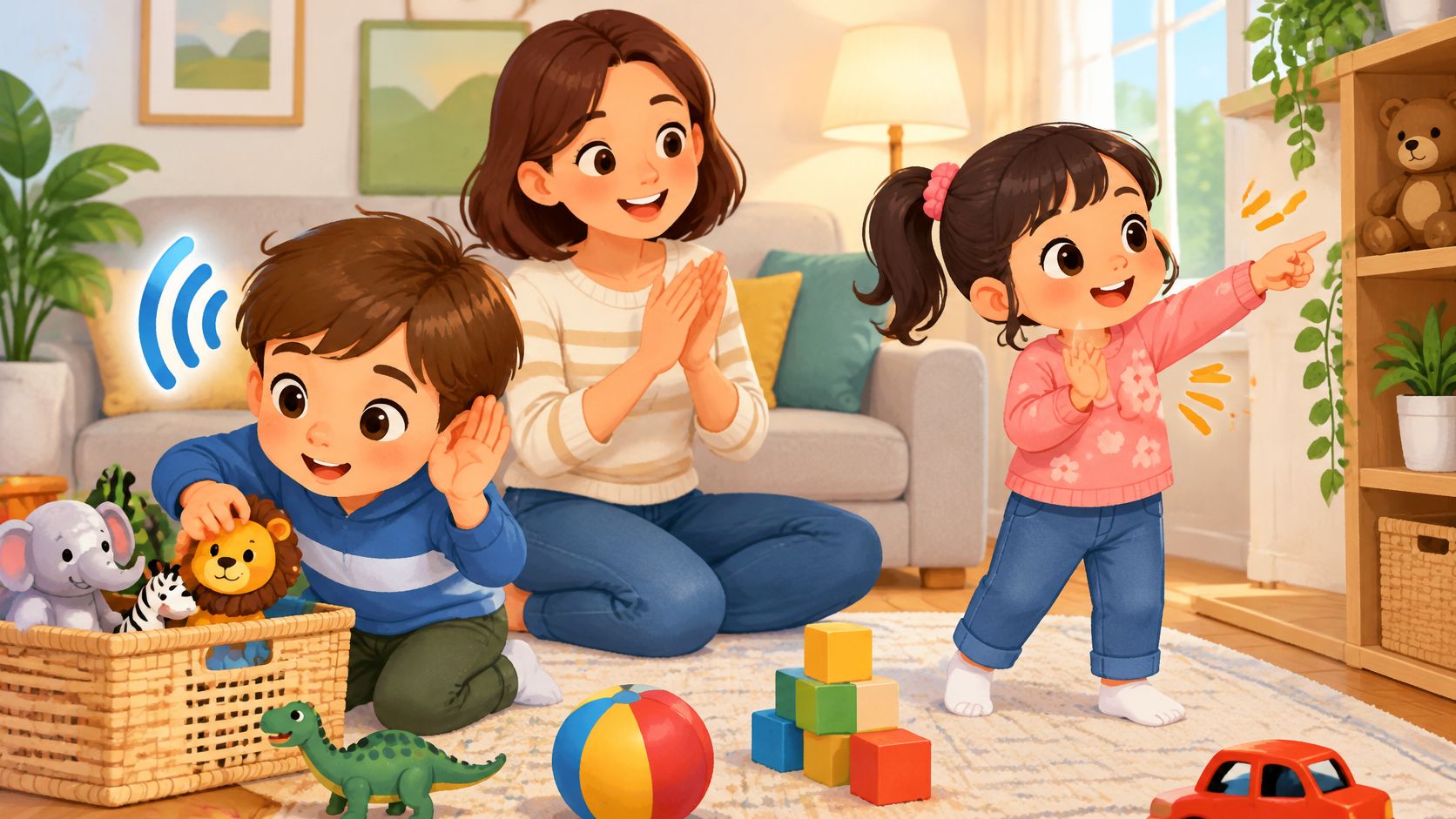
Twenty minutes before dinner. A child who has started hearing English at school comes home with three words and a shrug. A parent who can manage "good job" and "what's this?" freezes at the idea of running an English lesson.
So nothing happens, and the twenty minutes disappear.
Listening is the right place to start, and it asks far less of the adult than speaking practice does. A beginner needs to hear a word many times, attached to something visible, before that word becomes available to say. Games do this without fuss, because the child is busy playing rather than performing.
Every game below is free. Most need no materials, none needs a fluent adult, and none needs preparation longer than it takes to read the instructions. Each comes with adaptations for ages 5 to 6, 7 to 8 and 9 to 10, because a nine-year-old beginner and a five-year-old beginner need very different games even when their English sits at the same level.
1. Simon Says with Simple English Commands
“Touch your nose.” “Jump.” “Simon says, clap your hands.” Simon Says turns short English commands into a listening game, with no materials or fluent English needed. The child listens for the action and the phrase “Simon says” before moving.
Why movement helps a beginner
A child can show they understand a command by doing it, even before they can say the words. Keep the first round simple: choose a few actions the child knows, such as “sit down,” “stand up” and “touch your head.” Add a gesture if the meaning is unclear, then try the command again.
NAEYC's guide to reinforcing language skills at home suggests naming and describing actions during everyday interactions, and pairing listening with movement. For more ideas that combine action and play, explore music and movement games for preschoolers.
Try four commands during a short break: “Simon says, touch your toes.” “Simon says, hop.” Then say, “Touch the window.” The child should stay still because the command did not begin with “Simon says.”
- Start with familiar words. Use a small set of actions the child already knows. Add a new one when the others feel easy.
- Say the command clearly. Pause before showing the action. If the child is unsure, demonstrate rather than translating every instruction.
- Take turns. Once the child knows the rule, let them lead. They can choose familiar commands, while you listen and follow.
- Finish while it is still fun. A few minutes is enough for one round of play.
For parents with limited English: Choose a few short commands and repeat them. You do not need to explain the rules in English.
By age. At 5 to 6, use simple actions and demonstrate each one. At 7 to 8, take turns leading and add a familiar command. At 9 to 10, let the child write or choose the commands and lead a full round.
2. Listen and Find with Sound-to-Picture Matching at Home
Five animal drawings taped around a living room, a rainy afternoon, and a parent saying one word at a time. Listen and Find trains the skill underneath all later comprehension: hearing a word and attaching it to something visible, fast enough that meaning arrives while the word is still in the air.
Set it up in two minutes
Put two or three objects on the table and say "find the cup". Say the word twice, wait five seconds, then offer a clue. Once that's easy, hide five pictures around the room and turn it into a hunt. Words from the same category, such as four fruits, sharpen listening because the child can't rely on the obvious answer.
Practical rule: clue before rescue. Offer a category clue ("it's an animal") before pointing at the answer yourself.
A richer version costs nothing. NAEYC's guidance for talking with parents about play and learning describes children learning language in pretend situations rather than from isolated lists, and gives the imaginary shop as an example: say each item in English, ask the child to find or "buy" it, then let the child name it back.
By age. At 5 to 6, use two or three real objects and allow pointing. At 7 to 8, spread five to eight picture cards around the room and let the child give the clue while the parent searches. At 9 to 10, describe instead of naming ("find something you use when it's cold") so the child follows a whole phrase.
For a wider set of routines, these English learning games for kids work alongside the ones here.
3. Odd One Out, Listening for Categories
A nine-year-old who reads confidently in two languages can still be a complete beginner in English, and that mismatch confuses everyone. Odd One Out gives older beginners something age-appropriate to do with simple vocabulary. The adult says four words, and the child picks the one that doesn't belong: "apple, banana, dog, orange."
The ACTFL research brief on early language learning summarises the Barcelona Age Factor project, which compared learners who began English at ages 8, 11, 14 and over 18 and looked at progress after 200, 416 and 726 hours of instruction. Older starters progressed faster at first, but the younger learners caught up with them in listening and speaking over time, and the summary identifies total exposure hours as more important than starting age for those outcomes.
Read that as encouragement rather than a promise. A nine-year-old starting now isn't late, but the hours have to come from somewhere, and four short sessions a week beat one long Saturday lesson that everyone dreads.
- Begin with known categories. Colours, animals, food and clothes first, then new vocabulary in small doses.
- Ask for the reason. One word ("animal") or a gesture is enough at first.
- Let older children build the lists. A 9- or 10-year-old will happily try to catch an adult out.
- Reuse the same set for a week. Repetition across days builds recall better than constant novelty.
By age. At 5 to 6, use two known words plus a picture card so the child can point. At 7 to 8, move to food, clothing and rooms. At 9 to 10, the child creates the lists and defends the answer with a short phrase.
4. Shared Picture Book Reading with Audio Support
Repetition, not variety, is what makes a picture book useful. One short book read five times does more for a beginner than five new books read once, because the second and third readings free the child from guessing the story and let them listen to the words.
The habit already exists in most homes with young children. In 2024, 66% of UK parents reported that someone at home looked at books or read with their child aged 0 to 5 at least once a day, according to the Department for Education's survey of parents. The work at ages 5 to 10 is keeping that routine alive once books get longer and children start reading by themselves.
Let the pictures carry the meaning
A parent with limited English can play the audio version of a short story, or read it slowly, and ask "where is the dog?" while the child points. Pause before the last word of a repeated sentence and let the child finish it. Choose books with large pictures and repeating phrases, and ask two questions only: "what is it?" and "what colour is it?"
By age. At 5 to 6, the adult reads and the child points. At 7 to 8, the child reads the repeated line aloud while the adult reads the rest. At 9 to 10, listen to a short audio story together and let the child retell it from the pictures.
For stories built around simple repeated language, see these English learning stories.

5. English Sound Hunt Around the House
Some children will not sit still for a matching game, and asking them to try is a losing battle. A sound hunt gives movement a job. The adult offers a short English clue, such as "find something soft" or "bring me something round", and the child searches the home for a match.
Naming things during play is exactly what the evidence points to. The UNICEF data story on the power of play draws on comparable information from nearly 100 countries and identifies caregiver play, reading, singing, storytelling, naming, counting and drawing as activities that support children's cognitive, social, emotional and language development. A hunt is naming with footsteps attached.
Short clues are the whole trick. Two key words, one gesture, five minutes.
- Keep clues to one or two words. "Soft", "red", "something that goes ding" all work.
- Gesture alongside the word. Pointing at a jumper while saying "warm" gives a beginner a second channel.
- Set a five-minute limit. A timer keeps energy up and stops the game drifting into tidying.
- Recycle earlier words. Pull clues from the last book or game so old vocabulary keeps working.
By age. At 5 to 6, use one-word clues and search together. At 7 to 8, use two-part clues such as "something soft you put on your head". At 9 to 10, the child writes three English clues for a sibling or parent to solve.
6. Story Sequencing by Listening
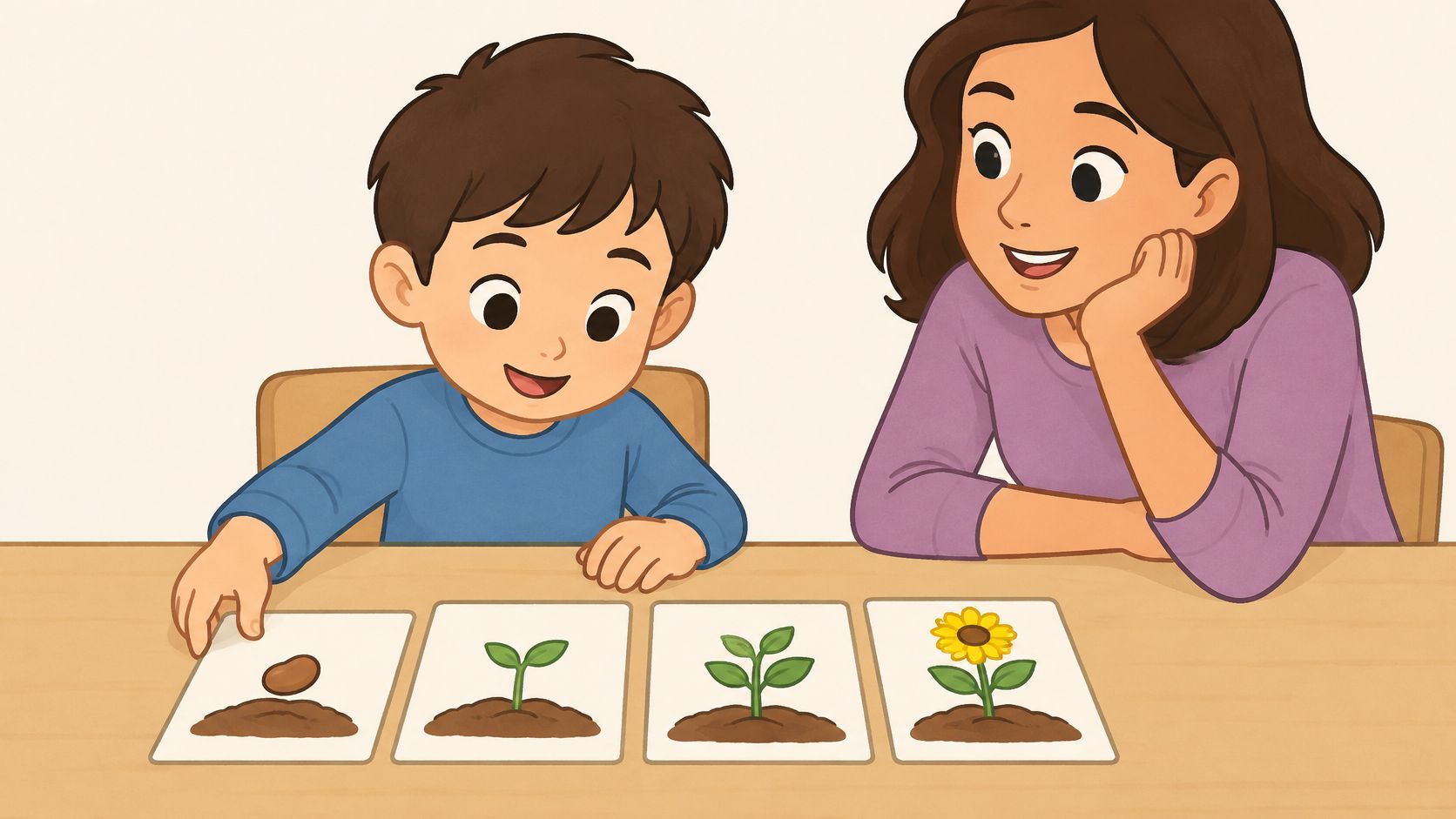
Sequencing is where single words turn into connected English. The adult reads or plays a four-line story, the child arranges pictures in order, then listens again to check. Words such as "first", "then", "next" and "finally" do the heavy lifting, and children start to expect them.
When the adult's English runs out
This is the game where a parent's own language matters most, and where switching language is an advantage rather than a failure. A U.S. early-childhood practice review on supporting young dual language learners says limited-English-speaking parents may provide the strongest overall language support by conversing with children in the family's first language, and recommends activities such as games, songs, storytelling and questions in that language while children learn English.
In practice, that means the English comes from the audio or from a few read-aloud lines, and the discussion happens in the language the parent is comfortable in. Ask "what happened first?" in the home language. The child still did the English listening, and nobody had to perform a lesson in a second language.
- Start with three pictures and build to six as confidence grows.
- Repeat the sequence words every time, so they become familiar signposts.
- Let the child draw the pictures. Personal drawings make the story easier to remember.
- Point to first and last before any retelling, which gives the child a frame.
By age. At 5 to 6, three pictures and a story of three sentences. At 7 to 8, five pictures and a story with a clear middle. At 9 to 10, six pictures, a second listening, then a retelling in English or the home language.
7. Short Song and Chant Listening Routine
Singing is the one activity where tone-deaf adults get a free pass. Children copy rhythm and melody long before they copy grammar, and a chant gives a beginner the same eight words, in the same order, with the same tune, until they arrive without effort.
NAEYC's article on play and language in public libraries reports that playful activities such as singing, drawing and games can support language growth, and stresses that the quality of interaction matters more than the quantity. Ten focused minutes with one song beats an hour of background audio.
Build a two-minute routine
Choose songs with clear pronunciation and a slow tempo. Explain the key words with pictures or actions before singing, hum the tune first, then add words, then add clapping. Keep to two or three songs a week rather than a new one every day.
By age. At 5 to 6, a counting or colour song with clapping, then the child names the colour in English. At 7 to 8, a weather chant used at the window each morning. At 9 to 10, the child picks a song, finds three words they recognise, and explains what it's about.
8. Offline Listening Practice for Travel and Low-Connection Moments
A train is delayed, the waiting room is quiet, or the internet drops during a trip. A ready-to-use offline activity can turn that spare time into a short English listening practice, without needing a strong connection or a parent who speaks English fluently.
The useful test is simple: does your child want to hear the activity again? Asking to replay it can signal engagement. Keep the routine short and let your child repeat words or match what they hear to a picture.
Talkio Kids is an iOS and Android app for complete beginners aged 5 to 10. Its short lessons combine listening, picture-matching, speaking and review, with Nox guiding children through a space adventure. Lessons, pictures and recordings work offline, and progress is stored on the device. No account or sign-in is needed. Subscriptions are available through the app, and eligible trial details and current prices are shown there.
- Prepare before travelling: Open the app while connected so it is ready to use offline.
- Use a familiar moment: Try a short activity during a bus ride or while waiting for swimming.
- Adjust for age: For younger beginners, focus on listening and matching words to pictures. Older beginners can try saying the words aloud.
- Keep a no-screen option: Name familiar objects together, or give a simple English clue for your child to follow.
For more ideas on choosing an app that works without a connection, see this guide to offline English learning apps for kids.
8 English Listening Games Compared
| Game | Ages | Materials Needed | Listening Skill Practised | Best For |
|---|---|---|---|---|
| Simon Says with Simple English Commands | Young children; examples include ages 7 and 9 | None; needs a little space | Following spoken commands and connecting words to actions | Shy learners and active short routines |
| Listen and Find: Sound-to-Picture Matching at Home | Early learners; examples include ages 5–10 | Household objects or simple pictures | Matching spoken words to objects and meanings | Beginners and children who are not yet reading |
| Odd One Out: Listening for Categories | Ages 7–10 | None | Identifying categories and comparing word meanings | Older beginners who enjoy word puzzles |
| Shared Picture Book Reading with Audio Support | Young children; examples include ages 5–9 | Picture book; optional audio | Recognising familiar words and understanding story context | Bedtime routines and shared listening |
| English Sound Hunt Around the House | Children; examples include ages 6–10 | Household objects; optional clue cards | Understanding short clues and descriptive words | Energetic children who enjoy moving |
| Story Sequencing by Listening | Ages 7–10 | Paper and 3–6 story pictures | Following story order and sequence words | Older beginners ready for connected stories |
| Short Song and Chant Listening Routine | Children; examples include ages 7–10 | Songs or audio; optional actions | Hearing repeated words, rhythm and pronunciation | Enjoyable, repeatable daily practice |
| Offline Listening Practice for Travel and Low-Connection Moments | Ages 5–10 | Device with downloaded app content | Listening and matching audio to pictures | Beginners practising during travel or waiting time |
Turn a Few Minutes a Day into Real Progress
The pattern behind all eight games is the same. A child hears a small amount of English, connects it to something visible, and responds without being asked to produce a perfect sentence. That cycle, repeated across weeks, is what builds the confidence a beginner needs before speaking feels safe.
Pick one game rather than eight. Attach it to something that already happens every day, such as the walk to school, bath time or the last ten minutes before lights out, and let it run for a fortnight before adding anything. A predictable five minutes beats an ambitious plan that gets abandoned in four days.
Then judge it by the result. If the child asks to play again, keep it. If the game produces silence and a request for a screen, change the game, not the child. Parents who speak little English often run these games better than fluent ones, because they rely on gestures, pictures and repetition instead of explanations, and that's what beginners need.
The same test applies to anything digital. NAEYC's code of ethics for early childhood educators says digital technologies and interactive media should be used responsibly and intentionally, only when they protect privacy, suit the child's developmental level and offer clear benefits. Before downloading anything, check what the activity is teaching, whether a non-reader can use it, what information it asks for, and whether sessions can stay short.
Good English listening games for kids at home share three features: they're brief, they're repeatable, and an adult who isn't confident in English can start them without preparation. Families who want a structured option alongside the games can explore Talkio Kids at https://talkiokids.com/#get-the-app, with the App Store version at https://apps.apple.com/app/talkio-kids/id6800876070 and Google Play at https://play.google.com/store/apps/details?id=com.talkio.kids. Trial eligibility and current prices are shown inside the app.
Talkio Kids turns a spare five minutes into purposeful English practice for beginners aged 5 to 10, with short listening and picture-matching missions, replayable audio and simple speaking steps guided by Nox. It pairs naturally with the games above, so a child can hear a word in a bath-time round and meet it again on a train. Visit Talkio Kids to see how the missions fit your family's routine.