
English learning at home
7 Number Matching Activities for Young English Beginners
Discover 7 playful number matching activities for young English beginners. Try simple card, dice and space games at home with no purchases needed.
By Talkio Kids ·
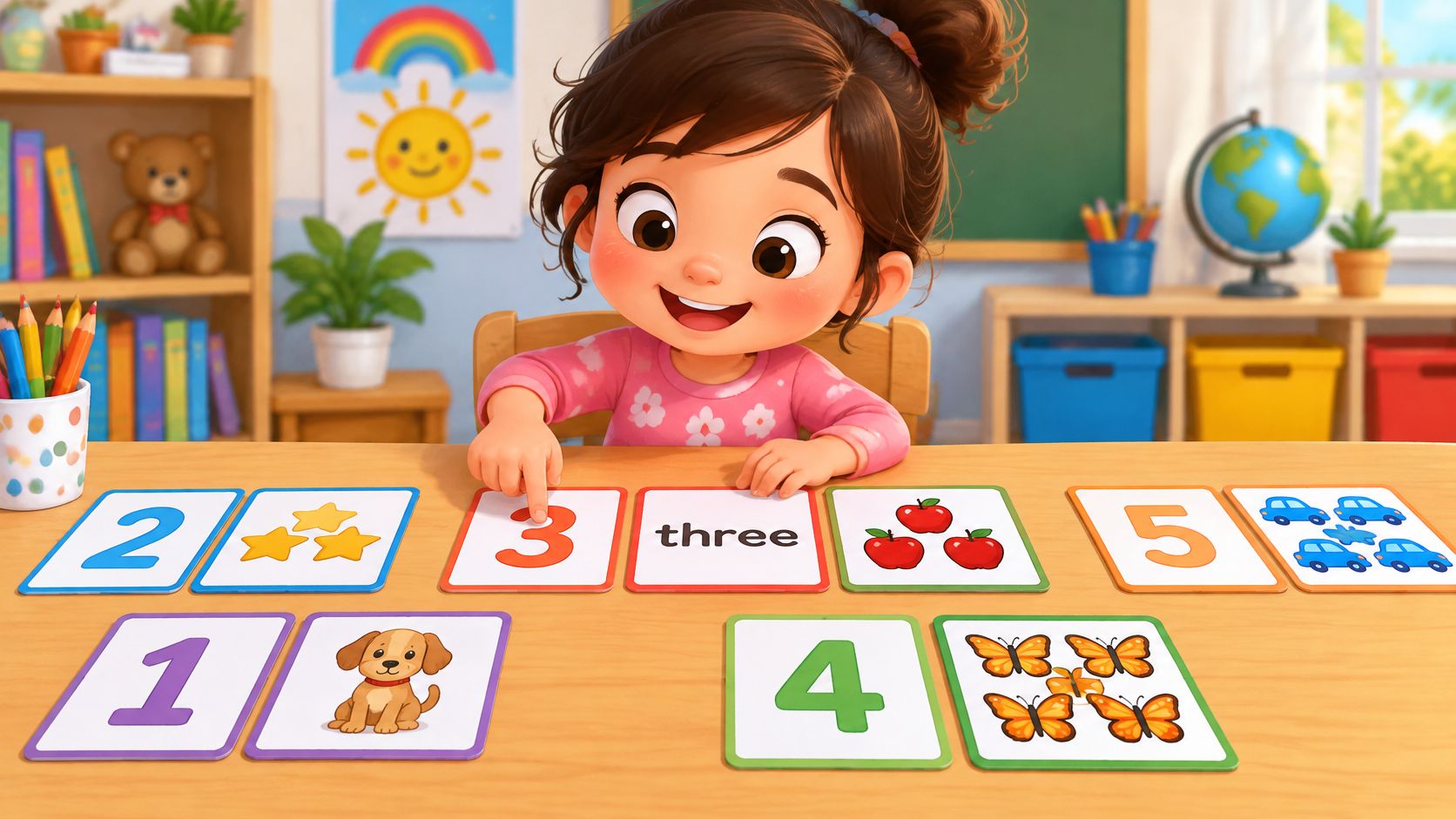
It's an ordinary Tuesday after school. A child has ten minutes, a pile of paper cards, and no interest in sitting at a desk. A parent wants a little English practice, but another worksheet isn't likely to help.
Number matching activities offer a simple starting point, especially when a child already counts in their home language. Familiar numeral shapes give the parent something concrete to point to while introducing an unfamiliar English word. The routine stays manageable: hear the number, find the quantity, match the numeral, then try saying it.
These games need only scrap paper, pencils, and everyday objects. Reading comes later, so an older beginner doesn't have to decode seven before showing that they understand it.
- For ages 5–6: Use familiar objects and plenty of adult modelling.
- For ages 7–8: Let children arrange cards, check quantities, and take turns leading.
- For ages 9–10: Use missions, scores, or practical challenges without making the English harder too quickly.
Families considering guided lessons alongside home play can also explore Englify classes for young learners, keeping the child's age and beginner level in mind.
1. Number Picture Match (Numeral to Object)
Start by saying a number while pointing to a matching group of objects. There's no need to show a written English word yet. A child can understand four through four bananas before recognising its spelling.
Prepare numeral cards from 1 to 10, plus separate pictures showing matching quantities. Rough pencil drawings are fine. The Institute of Education Sciences early-mathematics practice guide specifically recommends matching numeral cards with picture or quantity cards.
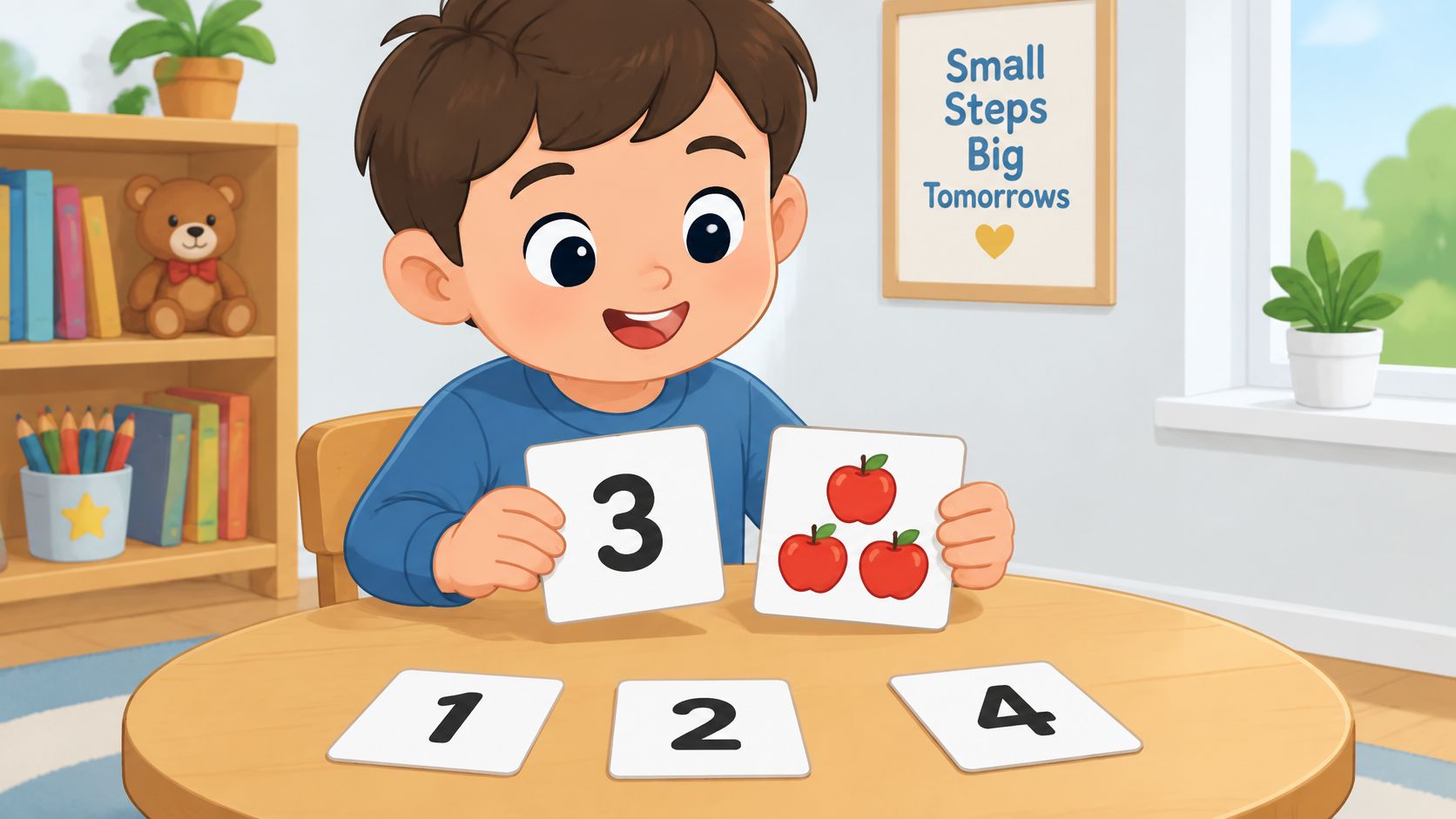
Build the match in small steps
- Listen and point: Place pictures of different quantities on the table. Say four and invite the child to point to four bananas.
- Add the numeral: Show the matching numeral card and place it beside the picture.
- Try speaking: Model four again, then invite the child to repeat it before pointing on the next turn.
- Check with objects: Replace a picture with pencils or biscuits and count them together.
For a gentle start, use numbers 1 to 3 and consider adding a new number each week, provided the familiar ones feel comfortable. Think of matching socks: the child is finding things that belong together, even though they don't look identical.
A child aged seven or eight can draw the picture cards. A nine- or ten-year-old might use footballs, game tokens, or scattered dots, then optionally add seven beside the numeral and quantity.
Picture support isn't only for younger children. The guide to audio-visual support for beginner English offers further ways to keep meaning clear without making reading the entry requirement.
2. Space Number Bingo with Nox
A parent calls seven stars, and the child searches a homemade space card. Before play begins, the parent points to a sample group of stars and says the number aloud. That quick demonstration makes the task clear without written instructions.
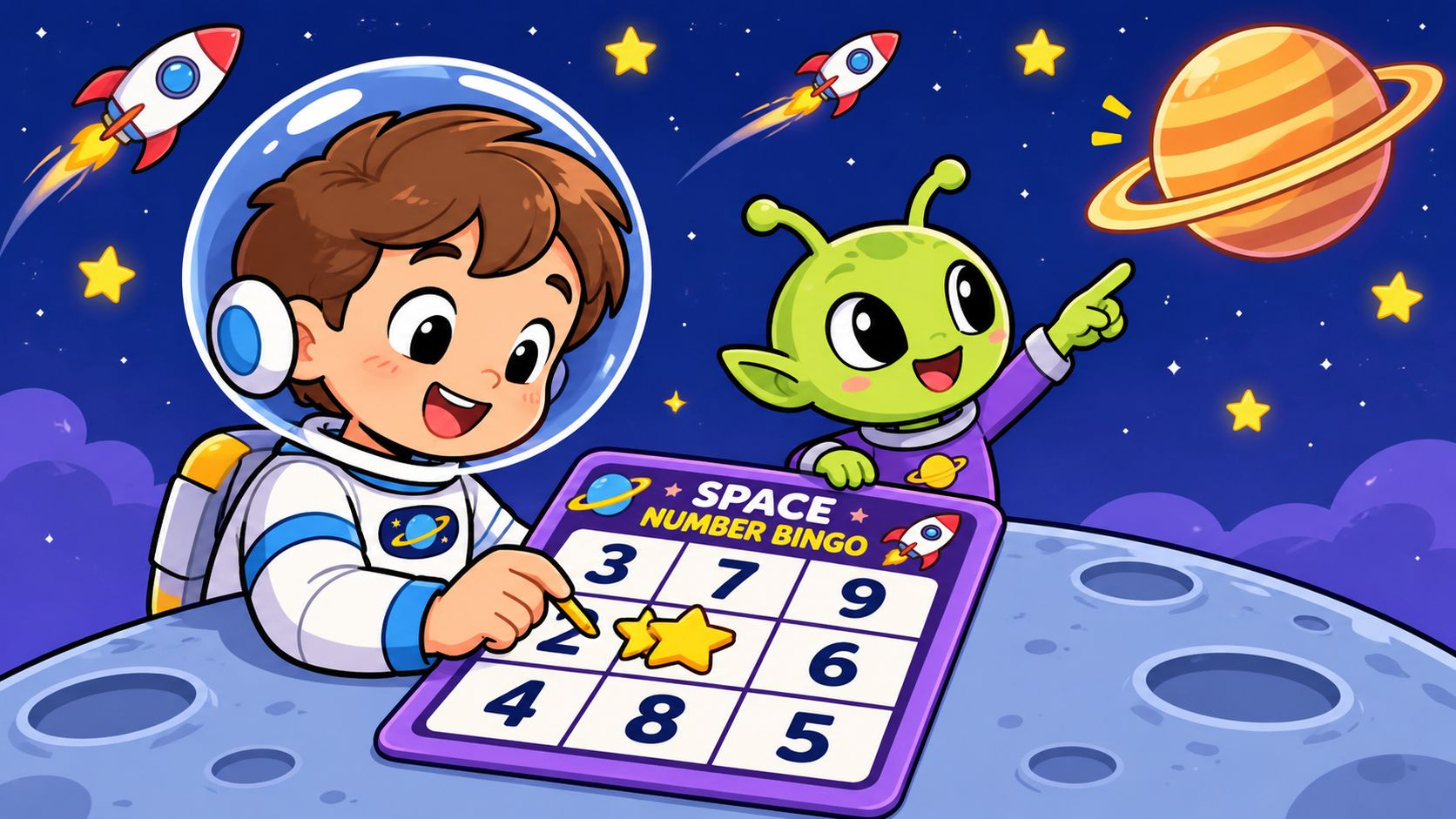
Draw small bingo cards containing numerals and groups of planets, rockets, or stars. Use numbers 1 to 10, but keep each player's card small enough to scan comfortably. An adult can play the part of Nox, the friendly alien caller, using a playful voice rather than adding complicated rules.
Make every square a listening task
Say the number twice before players search. The child covers the matching numeral, points to the corresponding quantity, and tries saying the number aloud. If a square contains only a numeral, the child can draw matching stars on scrap paper to complete the connection.
For example, after hearing seven stars, a child covers 7, counts seven drawn stars, and repeats seven. The family can agree that completing a row ends the round, with no need for a prize.
Keep the language steady: Repeat familiar number words before adding more space vocabulary.
For ages seven and eight, let children design different cards and become the caller when ready. For ages nine and ten, try a mission-control role: the caller announces a number, checks the quantity, and confirms the match.
A teacher or tutor can use the same cards for paired practice. Keep scoring secondary to listening, especially when a child knows the mathematics but is still learning the English words.
3. Number Memory Pairs
Memory pairs suit a quieter moment, such as waiting for dinner or winding down before bedtime. Begin with the cards face up: the adult says a number, and the child points to its numeral and matching quantity. Only then should the cards turn face down.
Make a pair from a numeral card and a picture card. Each time someone turns over a card, the adult models the English number and invites the child to repeat it, whether or not a pair appears.
A randomised preschool mathematics study used a matching condition in which children turned over cards and said the numbers represented. Its stronger reported gains concerned the separate magnitude-comparison game, so it shouldn't be treated as proof that memory matching alone produces broad mathematics gains.
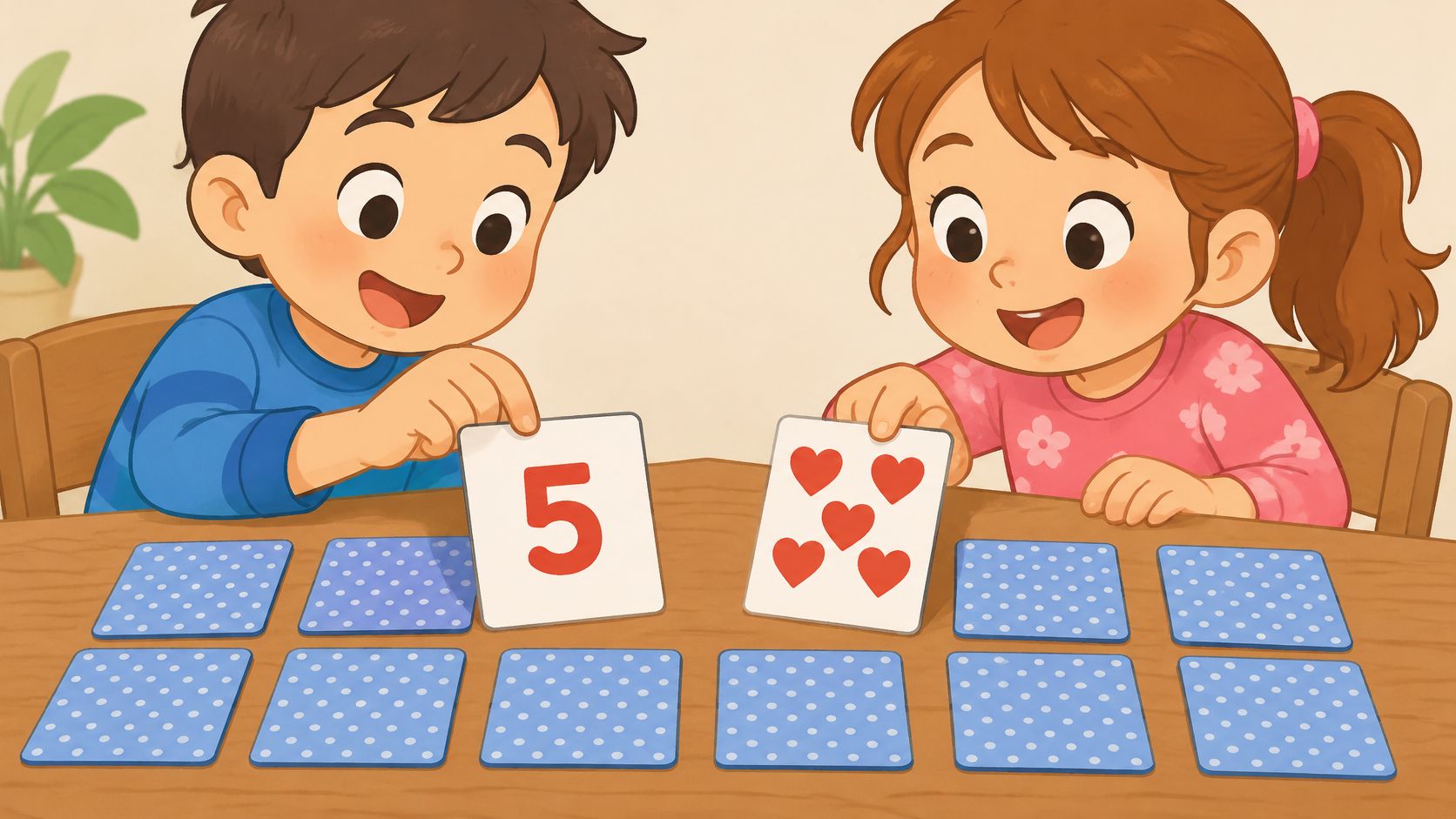
Change the cards, not every rule
- Begin with four pairs: Use clear quantities and numerals, keeping a familiar counting object nearby.
- Grow to eight pairs: Add cards when the child can follow the routine without constant help.
- Keep turns spoken: Say the number whenever a card turns over, not only after a successful match.
- Keep play brief: Around ten minutes is a practical stopping point, not a target that must be reached.
An older beginner can replace numeral cards with number-word cards, but should hear each word first. For twelve or thirteen, keep a matching numeral and a counted group nearby so reading never replaces understanding.
For another variation, a nine- or ten-year-old can explain a match using seven dots. Families can find other adaptable formats in these English-learning games for children.
4. Dice Count and Say
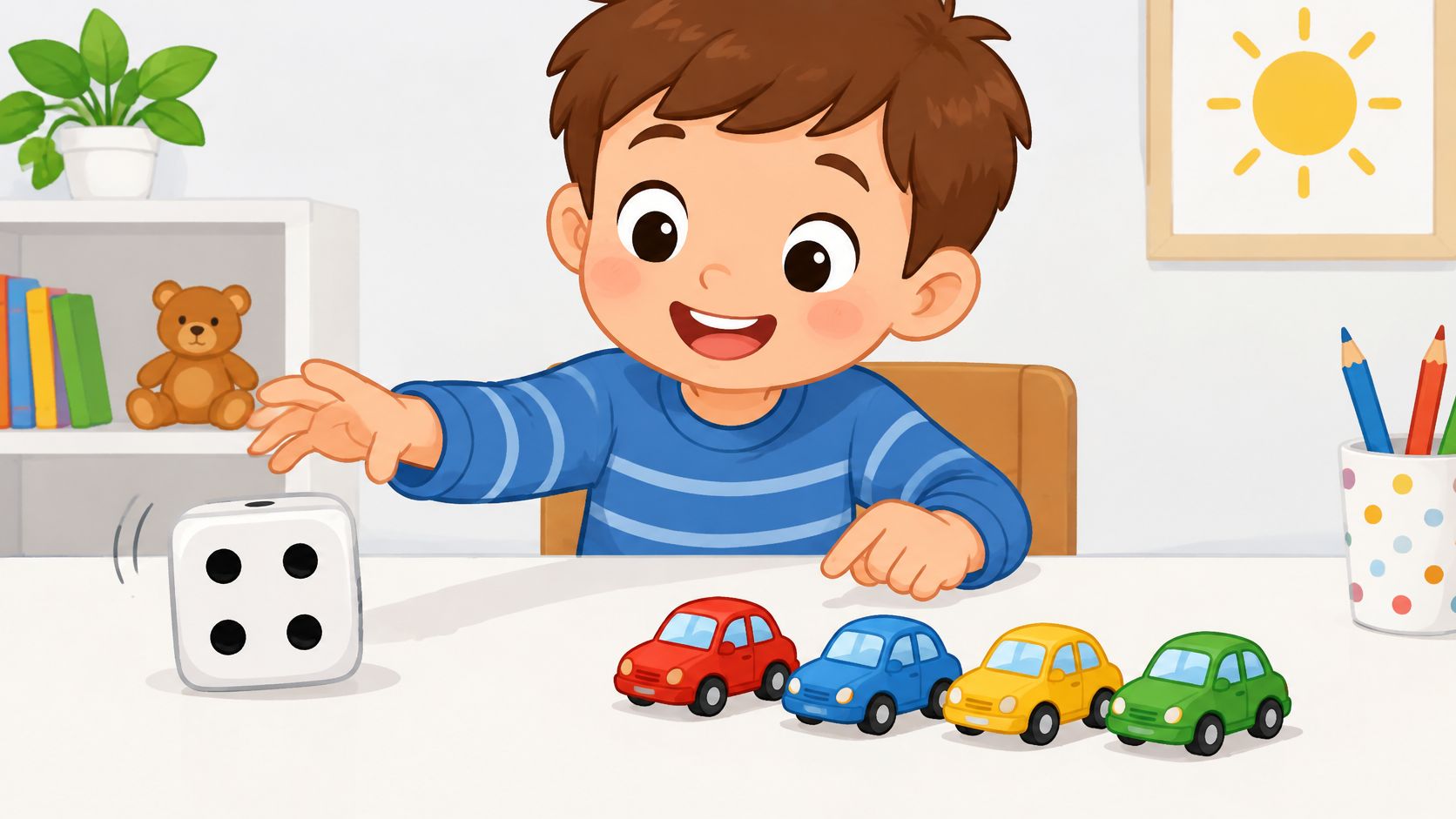
A roll of the die gives this game a clear beginning. The child rolls, looks at the dots, and listens as the parent models the number in English. The child then gathers the matching quantity and finds its numeral card.
For example, a roll showing four dots becomes four toy cars parked beside 4. The parent says four, then pauses for the child to try it. Written number words can wait until the listening-and-matching routine feels familiar.
Keep the English easier than the maths
Start with a single die. For a child aged seven or eight, try building a tower with the matching number of blocks, then placing a numeral card beside it. The child can check by touching each block while counting.
A nine-year-old who already understands addition can roll two dice. With adult modelling, a roll of six and five becomes six plus five is eleven, followed by eleven counters and the numeral 11 on a whiteboard.
A child can understand the calculation perfectly and still need help saying it in English.
There's no need to add arithmetic just because a learner is older. Changing cars to sports tokens or construction pieces may be enough to make the same simple language feel age-appropriate.
Use large foam dice when younger siblings are nearby, and keep small counters out of their reach. Finish by rearranging the objects and asking the child to match again, rather than relying only on a familiar dot pattern.
If pronunciation is uncertain, the adult can model slowly and accept another attempt without turning the game into a correction session.
5. Go Fish with Number Words
Before dealing cards, the parent says a number and asks the child to point to a matching numeral-and-picture card. This listening warm-up establishes the meaning before any reading or question practice.
Make paired cards, each showing a numeral and the corresponding number of dots or objects. Older learners can add the English word underneath. Deal a small hand to each player and leave the remaining cards face down as the fishing pile.
Give the conversation a predictable shape
- Model the question: Practise Do you have seven? while pointing to the relevant card.
- Model the answers: Use Yes, here you go when handing over a match, or No, go fish when the player must draw.
- Check the pair: After receiving a card, the child says the number and counts the pictured objects.
- Offer a prompt card: Write the question for readers, but say it aloud for children who don't yet read English.
Purposeful speaking matters here. The Education Endowment Foundation's oral-language guidance emphasises active, meaningful vocabulary use, although that evidence doesn't establish the effectiveness of this particular homemade game.
A group of nine- and ten-year-old beginners can use number-word cards while keeping a numeral-and-quantity reference sheet nearby. Children aged seven or eight may prefer illustrated cards and a parent who supplies the start of each question.
Aim to stop after 10 to 15 minutes, or earlier if the conversation becomes tiring. The point is a usable exchange, not finishing the deck.
For families seeking similar age-appropriate speaking practice, these English-learning games for eight-year-old beginners offer additional options.
6. Number Hunt Around the House
The sofa becomes the collection point, and the room supplies the materials. The parent points to a familiar object, says its name, then gives a short number instruction. A numeral card stays at the collection point so the spoken request, quantity, and symbol remain connected.
A parent might say Find four spoons. The child collects the spoons, places them beside 4, and tries four spoons. If the object word is unfamiliar, the parent can point to a spoon before repeating the instruction.
Turn everyday objects into clear clues
Start with a short hunt list, perhaps three familiar items such as books, shoes, and pencils. Choose objects that are safe to carry and easy to find. There's no need to hide anything or prepare a worksheet.
For children aged seven and eight, add a checking role: after collecting the objects, they count them and choose the correct numeral from a small selection. A nine- or ten-year-old can become the caller, while the adult deliberately gathers an incorrect quantity for the child to check.
Keep the number language familiar while changing the objects. If both the numbers and the nouns are new, the parent can simplify by pointing and saying only the number.
A useful distinction: Matching a quantity to a numeral and making a quantity from a spoken number are different tasks. Practise both directions.
A review of early-numeracy misconceptions describes difficulties children can have moving between quantities, number words, and numerals. A correct card choice shouldn't automatically be taken as evidence that every direction is secure.
On a walk, children can point to groups of trees, parked cars, or dogs instead of collecting objects. The matching numeral can be drawn on scrap paper afterwards.
7. Space Number Mission Routine
Give the game a clear job: help a space friend prepare for launch. Begin with the adult saying a number while pointing to a sample group of paper stars. The child listens and points before seeing any written mission.
Place a numeral card beside a paper rocket. The parent announces Find three stars for the rocket, and the child collects three stars, matches them to 3, and says three stars. A cuddly toy can play the alien helper for a younger child.
Let older beginners run mission control
A seven- or eight-year-old can arrange the launch supplies and choose the correct numeral after hearing the request. For a nine- or ten-year-old, use a cargo-planning challenge with paper rockets, planets, and stars. Keep the spoken English short even when the story becomes more grown-up.
An older child can also write a mission card containing two familiar numbers and read it aloud to a sibling. The listener completes the task with objects, then checks the numeral cards. Writing is an optional extension, not the starting requirement.
- Repeat the familiar mission: Keep the same language until the child can take part comfortably.
- Refresh the setting: Change the cargo or destination every few days rather than adding lots of new words.
- Finish clearly: End with Great job, mission complete! and put the materials away together.
The British Council's parent guidance recommends picture–word vocabulary games with audio and suggests extending practice through songs or stories. A homemade mission follows a similar practical progression when children hear familiar words and use them in a small story.
For tutors, the mission can become a short paired task. One learner gives the spoken instruction while the other listens, gathers, and matches.
How the seven number matching activities compare
A five-year-old pointing at three stars and a ten-year-old writing a mission card can use the same seven games. The difference is how much listening, speaking, and reading the adult builds into each turn. Every activity links three forms of a number: the numeral, the spoken English word, and the quantity of objects. Each one also starts with listening or pointing before any reading.
| Item | Suitable ages | Speaking practice | Materials needed |
|---|---|---|---|
| Number Picture Match (Numeral to Object) | 5–6; 7–8 for review | Repeat number words aloud | Number cards and picture cards or household objects |
| Space Number Bingo with Nox | 5–6 and 7–8 | Say numbers as caller; listen and respond | Bingo cards and markers |
| Number Memory Pairs | 5–6 and 7–8; 9–10 with harder numbers | Say number words when turning cards | Matching cards |
| Dice Count and Say | 5–6, 7–8, and 9–10 with addition | Say numbers and simple sums aloud | One or two dice; picture cards or objects |
| Go Fish with Number Words | 7–8 and 9–10; 5–6 with help | Ask and answer “Do you have...?” | Number-word, numeral, or picture cards |
| Number Hunt Around the House | 5–6, 7–8, and 9–10 | Say numbers while finding or calling out objects | Everyday household or outdoor objects |
| Space Number Mission Routine | 5–6, 7–8, and 9–10 | Follow spoken number tasks; older children can give instructions | Picture cards, objects, drawings, or a toy |
Use the table like a recipe card: choose the age range, check the speaking step, and gather the materials you already have. A 7- or 8-year-old beginner can run the same task with less support. A 9- or 10-year-old can add instructions, simple sums, or harder numbers.
Pick One Activity and Try It This Week
Families don't need to try every game at once. Each activity works on three forms of a number: the numeral, the spoken English word, and the quantity of objects. Each begins with listening or pointing before reading. Start with whichever game fits the child's interests and the household routine: picture matching at the kitchen table, a number hunt before dinner, or memory pairs while waiting for a meal. Treat one activity as a test drive. Ten minutes a few times this week is a manageable experiment, not another obligation.
Notice what the child enjoys and what still needs support. Pointing accurately, repeating a number, and using it independently are different achievements. A child who prefers pointing can keep listening while the adult models speech without demanding an immediate answer.
Choose the next step from the child's response
- If listening is difficult: Reduce the choice of numbers and repeat the same spoken prompt.
- If matching is easy: Change the object layout or reverse the task by asking the child to build a quantity.
- If speaking feels comfortable: Add a short phrase such as seven stars or a familiar question.
- If reading is the obstacle: Keep the pictures and audio support, regardless of the child's age.
For families considering an app, UNICEF's digital-learning guidance highlights practical concerns including offline access, data costs, privacy, and advertising. Those considerations matter alongside colourful artwork or an appealing theme.
Talkio Kids offers short listening, picture-matching, speaking, and review activities for complete English beginners aged 5–10, with Nox as a companion in a space adventure. It builds everyday vocabulary and simple phrases. Learning content works offline, progress stays on the device, and there are no ads, social features, open chat, or account signup.
Optional speaking exercises use compatible on-device recognition; microphone audio and transcriptions aren't saved or uploaded. If permission is declined or recognition isn't available, children can still use the course. Monthly and annual subscriptions are available, with current prices and trial eligibility shown in the app.
Parents can explore Talkio Kids and its download options, or visit the App Store and Google Play.