
English learning at home
Audio Visual Support for Young English Beginners
Learn how audio visual support, from picture matching to short listening routines, helps young English beginners aged 5-10 remember new words at home.
By Talkio Kids ·
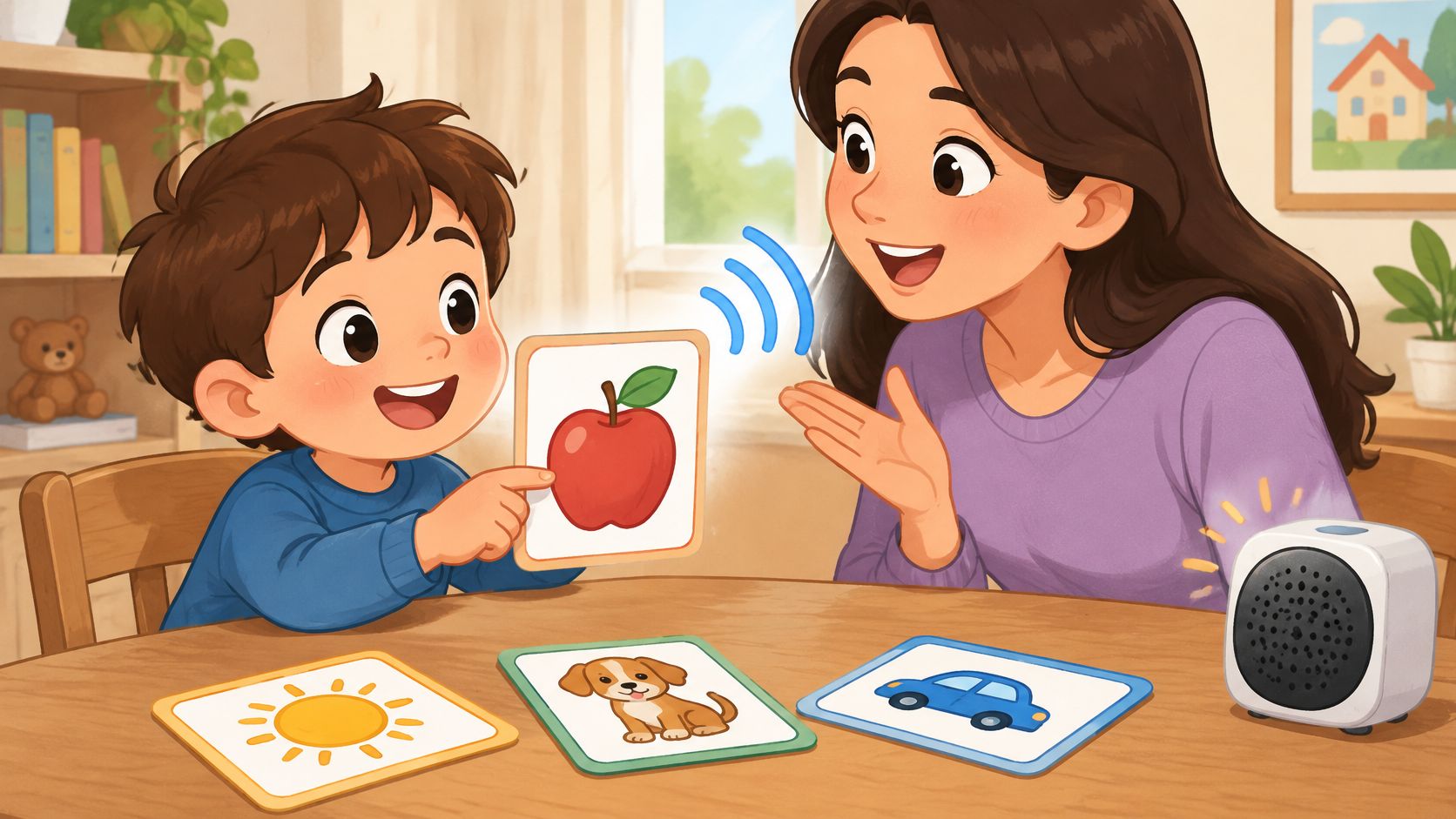
The apple is on the table. Next to it sit a cup and a spoon, and your child is watching you, waiting to find out what this is supposed to be. You speak a little English. You don't feel confident enough to teach it.
At this age, one clear word, one clear picture, and a prompt that doesn't need a fluent speaker to deliver work well. Audio visual support just means pairing something your child hears with something your child sees, so the meaning arrives through two doors at once. No curriculum, no screen and no perfect accent required.
Everything below can be run tonight with a pen, some paper and three objects from the kitchen. Some of it will work with a five-year-old who can't read a word; some of it is designed for a nine-year-old who is a complete beginner in English but reads confidently in another language. Those are different children with different needs, and the prompts change accordingly.
Five Audio Visual Activities to Try at Home
Start with what's already in the kitchen. Put an apple, a cup and a spoon on the table, or spend thirty seconds drawing those three things on a scrap of paper. Say apple clearly, once, then wait without repeating yourself. When your child points to the apple, the activity has already worked.
That's picture point, the simplest form of audio visual support there is. Every activity below keeps the same three parts: one short piece of English, one picture that matches it, one prompt from you. The five versions run from easiest to most involved.
| Activity | Audio cue | Picture cue | Parent prompt | Best for |
|---|---|---|---|---|
| Picture point | Say one word clearly, such as apple | One real or drawn apple among two other cards | Where is the apple? | Ages 5-6 |
| Mime bag | Say the requested word | Three hand-drawn picture cards in a bag | Show me the cat | Ages 7-8 |
| Song and action | Short English song with a clear chorus | Hand gestures for each word in the song | Sing it and do the action together | Ages 5-7 |
| Repeat after audio | Parent or recording says the word | Matching picture card held up | Say it after me | Ages 7-10 |
| Odd one out | Parent says three words | Three objects laid on the table | Which one is different? | Ages 9-10 |
Paper, a pen and everyday objects cover all five rows. Nothing needs printing, buying or downloading.
Rotating the same words across a week
Repetition works best when it doesn't look like repetition. Keep the same three or four words for a week and change the activity around them: picture point on Monday, mime bag on Tuesday, a song using those words on Wednesday, repeat-after-audio on Thursday, odd one out on Friday. British Council teacher guidance on how children learn recommends presenting the same vocabulary in different ways, for example listening to a song about a topic and then reading a story on that topic, and describes a word-bag activity where a child pulls out a card and mimes or guesses it.
By the end of a session, look for one of three things: your child points to the right picture, copies a word, or says the word before you prompt it. Any one of those means the ten minutes did its job.
For more variations built on the same logic, these listening games for kids at home pair one sound with one picture too.
Why Sound and Pictures Work Together
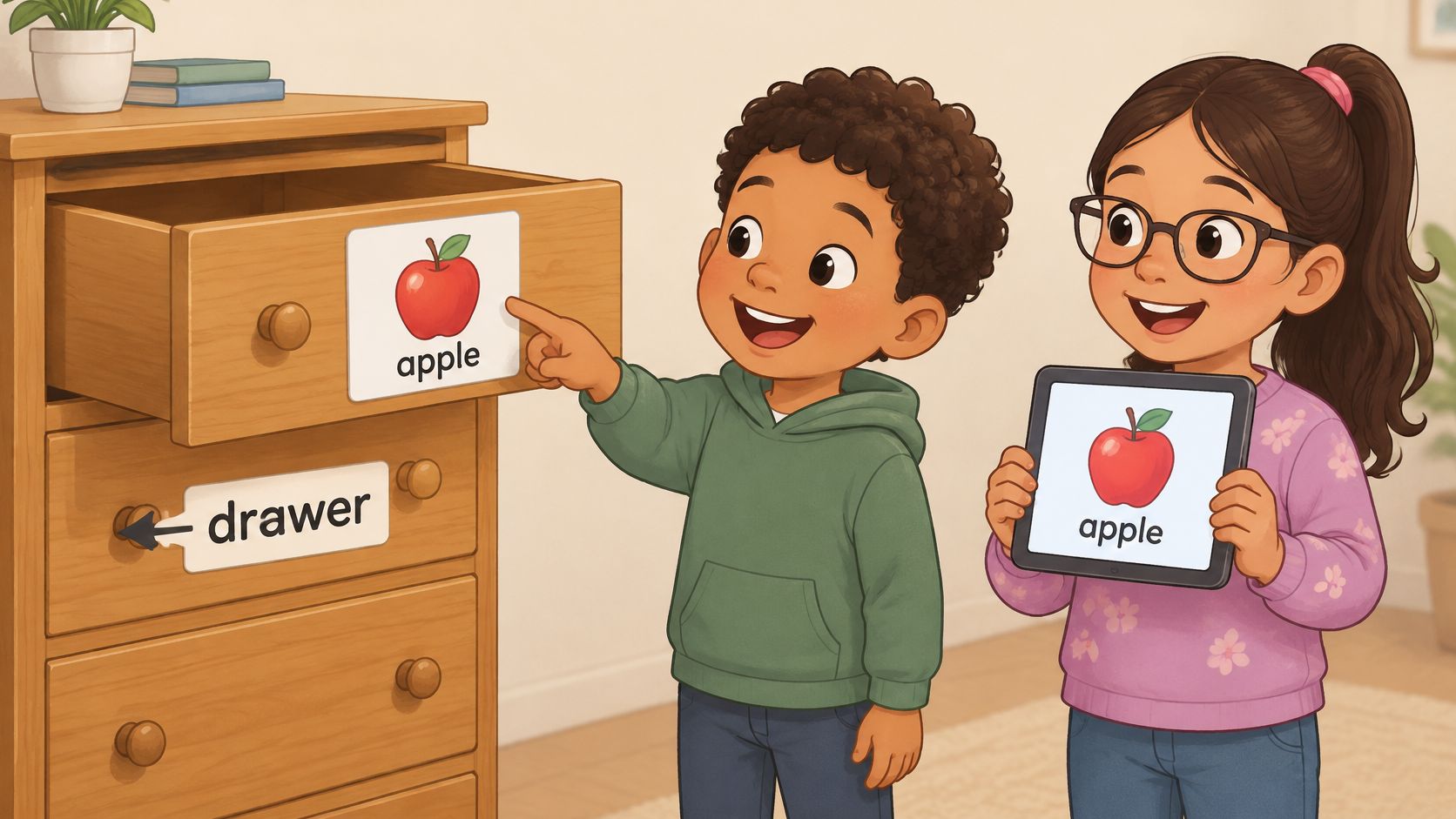
A label on a drawer only helps if you can see the drawer underneath it. Stack five labels on the same handle and you'll open the wrong one every time. Sound and pictures work the same way: the word is the label, the picture is the drawer, and your child needs both in one glance.
Beginners use whatever they can get as a clue to meaning. Pictures, movement, tone of voice and familiar words all help before a child understands the spoken sentence itself.
A seven- or eight-year-old in the middle of this is easy to spot. Watch the moment the word and the picture connect.
An observational study of 8 to 10 year olds learning English, published in ELT Journal, describes children repeatedly joining in with actions and sound effects, imitating language without being asked, and using images and familiar words to decode parts of a message they didn't yet understand.
The lesson for a parent is about pairing. Audio should sit tightly with a relevant picture or action, not play as a separate recording in the background while something else is happening. A short, clearly articulated clip matched to one unambiguous picture gives a beginner something solid to hold.
Say dog while showing a dog picture. Your child points. You say it again. Your child repeats it. That last step is the one parents skip, and it's the step that turns recognising a word into saying it.
Sound paired with a clear picture or action carries further than the early years, too. In 2024, 48.4% of surveyed children and young people said listening to audio helped them better understand a story or subject, according to the National Literacy Trust. A child who connects the word, the picture and the sound is building the link that memory depends on, and that connection doesn't require you to explain anything in English.
Keeping Each Picture Simple for Young Beginners
More colour, more animation, more pictures. It feels like more learning. Usually it's less.
Research on multimedia learning reviewed in Cognitive Research Principles and Implications reports that increasing visual support improved learning from combined audio and picture information but did not improve learning from audio alone. Lower language proficiency and reduced attention were associated with poorer recall when visual load was high. In other words, a relevant picture can reinforce a spoken word, while five images, three labels and a bouncing animation at the same time dilute attention and weaken recall.
Four rules follow from that, and they apply to a homemade card as much as to anything on a screen:
- One target at a time. Three words on the table, not twelve. Swap them out next week rather than adding more.
- Make the spoken word the loudest thing in the room. Say it clearly, once, and pause. Silence gives your child time to process.
- Choose plain, high-contrast artwork. A bold outline beats a detailed scene. If your child has to study the picture to find the object, the picture is working against the word.
- Skip the motion. A cat that jumps distracts from the word cat. Movement competes with the target object.
Take the comparison seriously. A card with one cat on it is easier to learn from than a page showing a cat, a dog, a ball, a hat and an animation of a bouncing ball. The second page looks richer and teaches less.
The five-second test: could your child point to the target within a few seconds without you explaining anything? If not, the picture is doing too much.
There's a second test worth applying. Audio has to make sense without reading, because an early reader may not decode written instructions at all. If your child can follow the spoken word alone, the design is right. If they need the caption, the audio is being propped up by text they may not read.
Three word cards shown one at a time will usually beat a busy poster of twelve. If you're drawing your own, browse classroom illustration ideas for simple, high-contrast art in the same style, so the pictures look consistent from card to card. For a word list to draw from, this guide to English vocabulary for kids stays with everyday nouns a beginner can point to.
How to Run a Ten-Minute Audio Visual Routine
Ten minutes, once a day, at roughly the same time. That's the whole commitment, and it's in line with what the British Council suggests in its practical tips for parents: plan English practice for about 10 to 20 minutes, adjusted to the child's ability to concentrate and their growing English. Ten minutes sits comfortably at the bottom of that range, which is exactly where a five-year-old beginner belongs. An older beginner can stretch it, but a short session that happens daily beats a long one that happens twice.
- Warm up for two minutes. Name familiar objects in the room together: chair, cup, window. This brings back words your child already knows, so the session opens with success rather than a test.
- Present three or four new words with pictures. Say each word twice while showing its picture, then once more while pointing. Keep the set small, because new words take up attention that pictures and prompts also need.
- Play one game from the activity table for three minutes. Mime bag or odd one out both work. The game turns listening into movement, which is what makes the word stick.
- Finish with one short song or picture book. Sing or read it, then say one word from the session on its own, without the tune around it. The ending gives the vocabulary a memorable repeat.
- Stop while your child still wants more. Note which word came most easily, and start there tomorrow.
Stop while your child still wants one more round. The ending you want is a request, not a sigh.
A fixed time slot and a shoebox that keeps the cards together make the habit survive a busy week. When the cards live in one place, setting up takes less time than the activity itself, and that's often the difference between doing it and not.
Don't worry about length. A good session ends with your child asking for another round, and a flat one ends early. Either is information, not a verdict on your teaching.
Your Role When English Is Not Your Strongest Language
Here's the reassuring part. Parent involvement doesn't mean constant teaching, and it certainly doesn't mean fluent English. It means simple prompts, repetition, praise and predictable stopping points. That's a role anyone can fill.
A 2025 study of 10 Malaysian parents of five- and six-year-olds, published in the Sultan Idris Education University journal, found parents associated English audiovisual content with gains in speaking, vocabulary, listening comprehension and spelling, while also stressing parental supervision and the need for complementary home activities. OECD guidance points in the same direction, describing co-viewing, choosing educational content and planning family media time as the things that help. None of those require you to speak English well. They require you to be in the room.
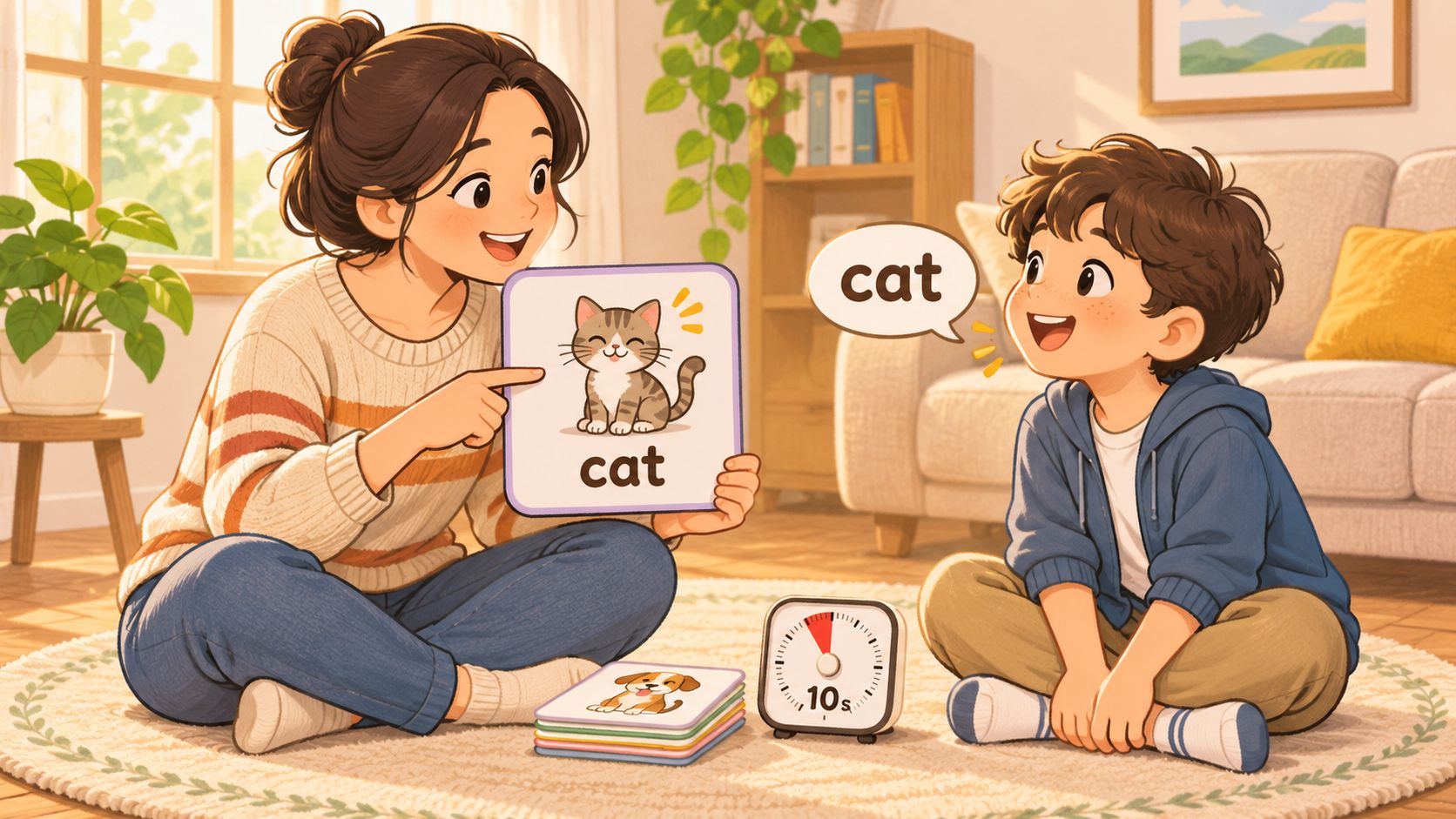
A young woman sits with a boy and one flashcard. That's the whole setup.
Four questions come up again and again, and each has a simple answer:
- When should the child listen? Let your child hear the word twice before you say anything. The audio does the first pass, and your voice is a second exposure rather than the source.
- Should you translate? Yes, a home-language word next to the English one is fine. It builds meaning fast, and the English word stays attached to the picture either way.
- How do you prompt without giving the answer? Ask "show me the one that says..." rather than naming the object. Your child does the retrieval work; you supply the frame.
- What if the answer comes in the home language, or not at all? Accept it, repeat the English word gently, and move on. Silence usually means the child is still processing, so offer two pictures to choose between rather than a third repetition.
A short set of prompts covers most sessions: "Show me the...", "Where's the...?", "Can you find...?", "Say it after me", "Which one is different?", "Your turn to ask me."
One more thing about age. A nine- or ten-year-old who is a complete beginner in English is still a beginner, but they are not a small child. They notice when an activity feels babyish, and they disengage fast. Keep the pictures plain, the pace brisk, and let them ask the questions too. Respect for their age and honesty about their English level can coexist.
For more on running this when your own English is shaky, this guide on how to teach your child English when you do not speak English covers the same territory in more depth.
Reading the Signs of Real Understanding
Understanding and repeating sound almost identical in a quiet room. They aren't the same thing, and you can tell them apart by watching what your child does with the word rather than how accurately they copy it.
British Council guidance on kids and listening suggests pre-teaching vocabulary with flashcards, asking children to point to pictures when they hear particular words, showing an image before listening so children can predict what they'll hear, and switching roles so the child gives the instruction. All four are observation opportunities, not tests. Watch what happens and adjust tomorrow.
| Observation | What it usually suggests | What to try next |
|---|---|---|
| Points to the right picture after the word is said in a new order | Understanding the word | Shuffle the cards and ask again |
| Repeats the word but cannot point to it | Copying sounds without the meaning | Go back to two-card matching |
| Uses the word in a silly new sentence | Using the word flexibly | Ask for one more sentence each day |
| Says the word only inside one song | Remembering the song rather than the word | Sing the song, then say the word alone |
| Answers in the home language but points correctly | Understanding before speaking | Accept the pointing and repeat the English word |
The last row matters most for beginners, and it's the one parents misread. A child who points correctly while answering in the home language has understood. Speech in English follows later, often months later, and pushing for it too early turns a comfortable activity into a performance.
Children move at different speeds, and a slow week isn't a warning sign. If a worry about your child's language or hearing persists across months and settings, that's a question for your child's school or a doctor, not for a game or an app.
Adapting Audio Visual Activities for Children Who Cannot Rely on Pictures
Audio visual practice assumes your child can use a picture. Some children can't rely on one, whether because of low vision, a visual-processing difference, or because images aren't available in the format they find easiest.
A 2024 review of 17 studies involving blind and low-vision school-age learners, published in ACM Digital Library, found that visual information was often not provided in the nonvisual format children found most useful. Videos without description were not enough. The learners themselves identified descriptive audio, tactile graphics and hands-on demonstrations as more equitable supports.
That gives a parent a straightforward set of swaps:
- Use a real object instead of a card. A small toy cat or a spoon does the job a drawing would do, and it can be held.
- Describe the picture before you say the word. "A round red apple, smooth and cool, that fits in one hand." Then say apple.
- Let your child touch the shape. Cut the outline from card so fingers can trace it while the word is spoken.
- Put real objects in the mime bag. Drawings are optional. A sock, a spoon and a toy animal work better.
- Describe what's on screen, sitting beside your child. If a video has no spoken description, you supply it in your own words.
- Ask which format helped most. Then keep using that one, even if it's the least tidy option.
Your job here is describer, not expert. If you have questions about how your child sees or hears, ask an eye-care professional or your child's school rather than working it out alone.
Try a Short Audio Visual Lesson Tonight
Three things carry almost all the benefit: one picture, one clear sound, one simple prompt. You don't need a plan beyond that to start.
For families who want a ready-made version of the same design, Talkio Kids is an iOS and Android app for complete beginners aged 5 to 10. Its short activities cover listening, picture matching, speaking and review, and Nox, a friendly alien guide through a space adventure, keeps the tone playful rather than test-like. Children start with vocabulary for familiar topics such as greetings, animals, colours, numbers, family and food, with pictures and audio making the meaning clear even for early readers. Every instruction and every word is spoken as well as written, and replaying audio is always one tap away.
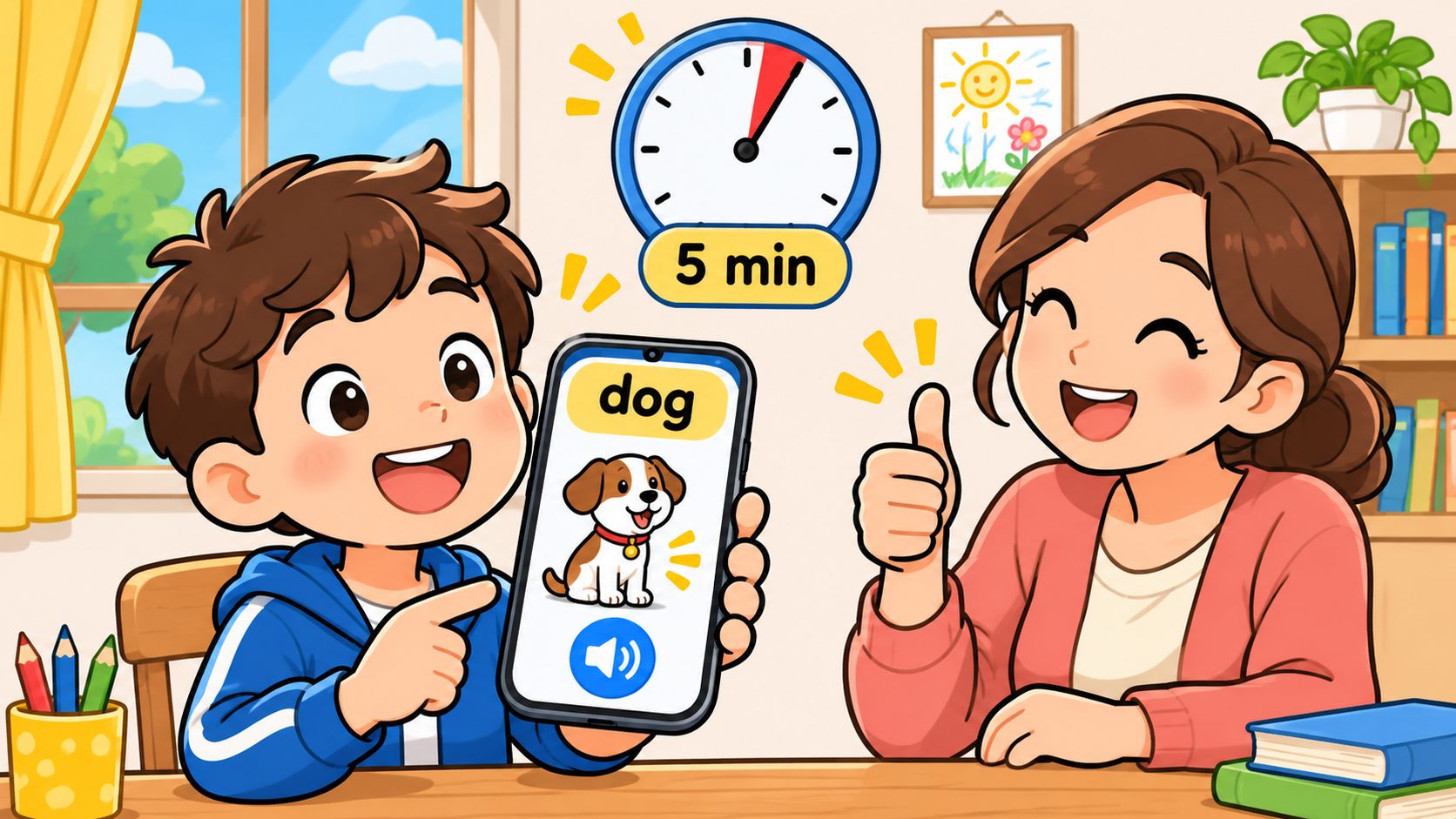
A happy boy holds up a phone showing a dog, and his mother leans in to look.
It builds basic everyday vocabulary and simple phrases, not guaranteed fluency, and that's the honest expectation to hold. Content works offline, progress stays on the device, and there are no ads, no open chat and no account signup, so a parent can hand over a phone without creating anything first. Monthly and annual subscriptions are available, with trial eligibility and current prices shown in the app.
Try the picture point routine tonight with an apple, a cup and a spoon. Then explore the app if a ready-made version of the same one-sound, one-picture approach would save you setup time. Talkio Kids is available on the App Store and Google Play.
Talkio Kids pairs each spoken word with a clear picture and a simple question, so a child can work out meaning before they can read a single instruction, and a parent can run a session without fluent English. It's built for complete beginners aged 5 to 10, with short listening, picture-matching, speaking and review activities led by Nox through a calm space adventure. Visit Talkio Kids to see how the lessons work and to start with one short session tonight.