
English learning at home
7 Playful Ways Kids Learn the Numbers in English
Discover 7 playful activities that help children ages 5–10 learn the numbers in English at home, with simple routines and practical tips for parents.
By Talkio Kids ·
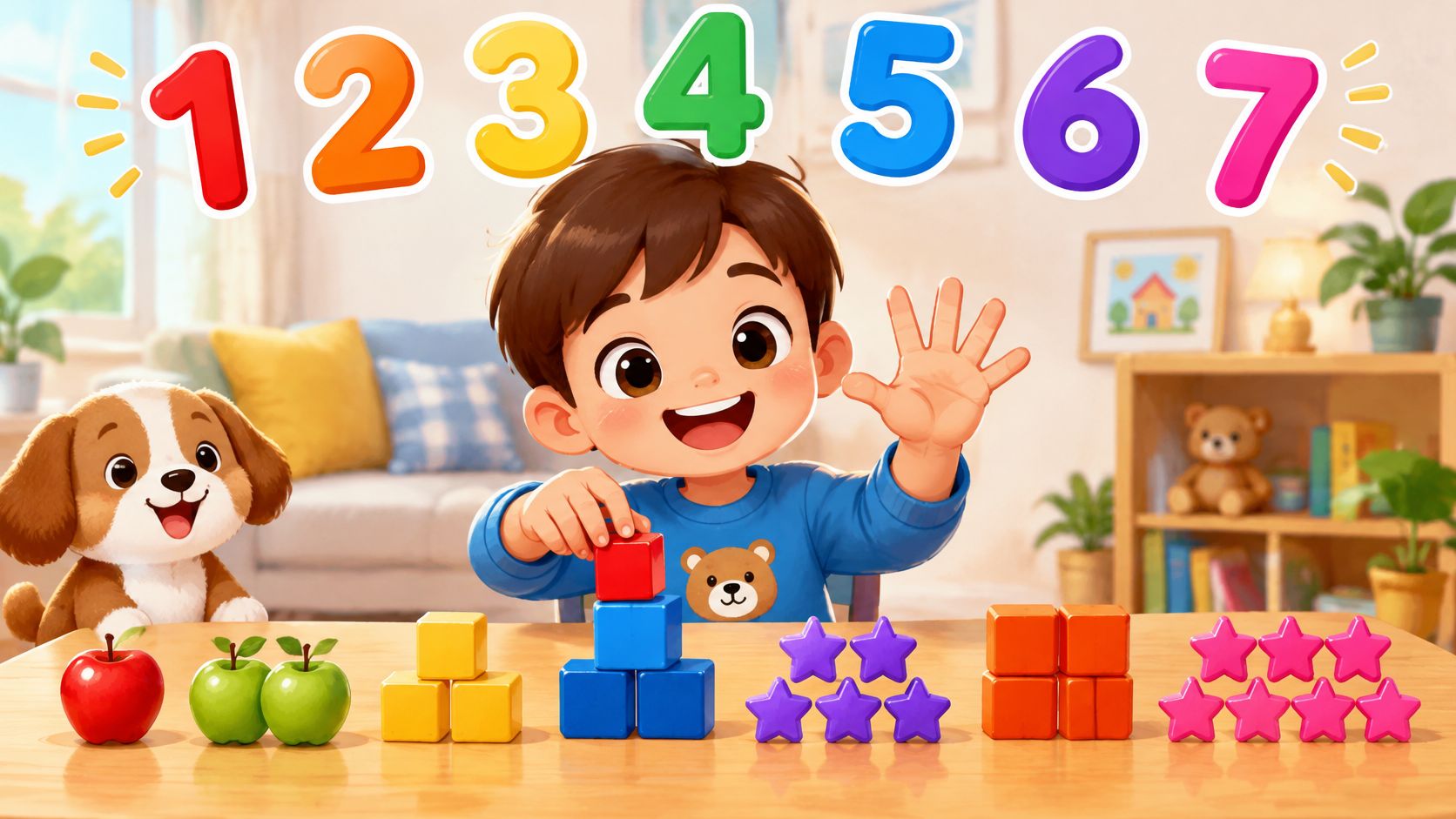
A parent and child stand in the kitchen during a five-minute break, moving apples into a bowl. The parent counts in English, and the child joins in, hesitates, then points to the next apple. There's no worksheet to finish, just a small job with a reason to count.
Number words make a practical first step in English because children encounter quantities during meals, games, shopping and play. Children aged 5–10 can learn the numbers through familiar activities, including older children who already understand the maths but are complete English beginners.
The activities below need little or nothing bought. Each includes adaptations for ages 5–6, 7–8 and 9–10, with language parents can copy. Families browsing family games from Very Special Games can also use familiar turn-taking routines as a starting point, while choosing themes that suit their child's age.
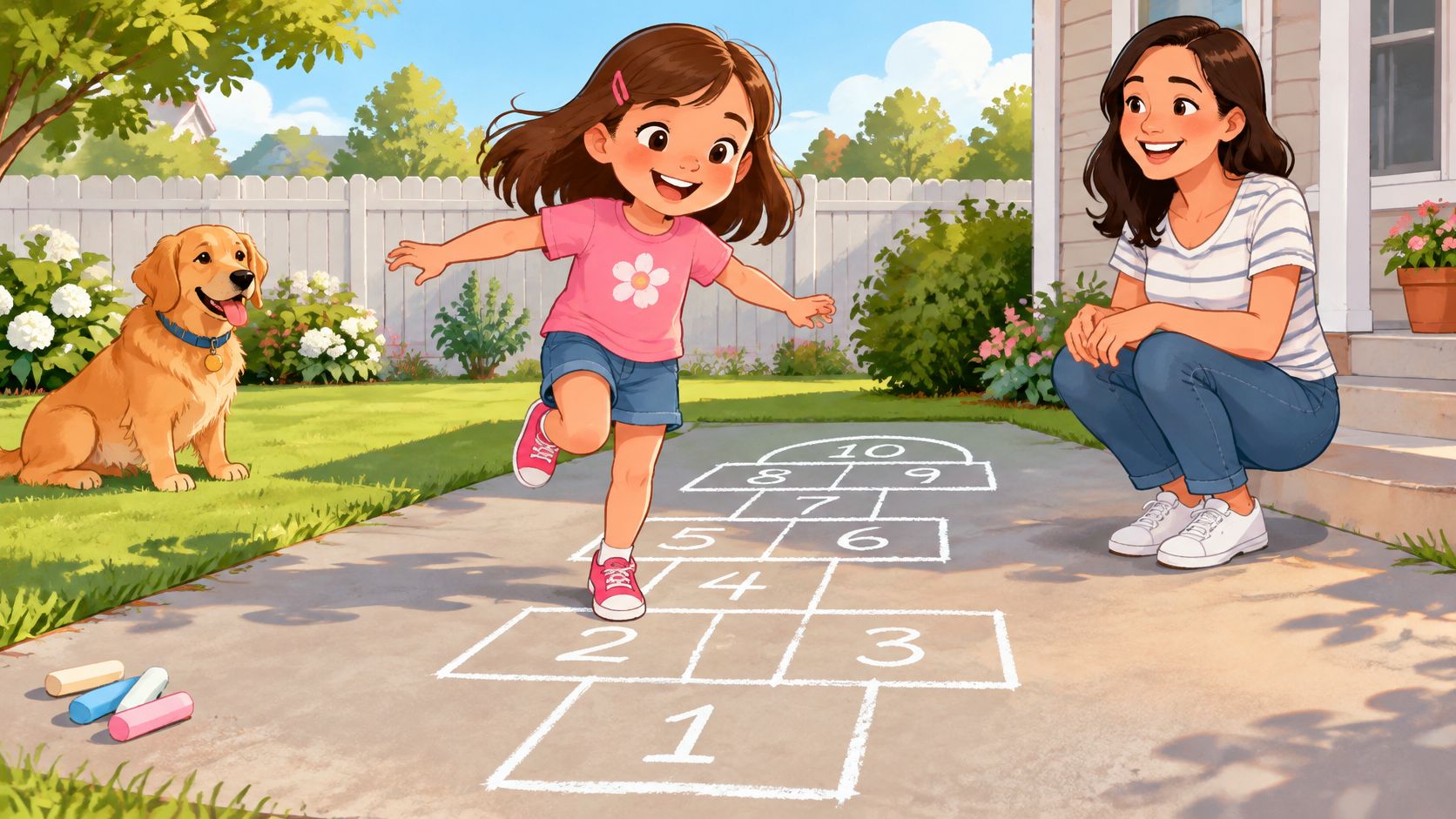
1. Number Hopscotch with English Counting
A chalk grid turns the pavement into a listening game. Indoors, securely attached floor tape can mark the spaces, or a paper grid can become a quiet version with fingers doing the hopping.
The parent writes numerals in order, demonstrates a move and says the matching English word. For example, the parent points to four, says four, then models the instruction Jump to four. A child who isn't ready to speak can land on the right space first.
Adapt the Grid to the Learner
- Ages 5–6: Start with a short run of familiar numbers. The parent says Jump to three, counts the jumps alongside the child, then invites the child to repeat three.
- Ages 7–8: Use numbers up to twenty if comfortable. Add Find twelve or Jump to the number after seven, demonstrating after with a pointing gesture.
- Ages 9–10: Make selected number stations up to a hundred rather than an enormous grid. Try Find thirty-five, followed by Find ten more when the English is familiar.
Older beginner doesn't mean advanced English speaker. A child may solve the number task immediately but still need the parent to model the English answer. Keep the maths comfortable while introducing unfamiliar language.
Practical rule: Change the speaking task before making the maths harder.
Once the child knows the routine, the parent becomes the jumper and the child becomes the caller. Stop while the game still feels enjoyable, especially if hopping becomes tiring.
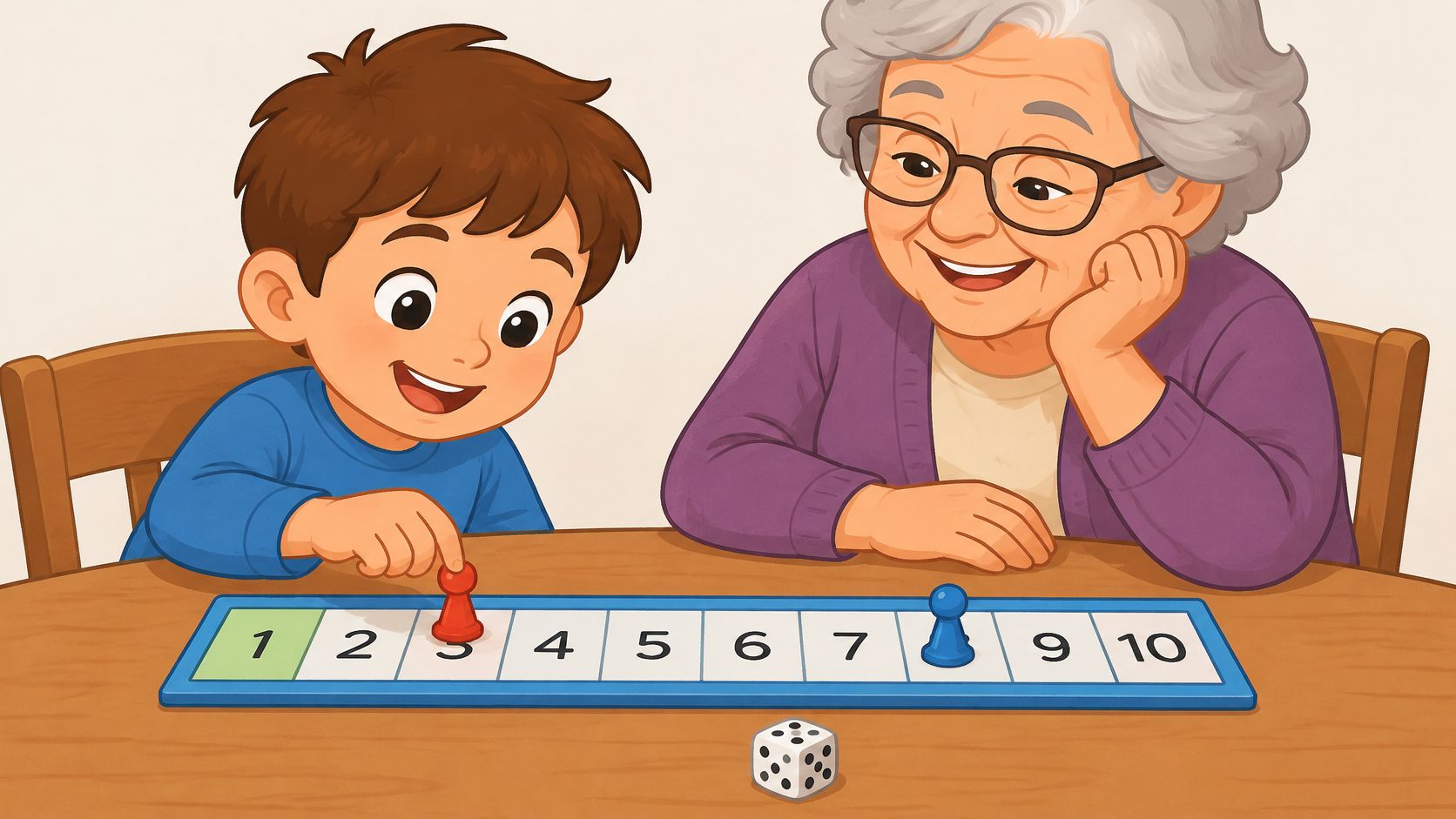
2. Linear Number Board Game (Roll, Move, Say)
A strip of paper, a die and a folded-paper counter are enough for a homemade board game. Draw an evenly spaced number track, give each player a counter and demonstrate a turn: roll, move, name the landing space.
The parent can count each movement aloud before naming the final number. Keep the counter's starting position clear so the child doesn't count the same space twice.
Keep the Game Familiar, Change the Language
For ages 5–6, a track ending at twenty provides room for a short game. The adult models Four. Move four, then helps the child name the landing space. A child can point while the parent supplies the word.
For ages 7–8, add a prediction before moving: What number is next? After landing, the child names the numeral and asks the adult the same question. Written words can sit beside unfamiliar numerals without becoming a reading test.
For ages 9–10, a longer track or a selected section of larger numbers can feel more age-appropriate. Try Move ten more or Which number is bigger?, but return to simple naming if understanding the instructions takes all the child's attention.
- Model turn-taking: Use It's your turn while passing the die.
- Offer a prompt: Point to the landing numeral and slowly begin its English name.
- Share the finish: Play towards a shared destination if racing creates frustration.
For example, siblings can use the same track while the younger child names a landing number and the older child names the number after it. Different language tasks keep both involved without requiring different equipment.
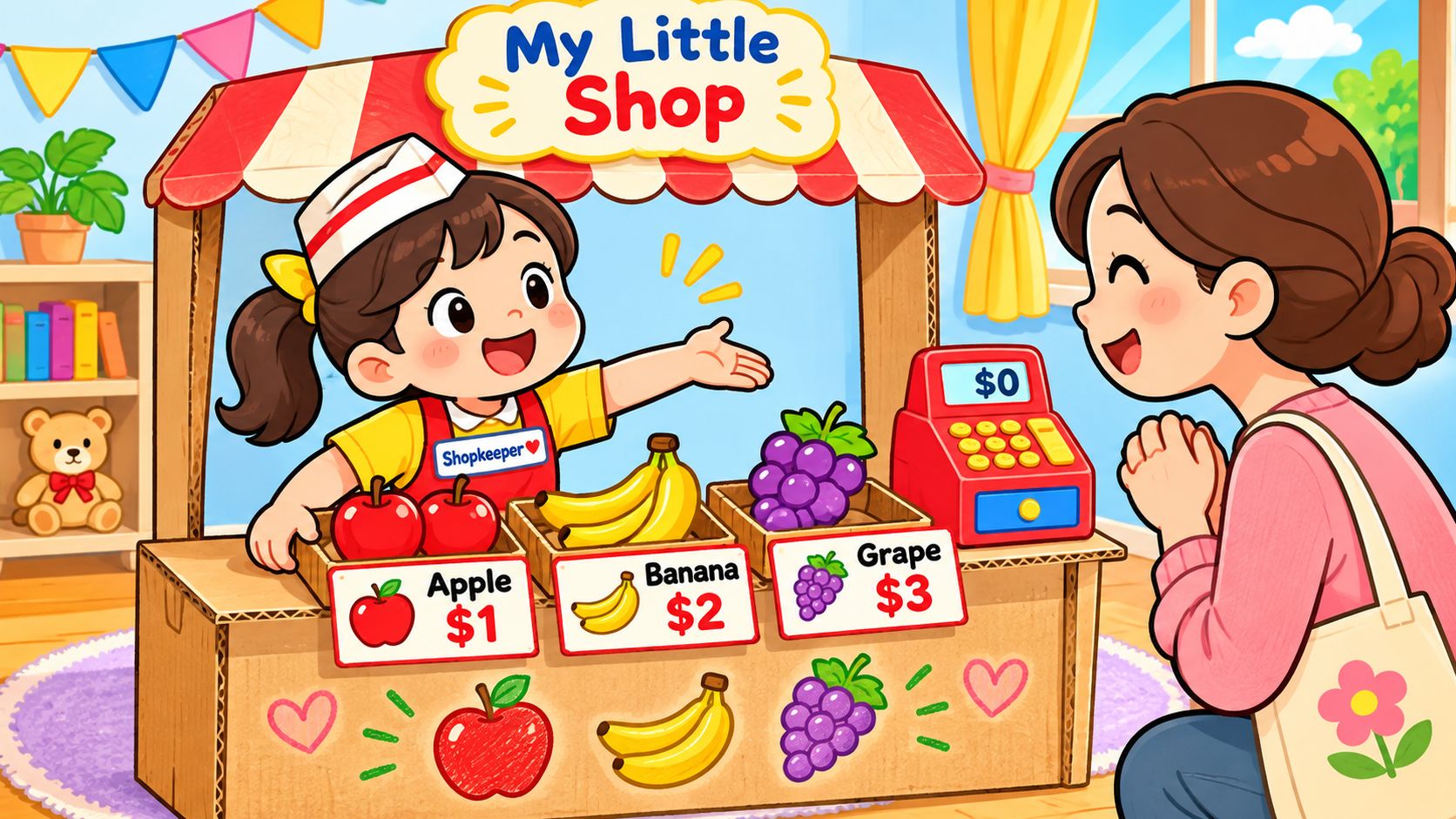
3. Shop-Till-You-Count Role Play
An empty cereal box becomes a counter, apples become stock and scraps of paper become price labels. The parent plays the customer while the child hands over the requested items.
Ask for a response rather than supplying every answer. A study described by Stanford's DREME network found that parent number prompts were associated with children using a wider range of number words during play. That's a reason to leave space after How many?, not a promise that every shopping game produces a particular result.
Build a Small Shopping Script
- Ages 5–6: The parent asks How many apples? and holds up fingers as support. The child selects the fruit, counts it and hears the adult model Three apples.
- Ages 7–8: Add How many, please? and Four, please. Swap roles so the child practises asking as well as answering.
- Ages 9–10: Add prices in the family's familiar currency. Model How much is it?, That's five, please and Here's the change, using paper money and comfortable sums.
Say an older beginner buys an item costing two with a paper note worth five. The parent can demonstrate Five minus two is three while moving the notes, then let the child repeat only the number words.
A correct answer in the home language can be followed by a calm English model. It doesn't need to become a correction.
Keep a phrase card beside the shop. Parents who aren't confident English speakers can use the same small script each time instead of inventing a conversation.
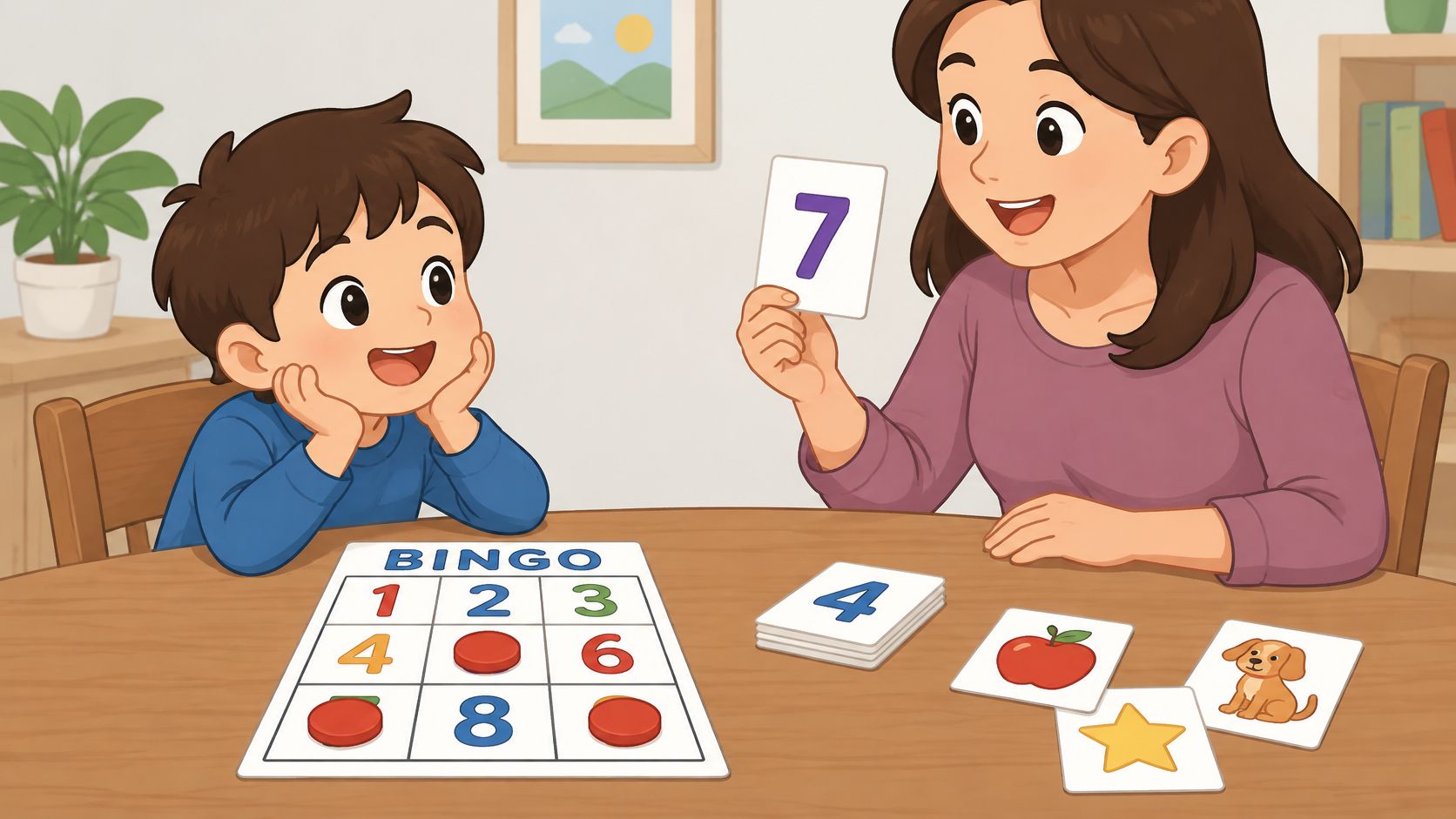
4. Number Bingo with Picture Cards
Bingo separates listening from reading. A parent calls an English number, and the child covers its numeral or a picture showing that quantity.
Draw a small grid on scrap paper and fill it with numerals, dot groups or simple objects. Make matching caller cards, shuffle them and demonstrate a turn slowly, allowing the child to point before speaking.
The British Council's getting-started guidance recommends picture-matching word games and explains that its games include audio for pronunciation practice. Homemade number bingo uses a similar match-the-meaning routine, with a parent supplying the spoken word.
Choose the Right Kind of Card
- Ages 5–6: Use countable dot groups or pictures of fruit. After Find five, the child touches each object and covers the matching picture.
- Ages 7–8: Mix pictures and numerals. The parent says Find fourteen, repeats it at a comfortable pace and invites the child to say fourteen back.
- Ages 9–10: Use larger numerals that the child already understands mathematically. Let the child prepare a themed card using sports scores, rocket labels or delivery numbers, then take the caller's role.
There's no need to race. If a child confuses unfamiliar number words, the adult can show the caller card, name it again and continue without removing a turn.
For example, an older beginner might recognise 30 immediately but need another English model before saying thirty. That's a vocabulary task, not evidence of difficulty with the quantity.
Paper bingo also packs easily beside the activities in this guide to English practice for kids while travelling.
5. Counting Rhymes, Finger Songs and Number Story Books
A counting rhyme doesn't need a performance. The parent can say the words gently, show the matching fingers and pause for the child to supply a familiar number.
Shared reading offers another setting for the same exchange. NAEYC's guidance on language and literacy development describes shared book reading that invites children to contribute words or answer questions, and explains how repeated read-alouds can support vocabulary and awareness of print.
Let the Child Choose the Format
Ages 5–6 may enjoy finger counting alongside a familiar rhyme such as One, Two, Buckle My Shoe. During a picture book, the parent can point to a group, ask How many? and count the objects together.
Ages 7–8 can create a dot picture inspired by Ten Black Dots by Donald Crews, or look for quantities in a library copy of Eric Carle's The Very Hungry Caterpillar. The parent can model Find three and What comes next?, with fingers or drawings supporting the answer.
Ages 9–10 can choose a comic-style counting story rather than a nursery rhyme. A child might draw a spaceship collecting supplies while the adult models Six boxes, then Two more boxes. Backwards counting can become part of the story if the words are already familiar.
Keep it age-respectful: An older child can need beginner English without wanting preschool songs or babyish pictures.
A homemade folded-paper book works too, so buying a title isn't necessary. The same listen, point and respond approach appears in these ideas for English-learning stories.
6. Card Games for Number Words (Snap, Go Fish and War)
Card games give children a reason to repeat number words without reciting a list. Use a playing-card deck with face cards removed and agree how aces will work, or make matching paper cards.
The British Council's English-games guidance includes picture-card games and turn-taking phrases as ways to organise vocabulary practice. Number cards can serve the same purpose when the parent keeps the rules and spoken exchanges simple.
Match the Game to the Child
- Ages 5–6, gentle Snap: Turn over cards slowly and name each numeral. When matching numbers appear, both players tap the pair and say the number together.
- Ages 7–8, simplified Go Fish: Deal a small hand and leave a draw pile. Model Any fours? while pointing to a four, then practise Yes or Go fish.
- Ages 9–10, number comparison: Each player turns over a card and names it. The player with the larger number collects the pair after saying a phrase such as Eight is bigger than five.
An older complete beginner can start with the shorter response Eight, while the parent supplies the full comparison. Larger homemade numerals can add interest later without making the English sentence longer.
Keep useful language visible. A scrap-paper reminder with Any fours?, Your turn and Go fish can reduce the pressure to remember everything at once.
For a cooperative version, both players work to find matching pairs rather than collecting the most cards. The same homemade deck can later join other English vocabulary activities for kids, with pictures replacing numerals.
7. Space Countdown and Alien Counting Adventure
A paper rocket waits on the table. The parent begins a countdown, the child joins the familiar part and both launch the rocket with a gentle push.
Add folded-paper aliens and a drawn planet for a second mission. The parent asks the child to move a quantity of aliens onto the planet, then checks the total together.
Keep quantity visible, not just the number sequence. The Encyclopedia on Early Childhood Development's early-numeracy guidance identifies understanding that the final counting word represents the total as a foundational skill. A child who can chant a countdown may still benefit from matching English words to actual groups.
Give Each Age a Mission
- Ages 5–6: Count down from ten with fingers for support. After landing, the parent says Find three aliens and helps the child count the paper figures.
- Ages 7–8: Add delivery instructions such as Put four boxes here. Ask How many now? after another box arrives.
- Ages 9–10: Offer mission cards with simple problems. For example, an alien has five supply boxes and collects three more; the child moves the pictures before answering Eight boxes.
Older beginners can plan the mission while the adult supplies short English instructions. Counting backwards in twos or fives is an optional maths extension, not a requirement for practising English.
If the child answers correctly by pointing, the parent can acknowledge the choice and model the words. Let the child direct the next launch when ready, using the same manageable phrases rather than a longer speech.
Seven number-practice activities at a glance
Each band changes the phrase, not the game: ages 5–6 can repeat six, ages 7–8 can answer It is six, and ages 9–10 can use a fuller turn such as I have six or Take six.
| Item | Best Age Range | Main Skill Practised | Setup Needed | Typical Session Length |
|---|---|---|---|---|
| Number Hopscotch with English Counting | 5–10 | Number recognition and counting aloud | Chalk, tape, or paper; clear space | About 5 minutes |
| Linear Number Board Game (Roll, Move, Say) | 5–10 | Number order and magnitude | Number track, counter, and die | About 10 minutes |
| Shop-Till-You-Count Role Play | 5–10 | Counting, prices, and everyday phrases | Household items, price labels, and optional play money | Up to 15 minutes |
| Number Bingo with Picture Cards | 5–10 | Listening for and saying numbers | Homemade bingo and number or picture cards | About 5–10 minutes |
| Counting Rhymes, Finger Songs and Number Story Books | 5–10 | Number order, counting, and listening | No materials; optional counting book | About 5 minutes |
| Card Games for Number Words (Snap, Go Fish and War) | 5–10 | Number words, questions, and comparison | Standard or homemade number cards | About 10 minutes |
| Space Countdown and Alien Counting Adventure | 5–10 | Counting backwards and number problem-solving | Optional paper or household props | About 5–15 minutes |
Pick One Activity and Make It a Five-Minute Routine
One familiar game is enough to begin. A parent can choose the activity that fits the child's energy, repeat it daily for a week and keep the English phrases predictable.
A lively child might prefer hopscotch after school, while another might choose quiet cards or a paper space mission. As confidence grows, the child can become the caller, customer or mission leader, with the parent remaining available to model unfamiliar words.
A useful stopping point: End after an enjoyable turn, rather than waiting until the child is tired of the game.
Progress doesn't have to mean bigger numbers. A child may move from pointing, to repeating, to naming a quantity independently, while working with exactly the same objects.
For families choosing an app alongside these games, Talkio Kids offers short listening, picture-matching, speaking and review activities for complete English beginners aged 5–10. It builds basic everyday vocabulary, including numbers, and simple phrases through a space adventure with the alien companion Nox, rather than promising fluency.
Audio and pictures support early readers, learning content works offline, and progress stays on the device. There are no ads, social features, open chat, open-ended AI conversations or account signup; monthly and annual subscriptions are available, with current prices and any trial eligibility shown in the app.
Parents can explore the app and download options, including the App Store and Google Play. For more activities using familiar household materials, the home-learning blog offers further ideas.
Talkio Kids offers short, audio-led English activities that connect number words and everyday vocabulary with pictures and speaking practice. Parents looking for a structured companion to these homemade games can visit Talkio Kids and explore a beginner-friendly space adventure with Nox.