
English learning at home
English Practice for Kids While Travelling: 7 Easy Ideas
Looking for English practice for kids while travelling? Try seven low-pressure, offline games and routines for ages 5–10, from I Spy to picture bingo.
By Talkio Kids ·

A six-hour train ride, a restless seven-year-old, and a tired adult beside them. That scene is ordinary on family journeys. English practice for kids while travelling does not have to mean worksheets or a sit-down lesson. The seven ideas below use what is already around you, such as the window, the seat, and the ticket queue, to build listening, simple words, and speaking confidence for children aged 5 to 10.
Nine- and ten-year-olds can be complete beginners too. English level is not the same thing as age or reading skill, so each game comes with a simpler path for ages 5 to 6, then separate adjustments for ages 7 to 8 and 9 to 10. Most games need no materials at all, and you can stop the moment the queue moves. One idea is a short app routine that works offline, which earns its place on planes and trains with no signal.
None of them promise fluency.
A roomy bag still helps for a book, a snack, and a spare jumper. If you are still choosing one, this guide on how to choose a travel tote covers the practical points. The 2025 U.S. Family Travel Survey found that 74% of parents reported that their children aged over 7 loved to travel. Use that interest. Pick one or two ideas, not all seven.
1. I Spy in English on the Go
One person secretly picks something everyone can see, then says, "I spy with my little eye something that is red." The others guess in English. A bus, a tree, or a red car is enough. The game needs no cards, and it works on trains, buses, and in waiting rooms.
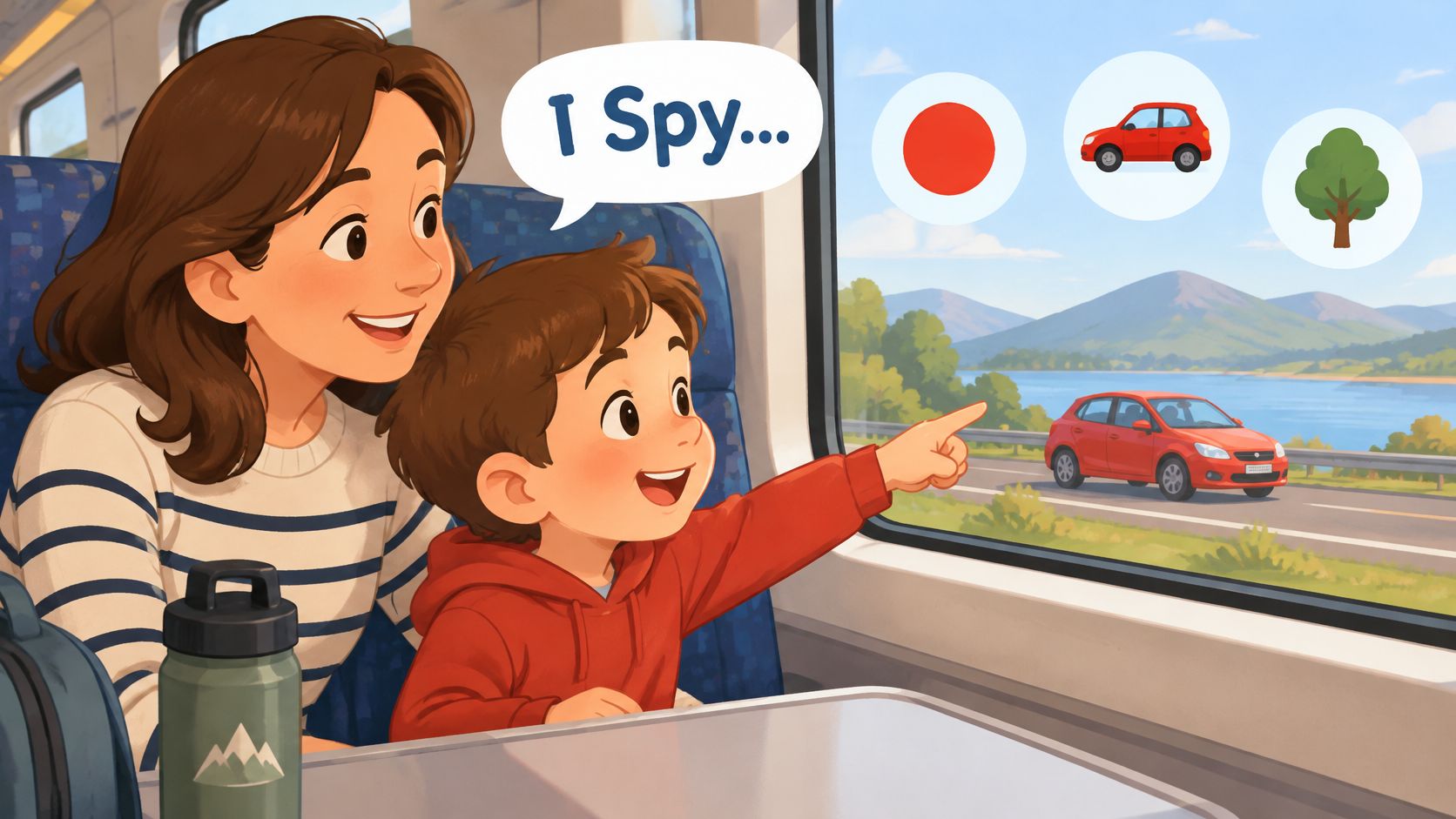
Say a family is on a long train ride. They take turns naming colours through the window. At an airport gate, a grandparent and two children start with single-word answers only. The adult models the full sentence first, then hands the turn to the child. That builds listening for colours, shapes, and everyday nouns without a quiz feel.
Let older beginners run the clues
Ages 5 to 6 do best with colours and one object word. Ages 7 to 10 can be the spy. Giving the clue builds independence, and a nine-year-old beginner is not "too old" for a looking game if the English is still new.
- Start small: Colours and simple objects come before sentences such as "It is big" or "It has wheels."
- Model, don't mark: Repeat the answer in a full sentence so the child hears correct English without a harsh correction.
- Stop cleanly: One colour round is a finished session. There is no need to play until someone is bored.
Practical rule: If the child answers with a point or a home-language word, accept it, then say the English word once and move on.
The trade-off is noise and repetition. In a quiet carriage, whisper the clues. The game fails when the word list jumps ahead of what the child can hear.
2. Window Word Hunt
Children look outside and say the English name of what they see. Before you leave, pick five to eight words only, such as tree, bridge, sheep, bus, or bicycle. Each find gets a tick on a small paper list. Real places make the words easier to remember on a long day, and a short list beats a poster of every noun in town.
A seven-year-old can tick bridge, river, and cow on a countryside train. On a city bus, a parent can draw five simple icons so an early reader follows pictures, not print. Say each word first, then ask for a repeat. For ages 9 to 10 who are beginners, add a short note after the find, such as "The bus is blue," rather than treating the hunt like a toddler game.
Keep the list smaller than the view
The Eurostat figures on language learning in primary education show that in 2024, 82.5% of primary-school pupils across the European Union were learning English as a foreign language. A window hunt is a light way to reuse words many children already meet at school, not a new curriculum.
What does not work is a list of twenty items, or expecting a child who cannot read yet to manage written labels alone. Pictures, or the adult reading the word aloud, keep the hunt fair. If the scenery outside is a tunnel, switch to objects in the carriage and end the round.
3. Read-Aloud Picture Books with Audio
Eric Carle's The Very Hungry Caterpillar, first published in 1969, is a clear example for beginners. Counting, days of the week, and food words repeat in a pattern a child can join. On a flight, read it once without stopping. On the second round, play a story audio and pause so the child says the repeated foods.
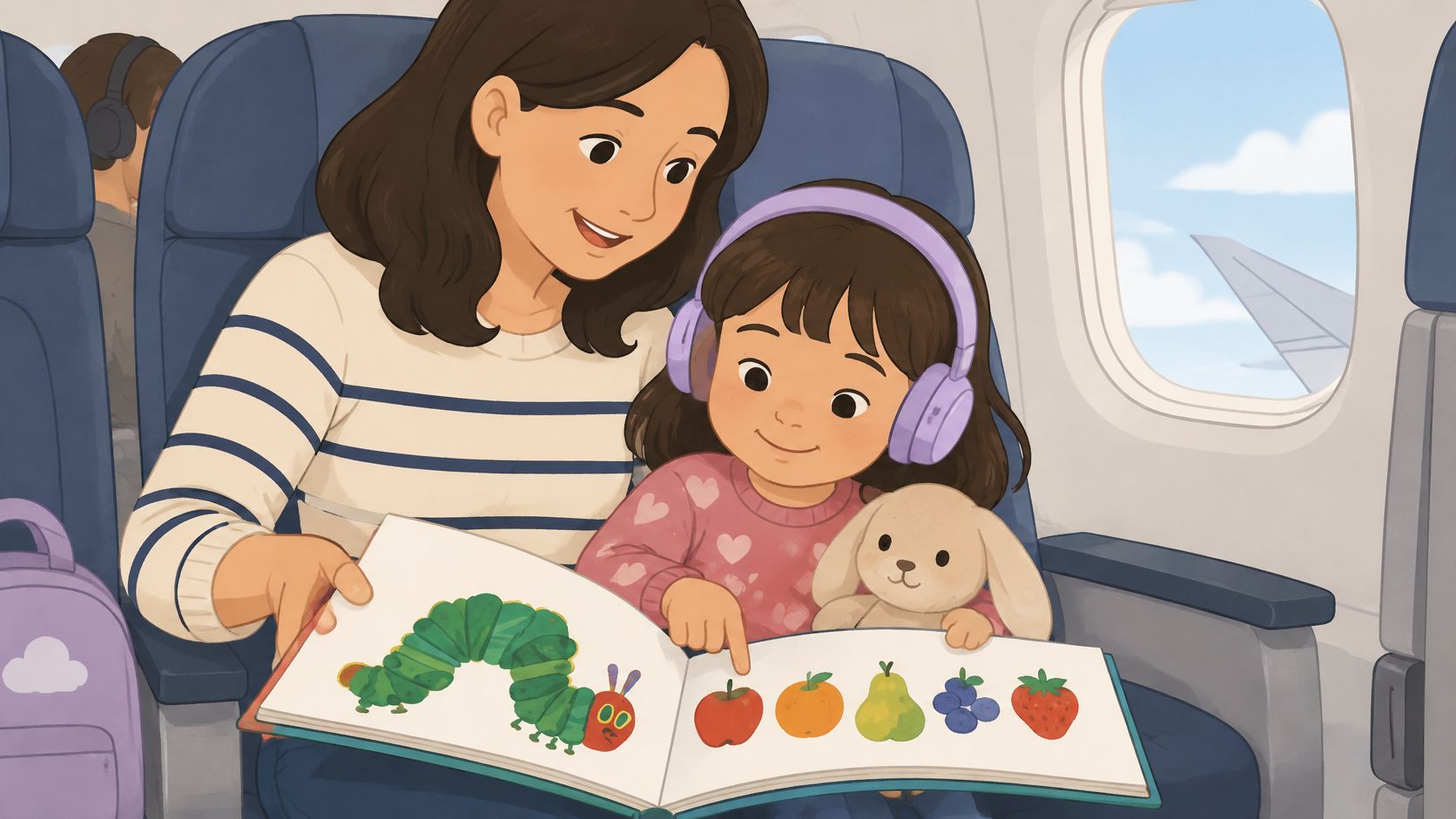
A nine-year-old who is a complete English beginner can follow the pictures and repeat food names without being treated as a preschooler. Choose strong pictures so meaning shows up without a translation of every line. For ages 9 to 10, pick a book with a slightly older theme, still with short repeated lines, rather than a baby-style board book. Ages 5 to 6 can stay with one repeated chorus and actions.
The British Council's practical tips for parents suggest warming up with a familiar rhyme, adding one new rhyme, and inviting the child to join with actions or words when ready. The same shape works for a story. Familiar line first, one new phrase next, then a chance to answer.
More story ideas for short sessions sit in this guide to English learning stories. Audio helps early readers hear pronunciation, but a second screen with unrelated video pulls attention away. One book, two passes, then close it.
4. Simon Says with Travel Actions
Children move only when the leader starts with "Simon says." Try "Simon says touch your nose," "Simon says clap your hands," or "Simon says show me the window." Listening and body words come before any need to speak, which helps shy beginners.
A family can play in a hotel lobby to use energy before dinner. A tutor can use the same five commands as a warm-up with young beginners, then stop. Start with five or six actions. Add more only after the rule is solid. Let the child lead once they can give the instruction. In shared spaces, keep actions small and quiet.
Screens often feel like the easy option on a journey, yet a two-minute listening game can do the same job of filling a wait without another video.
The Family Travel Association's 2025 survey report notes that more than 60% of parents believe screens make travelling with children easier, and that screens were considered especially useful in cars (86.2%) and in airports or airplanes (52.2%). Nearly 60% also supported specialised summer screen-time guidance. Simon Says is the no-materials alternative when you want a boundary.
The trade-off is space. A full carriage is a bad place for jumping. Swap big moves for eyes, hands, and pointing. If the child copies every command, including the ones without "Simon says," treat that as listening practice, not a loss.
5. Travel Vocabulary Picture Bingo
Draw a four-by-four grid with simple travel pictures. Bus, bag, ticket, hotel, boat, suitcase, map, and train are plenty. The caller says each word. The child covers the matching picture. The image carries the meaning, so little or no reading is required, and paper works with the phone switched off.
Two siblings, aged six and nine, can play in a station with hand-drawn grids. A tutor can use printed cards with a small beginner group. Use eight to twelve travel words so the round stays short. Show the picture as you say the word. Once the words are familiar, let the child be the caller. A 9- or 10-year-old beginner can run the grid for a younger sibling, which is a better fit than a babyish prize chart.
Match the round to real app time
Qustodio's device-usage research, covering more than 400,000 family homes across the United States, United Kingdom, France, Spain, and Australia, found children spent an average of about 6 minutes per day on educational apps, while language-learning apps averaged approximately 8 minutes daily. A bingo round should finish inside that kind of window.
- Draw, don't buy: Icons on a napkin are enough.
- One winner, then stop: A second card is optional, not a requirement.
- Skip the fine print: If the child cannot read "ticket," the picture is the answer.
What fails is tiny clip art nobody can see on a moving bus, or mixing in grammar the child has never heard.
6. Role-Play Ordering a Snack or Buying a Ticket
Short role-play gives a clear reason to speak. Practise "Can I have a juice, please?" or "One ticket, please." One adult or sibling plays the shopkeeper. The same three or four phrases come back in a predictable place, which makes them easier to hold.
A nine-year-old can rehearse a café order before the family goes in. A parent and child can practise a museum counter in the queue. Swap roles so the child also plays the shopkeeper. Praise the attempt, not perfect pronunciation. Ages 7 to 10 often like the acting. Ages 5 to 6 can stick to one line and a point at the picture.

Parents who are not confident English speakers can still help. Hear the phrase, match it to the juice or the ticket, repeat it together, and celebrate recognition. You do not have to translate every word. A fuller set of lines is in this guide to English conversation for kids.
The 2023 Eurobarometer survey of 26,523 people across all 27 EU Member States found that 42% identified using a new language on holidays abroad as a benefit. A three-line script is a realistic slice of that benefit. A long dialogue, or correcting every sound in public, usually shuts the child down.
7. Five-Minute Offline Listening and Speaking Routine with Talkio Kids
Five spare minutes in a departure lounge is enough for this routine. Talkio Kids is an iOS and Android app for complete beginners aged 5 to 10. It builds everyday vocabulary and simple phrases through short listening, picture-matching, speaking, and review steps, while Nox, the alien companion, runs a space journey that gives children a reason to keep exploring.
Download it before the trip, then open a lesson with the network off to check. Every lesson, picture, and recording ships inside the app, progress stays on the device, and no account or sign-in is needed. There are no ads, social features, open chat, or open-ended AI conversations, and purchases sit behind a parent gate. One session fills a wait on a flight, and the same words can come back later beside a window hunt or a bingo grid.
The Vodafone Foundation report on parents and devices found home access to devices for educational content ranging from 83% to 90% across surveyed countries, with a global figure of 86%. Access is not the same as learning. Offline audio and pictures matter more than a live connection in a tunnel.
What to check before you rely on it
The British Council's guide to online resources and apps describes children's materials that mix games, listening, speaking, reading, and parent guidance, and it treats safe, ad-free use as something parents should notice. Use that as a checklist, not as a score for any one app.
- One short session: About five minutes, then back to the journey. Audio replays whenever the child needs it, so a missed word is one tap away.
- Early readers: Every instruction and every word is spoken as well as written, so pictures and audio carry the meaning when reading is still hard.
- Older beginners: Ages 7 to 10 can replay a word and try the speaking step without a parent teaching grammar. Speaking is recognised on the device, and if the microphone is declined or unavailable, the child taps to self-assess instead.
- Before you pay: A new profile needs an active Premium subscription, with monthly and annual options. Trial eligibility and current prices are shown in the app, not as a fixed public rate.
A wider look at options is in this guide to offline English learning apps for kids. Talkio Kids is an educational aid rather than a school or tutoring service, and it does not guarantee a particular learning outcome. Treat it as a spare routine for a wait, not a replacement for looking out of the window together.
How the seven travel activities compare
| Item | Materials needed | Main skill built | Best travel setting |
|---|---|---|---|
| I Spy in English on the Go | None; use visible surroundings | Listening and everyday vocabulary | Trains, buses, or waiting rooms |
| Window Word Hunt | Paper checklist with words or pictures | Vocabulary linked to real-world objects | Journeys with things to spot outside the window |
| Read-Aloud Picture Books with Audio | Picture book; audio device if using audio | Listening and speaking through repeated phrases | Flights or other journeys with time to read |
| Simon Says with Travel Actions | None | Listening comprehension and action vocabulary | Train seat areas or waiting lounges with room for gentle actions |
| Travel Vocabulary Picture Bingo | Paper grids or picture cards and a pen | Listening and picture-word matching | Train stations or journeys with a small group |
| Role-Play: Ordering a Snack or Buying a Ticket | No special materials; optional menu or ticket context | Speaking confidence and practical phrases | Before visiting a café, shop, or ticket counter |
| Five-Minute Offline Listening and Speaking Routine with Talkio Kids | Device with the app and offline content downloaded | Listening, speaking, and basic vocabulary | Flights, long journeys, or places with weak internet |
Pick Two Ideas, Then Keep the Journey Light
A five-minute I Spy round plus one snack role-play is enough for a travel day. Choose two activities, keep each one short, and praise the try more than the accent. Stacking every game from this list usually means the child is done before the games are.
Match the pair to your child's patience. For ages 7 and 8, pick one spotting game and one activity with audio or pictures, so new words stay anchored to something they can see. For ages 9 and 10, one game plus the role-play tends to work better, since they can handle full phrases like "Can I have..." and do the ordering themselves at a café or ticket counter.
If you would rather not invent a game, Talkio Kids gives complete beginners aged 5 to 10 the same kind of short routine. Nox guides children through a space journey while they hear English, connect words with pictures, and practise saying them aloud, with no previous English needed. Lessons, pictures, and recordings work offline, progress stays on the device, and no account or sign-in is needed. New profiles need an active Premium subscription, and eligible new subscribers can try the complete course free for seven days, with trial eligibility and current prices shown in the app. Talkio Kids is an educational aid rather than a school or a promise of a set result.
Pack for the child as carefully as the language practice. A hungry child will not stay with bingo, so the Rip Van guide to trip-ready snacks is a useful companion when you are planning what fits in a bag. Then leave room for quiet, a window, and a full stop whenever the child has had enough.
For an offline option that matches these short sessions, visit Talkio Kids and choose a subscription inside the app if it suits your family. It keeps English practice for kids while travelling brief, calm, and free of ads or a required account.