
English learning at home
Language Learning for Kids: How Parents Can Start at Home
Language learning for kids made simple: short home routines, playful word games, read-alouds and tips for choosing a beginner English app.
By Talkio Kids ·
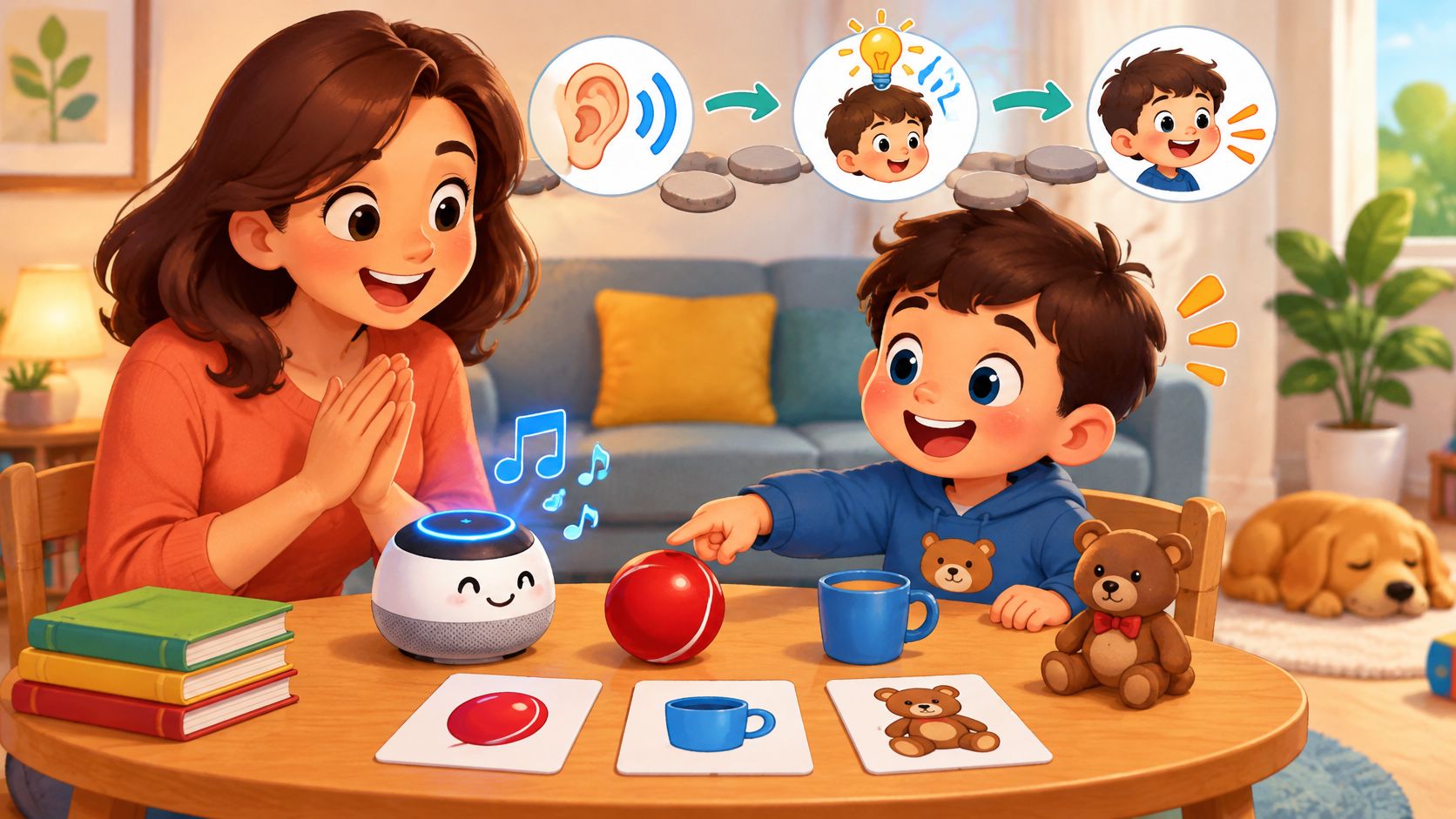
A child taps the right picture when an English word plays, then goes quiet when a parent asks for the word aloud. The parent wonders whether anything is sticking, especially when their own English feels uncertain. Another family may have an older child who reads confidently in the home language but is starting English from the beginning.
Neither situation calls for a fluent parent or a cupboard full of teaching materials. Language learning for kids can start with a familiar object, clear audio and an adult willing to listen. The useful starting point is a small routine that helps the child understand, respond and gradually try words independently.
How Children Build English From Listening First
English is already a mainstream part of primary education. Eurostat reports that 82.5% of pupils in EU primary education were learning English in 2024, showing that it isn't a niche enrichment subject.
At home, though, the first priority isn't keeping pace with a statistic or completing a grammar book. It's helping a child connect an unfamiliar sound with something meaningful.
Learning a language resembles finding a way around a new neighbourhood. A newcomer notices the playground, the shop and the familiar doorway before being able to give directions. Likewise, a beginner may recognise apple and point to it long before producing a sentence about it.
What Early Progress Can Look Like
Parents can watch for different kinds of participation rather than expecting speech immediately:
- Recognising meaning. The child hears a word and looks towards the matching object or picture.
- Offering a word. A familiar picture prompts an answer such as cat, perhaps after a pause.
- Trying a combination. The child begins using a short phrase such as red car or a big dog.
These aren't fixed steps that every child completes neatly. A child might repeat a whole phrase from a song while still needing help recognising its individual words.
Age isn't the same as English proficiency. A child aged nine can need the same introductory vocabulary as a child aged five, without needing the same presentation. The older beginner can choose the topic, control audio replay and use written labels when those labels help.
Practical rule: Understanding counts as progress, even before a child is ready to speak.
Listening first doesn't mean keeping children silent. It means offering a clear model and an understandable context before requesting an answer. The foundations are meaning before grammar, repetition across the week and short sessions that finish with success.
A Weekly Home Routine for Ages 5 to 10
| Age group | Sessions per week | Session length | Core activity | Parent's role |
|---|---|---|---|---|
| Ages 5–6 | 5 sessions | About 5 minutes | Point to picture words and repeat them | Say the word, then let the child point |
| Ages 7–8 | 4 sessions | About 8 minutes | Listen to a short picture book and answer with one word | Pause, then offer a choice of two |
| Ages 9–10 | 4 sessions | About 10 minutes | Play a clue game and say three short phrases | Ask a question and wait for the answer |
These are suggested starting points, not tested prescriptions or age-based requirements. Audio can supply the spoken model whenever a parent isn't comfortable saying a word. An older beginner may prefer a shorter session initially, while an interested child may ask for an extra brief turn.
The reason for spreading practice across the week is practical: the child gets more opportunities to meet familiar English in different situations. A study of early child second-language acquisition published in the Journal of Child Language found that input quantity was an important predictor of outcomes in the English/Dutch children studied, appearing more important than starting age for the outcomes examined. That doesn't make age irrelevant or establish an ideal session length.
A Sample Week With Familiar Words
A family could choose a small set of food words and use the following pattern. Families following a lighter schedule can combine activities or leave a day clear.
- Monday, picture words. Use food packaging, drawings or actual fruit. Play or say each English word while the child points to the matching item.
- Tuesday, a song. Choose a simple song containing familiar vocabulary. The adult can join through gestures rather than having to sing confidently.
- Wednesday, a colour game. Sort objects into colour groups, then add a useful combination such as red apple. The familiar noun now has a practical partner.
- Thursday, a read-aloud. Look through a picture book or short illustrated text. Pause when a familiar object appears and allow the child to identify it.
- Friday, favourites and recall. Let the child choose an activity to replay. Before providing the audio, offer a chance to name a familiar object independently.
The activities change, but the vocabulary stays manageable. Replacing every word each day creates novelty without giving the child much opportunity to use what has already appeared.
How to Finish and Check Progress
Stop before the child becomes tired or frustrated, ideally while another turn still sounds appealing. Close with a word the child can say independently, or offer a model if that day's speaking feels difficult.
At the end of the week, check whether the child recognises most of the chosen words without a gesture giving away the answer. Then invite the child to say them before replaying the audio. Independent recall and repeating after a model are different achievements, so notice both without treating either as a pass-or-fail test.
If most words still need help, keep them for another week. A missed day doesn't require a longer catch-up lesson.
Vocabulary Games You Can Play With Household Objects
A spoon, a sock and a toy car can become useful English materials. Familiar objects remove the need to explain an unfamiliar concept at the same time as introducing its English name.
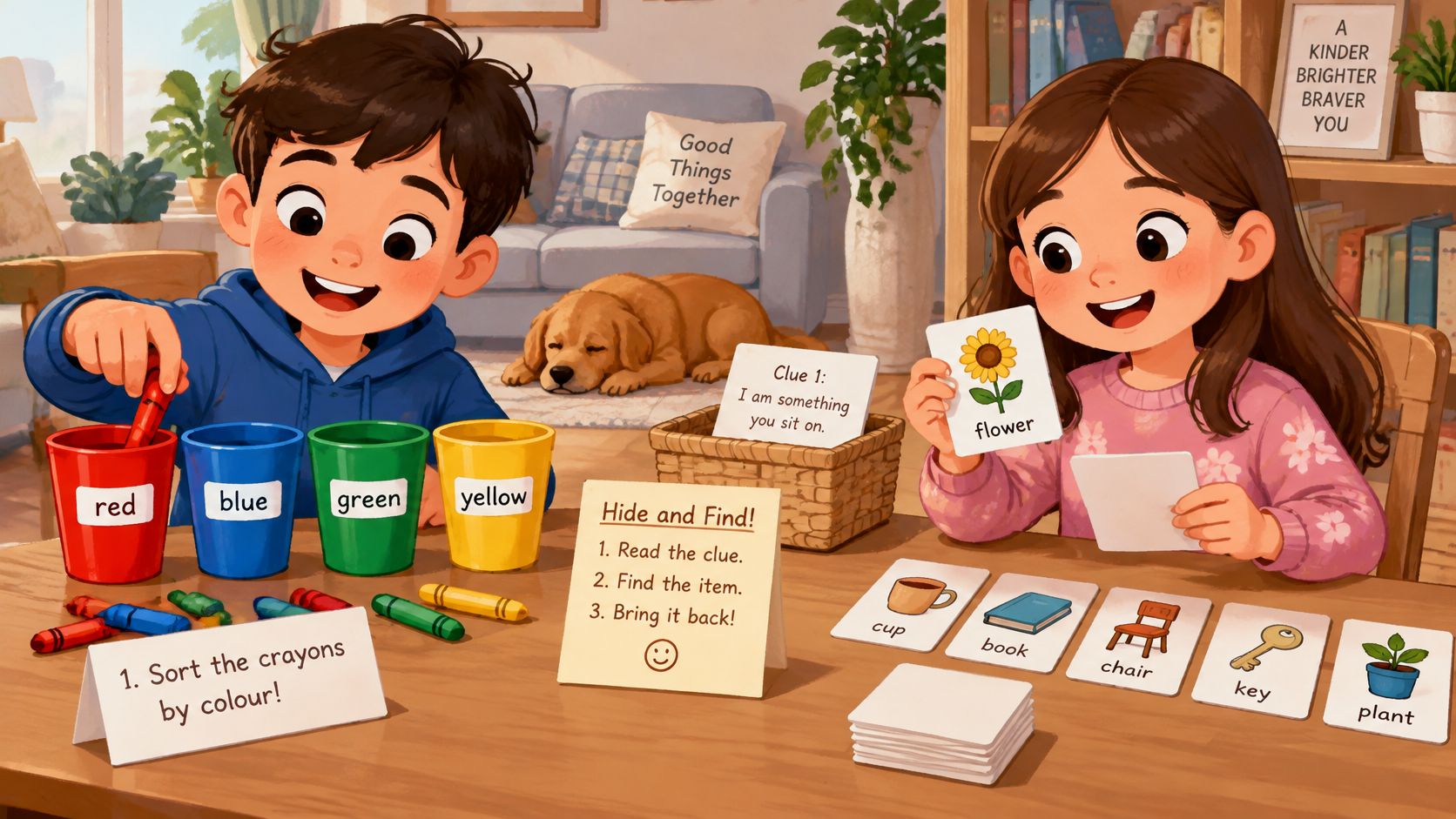
A colour sort is an easy beginning. Place crayons, clothes or food packaging on a table and group matching colours together. The adult supplies or plays the colour word, then invites the child to find another object in that group.
Hide and Find With a Memory Turn
A suggested game can work with a small set of objects:
- Choose three objects the child already knows in the home language. Introduce their English names through audio or a parent model.
- Hide an object while the child looks away. Give a simple clue, such as It is red, with a gesture if needed.
- Let the child find the object and try its English name.
- During the next round, ask for the name before revealing the hidden object. If the clue isn't enough, offer another hint rather than making the child guess endlessly.
- Return to the same set on another day. Once the familiar words feel secure, swap in a new word.
The important cycle is hear, connect, hide and recall. A primary-school vocabulary study published in Memory & Cognition found better recall after a week for retrieval-practised words than for restudied words, although the advantage wasn't consistent on multiple-choice recognition tests. Results differ across tasks, so memory prompts should sit alongside clear audio, meaning support and helpful feedback.
Homemade Cards and Older Players
A picture match needs only scrap paper. Draw familiar objects, spread the drawings out and play or say a word for the child to match. Later, turn a drawing over and ask whether the child remembers its English name.
For learners aged nine to ten, keep the challenge but remove any babyish presentation. The child can help write three simple clue cards, hide the objects and read the clues aloud. The adult checks recall with What is it called? rather than pointing at the answer, and the child chooses the next vocabulary set.
Keep the core words stable during the week before making substitutions. The English vocabulary guide for children offers further ideas for choosing useful starting words.
A mistake is a reason to supply the word gently, not to restart the whole game.
After a correction, continue playing. Another opportunity later in the week is more useful than repeated demands for a perfect answer immediately.
Listening and Speaking Confidence Through Read-Alouds and Songs
A child doesn't need to read independently to take part in a shared English book. Pictures provide something to discuss, and the adult or recording supplies the spoken language.
The National Literacy Trust's guidance on reading aloud and sharing books explains that books introduce vocabulary and support conversation, while songs and rhymes use rhythm and repeated language to make language structures easier to learn. That makes both useful starting places for beginners.
A Repeatable Picture-Book Routine
- Look at the cover together. Say the English title or listen to it in a recording.
- Name three objects on a page, pointing to each as its word is spoken.
- Pause before turning the page. Leave a few quiet seconds rather than answering immediately.
- Invite the child to point, choose between two pictures or repeat a familiar word.
The suggested object count is a way to keep the activity small. There's no need to explain every detail on the page.
For children aged seven to ten, choose a short text with an interesting situation rather than assuming that beginner English requires a preschool story. An adult or recording can read first, with the child joining repeated lines. The guide to English-learning stories can help families plan this kind of shared practice.
Add Movement Without Adding Pressure
Choose a clear movement for each song line, such as pretending to eat when a food word appears. Keep the same song during the week so the child can anticipate both the action and the language.
Talkio Kids uses a similar listening-and-response rhythm. Nox introduces words with pictures and spoken audio, and the child listens, matches pictures, answers simple questions and practises speaking. Every instruction and word is spoken as well as written, with audio replay always a tap away.
For a quiet child, pointing and choosing are valid ways to participate. Speaking can follow when the child feels ready, without an adult turning every page or song into an oral test.
Beginner English for Ages 9 to 10
A child aged nine or ten can be a complete English beginner. Reading ability in the home language and English proficiency are separate things. Practice should match the child's English knowledge without treating the child as younger than their age.
Let the learner choose a theme such as football, animals, games or space. The parent can act as a listener and coach rather than directing every tap or supplying every answer.
An Independent-Friendly Session
The following is a suggested routine of about ten minutes, not a required learning dose:
- The child listens to three words or a short phrase, using audio and pictures to establish meaning.
- The child matches each word to a picture or action without needing to write it.
- The adult asks an open question such as Where is it? and waits. A single word or a meaningful gesture is an acceptable starting response.
- The child tries three brief phrases and chooses a favourite to teach back to the adult.
A football-themed version might use ball, red and big, followed by combinations such as a ball, a red ball and a big ball. The child works with a manageable set rather than being expected to invent sentences from unknown language.
Once the routine is familiar, parts can happen independently. The adult can return for the teach-back moment instead of supervising the entire activity.
Add Print as Support, Not a Barrier
Read a short caption or label together after listening. Let the child locate the written word that matches the sound, without making copying or spelling a condition of joining in.
An older child may appreciate keeping a small collection of useful labels for an interest, such as animal names beside drawings. If English print causes frustration, return to the audio and picture rather than assuming the child isn't trying.
The home-practice guide for nine-year-old English beginners offers more age-respectful ways to organise practice.
A useful finish: Leave the child with something they can demonstrate, not a list of everything still unfamiliar.
End before enthusiasm fades, with a word the child can produce alone. Independence should mean having a familiar routine and access to help, not being left to struggle.
Supporting Your Child When You Are Not a Confident English Speaker
A parent who doesn't speak English confidently may assume that an app or teacher must handle all the learning. Yet providing fluent speech and providing useful support aren't the same job.
A 2025 study of 65 families published through SCITEPRESS found that parental involvement was more strongly associated with early English-as-a-foreign-language development than gadget use; the same source describes a 2025 evaluation involving 600 low-income parents in which vocabulary-discussion prompts improved children's vocabulary and strengthened parents' belief that their input mattered. These findings don't establish that an app causes progress, but they challenge the assumption that the adult has little to contribute.
Let Audio Model the English
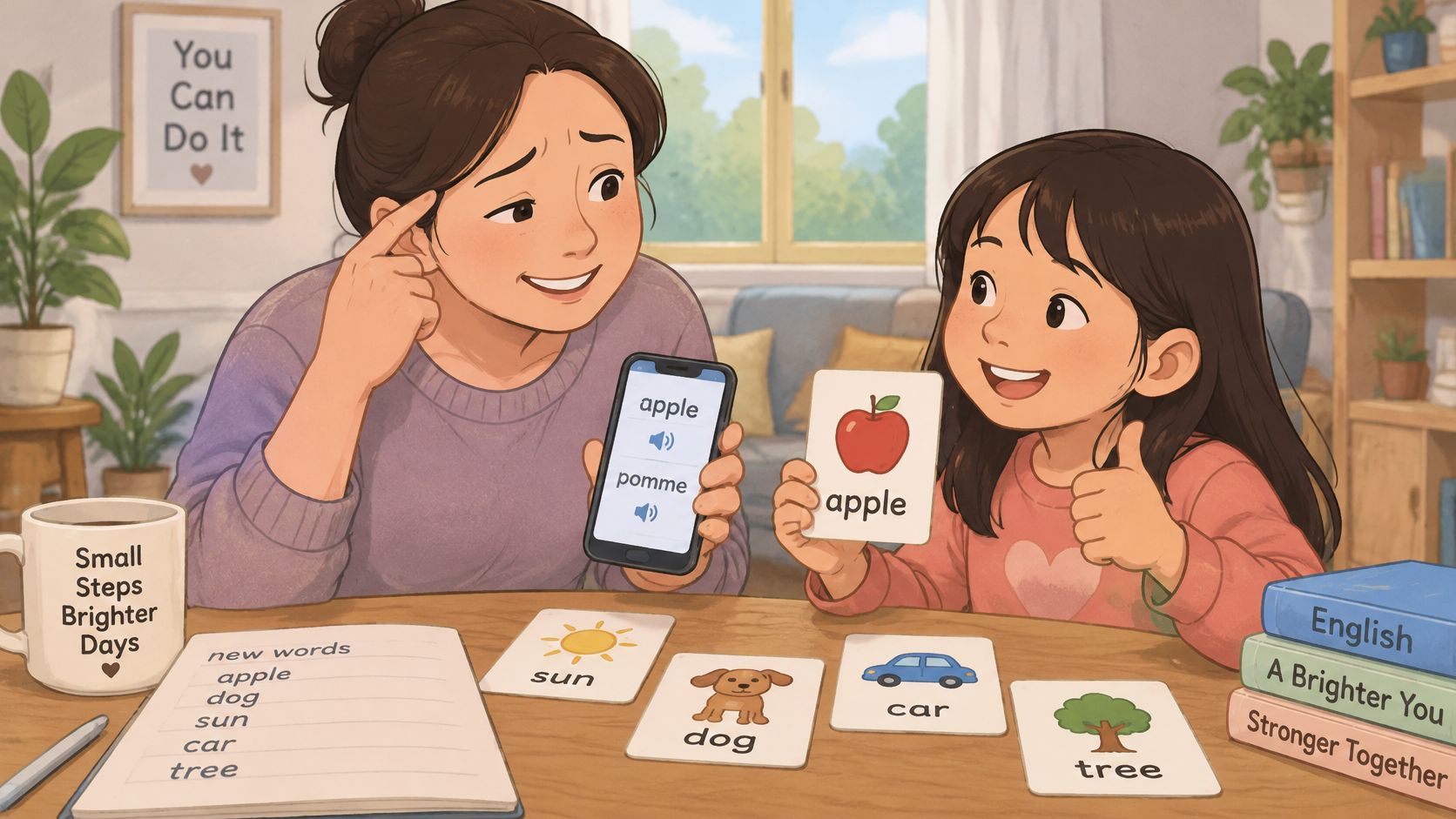
The parent can explain meaning in the home language, point to the object and add a gesture. After listening together, the child gets a chance to supply the English word. There's no need for the adult to translate every instruction unaided.
Simple reusable prompts include:
- What is it? Invite a name after the object or picture is familiar.
- Where is it? Ask the child to locate something rather than explain it.
- Show me. Accept an action or a point when speech isn't available yet.
These prompts can also be introduced in the home language first. The purpose is understandable participation, not an English-only household.
Keep the Parent's Role Manageable
Talkio Kids introduces familiar topics including greetings, animals, colours, numbers, family and food. Nox guides the short listening, picture-matching and speaking activities that build everyday vocabulary and simple phrases, leaving the adult free to encourage effort.
The surrounding app supports English, Spanish, German, French, Italian and Danish. New words are explained in the family's selected home language when it is among those supported languages.
For a busy family, a suggested five-minute version is enough to begin: sit beside the child, listen together and notice a specific effort, such as replaying a tricky word. Finish by letting the child teach the adult a word. The parent doesn't have to know the answer first to show that the child's learning matters.
What to Check When Choosing a Beginner English App
Parents need clearer criteria than star ratings alone. An app should suit the child's starting point and give understandable opportunities to participate, without promising fluency.
The British Council's guidance for parents highlights resources such as songs, games and simple stories. Useful selection criteria include age-appropriate audio, pictures, repeated vocabulary, speaking opportunities and support for early reading, rather than passive video or word lists alone.
| Criterion | What to look for | Why it matters |
|---|---|---|
| Audio for every word | Clear audio for each word and instruction | Children can listen again without an adult modelling the English |
| Picture support | Images that make each word's meaning clear | Early readers can follow without relying entirely on text |
| Short sessions | Lessons lasting a few minutes | Fits a suggested five-to-ten-minute home routine |
| Speaking practice | Opportunities to say words after listening | Adds producing English to recognising it |
| Offline use | Content available without internet | Supports practice during travel or weak connections |
| Privacy | No ads, social features, open chat or account signup | Reduces opportunities for a child to share personal information |
| Family controls | Check time limits, emailed reports and family plans | Talkio Kids doesn't offer parent-controlled time limits, emailed reports or family plans |
Check Practical Limits Before Subscribing
Talkio Kids includes its lessons, pictures and recordings offline, stores progress on the device and requires no account or sign-in. It has no ads, social features, open chat or open-ended AI conversations. Its child-directed learning experience is designed to work without the child sending personal information.
Speaking recognition happens on the device; microphone audio and transcriptions aren't saved or uploaded. There is no school dashboard or cloud sync, so teachers and tutors shouldn't expect central reporting for supplementary practice.
Monthly and annual subscription prices and trial eligibility are shown in the app. Parents should review the current store listing and subscription terms before purchasing, and apply the same scrutiny to competing apps.
- Independence: Can the child use the activities alone after an introduction?
- Connectivity: Does the content work without internet?
- Clarity: Does the parent understand what each activity asks the child to do?
Start a Five-Minute Routine This Week
Choose a single activity, such as the household-object game or picture-book routine, and try it for five minutes a day during the coming week. Note which words the child produces without a model. Treat that record as a guide to the next activity, not a scorecard.
Talkio Kids is an educational aid, not a school, tutoring service, assessment, medical service or substitute for professional advice. It doesn't guarantee fluency or any particular learning outcome.
The iOS and Android app supports complete English beginners aged five to ten. Nox, an alien companion on a space adventure, guides short lessons, introduces everyday words and celebrates effort.
Monthly and annual subscriptions are managed through the App Store or Google Play. Eligible new subscribers can try the complete course free for seven days; eligibility and current prices appear in the app, so the store terms should be checked before subscribing.
Parents can explore the app, download it from the App Store, or find it on Google Play.
Talkio Kids combines spoken English, pictures and opportunities to practise aloud for children starting from the beginning. Parents looking for a manageable companion to home vocabulary games and shared listening can visit Talkio Kids and explore whether its short activities suit their child's routine.