
English learning at home
Free English Practice at Home for 9 Year Old Beginners
Discover English practice at home for 9 year old beginners with simple games, daily routines and reading tips you can start today, no purchases needed.
By Talkio Kids ·

It's Tuesday evening. Dinner is nearly ready, a 9-year-old has declared English boring, and the parent beside the kitchen counter isn't sure how to help. A textbook feels like another school lesson, while an unfamiliar app raises questions about reading, speaking and screen time.
A 9-year-old can be a complete English beginner. English knowledge, age and reading ability are different things. A child who reads confidently in the family's language may recognise almost no written English, while another child may need pictures and audio for both.
English practice at home for 9-year-old beginners can start with familiar objects, playful choices and an adult who's willing to participate. Fluent English isn't required, and neither is correcting every mistake.
- Start without spending. Household objects, scrap paper and books already at home are enough for the home games below.
- Keep the challenge age-appropriate. Older beginners can enjoy detective missions, café menus and leadership roles without needing difficult English.
- Separate free activities from paid tools. The household games need no purchase; the app option requires a subscription.
Small activities are easier to fit around family life than elaborate lessons. LearnStream's guide to microlearning examples offers another way to think about learning in manageable pieces, but a home routine can remain wonderfully simple: hear something, do something and revisit it later.
1. Household Object Hunt
A cup, a chair and a spoon can become the start of an English treasure hunt. Real objects make meaning visible, so a beginner doesn't have to guess from an unfamiliar written word.
Begin with a small selection of familiar objects. The parent points, says the English word and invites the child to touch or collect the matching item. Repetition is welcome, but pointing is a perfectly useful response when speaking still feels uncomfortable.
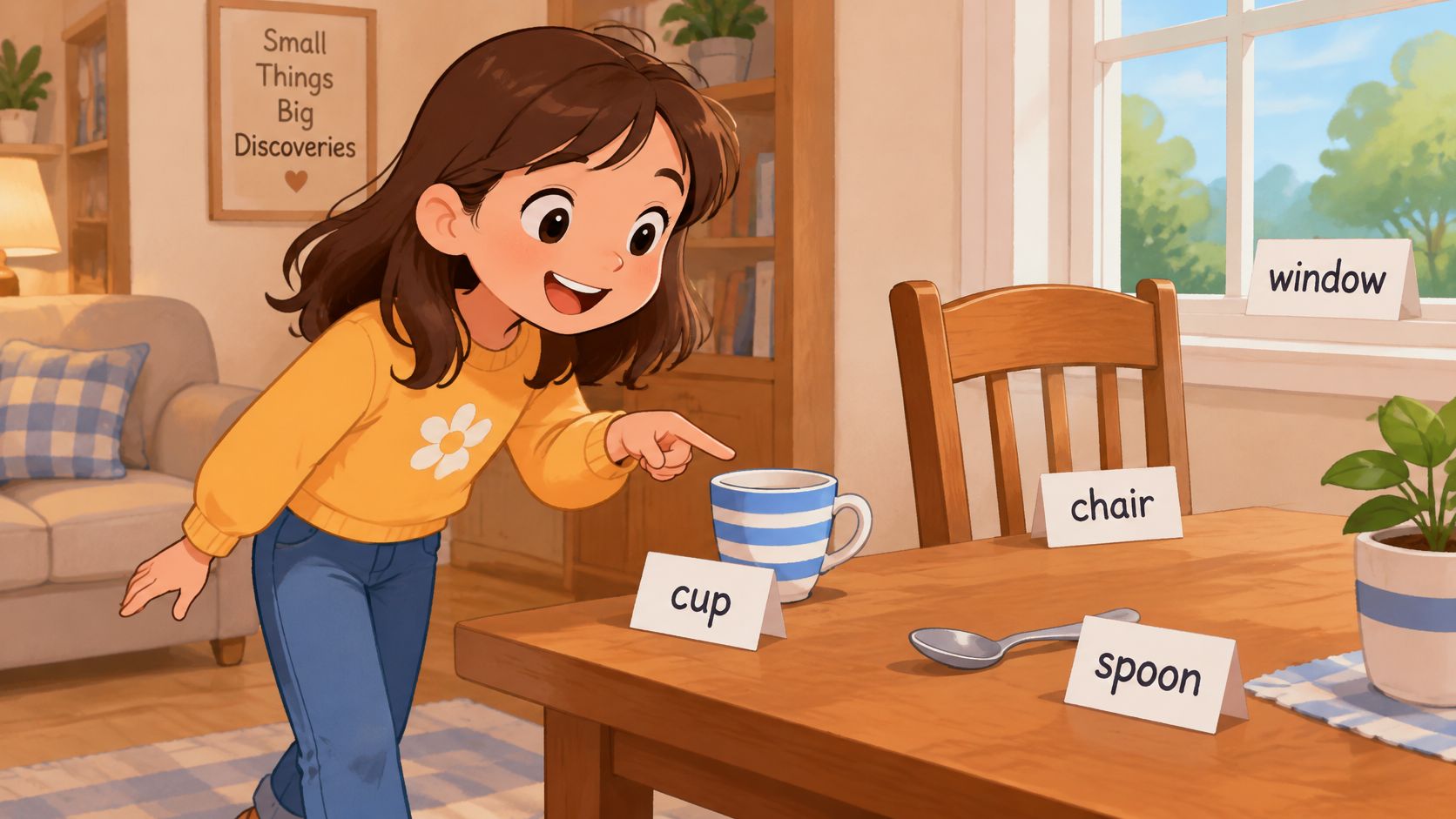
Turn familiar words into a mission
- Introduce the objects. Say cup, chair, spoon, door and window while pointing to each.
- Begin the hunt. Give a simple instruction such as Find the spoon. Help with a gesture if necessary.
- Swap roles. The child chooses an object, and the adult finds it.
- Revisit naturally. Use a familiar word when setting the table or opening a window, rather than arranging another quiz.
For a child who isn't reading yet, leave written labels out. Finding the correct object shows understanding without adding a reading task.
For an older beginner wanting a challenge, make it a secret-agent mission. Once the basic words are familiar, introduce a clue such as Find something soft, showing a cushion first so that soft has a clear meaning.
A hidden-object round can introduce It is on the table. Keep the object visible at first, then hide it somewhere safe and easy to reach. A timer is optional, not a requirement for making the game interesting.
2. English Simon Says
Some children would rather move than speak after school. Simon Says gives them a way to respond to English through actions before taking a speaking turn.
The adult demonstrates Touch the nose, Clap or Hands on the head. The child copies the movement while hearing the words, then tries again with less demonstration. Keep the early rounds cooperative rather than eliminating anyone for a mistake.
British Council guidance on children's learning explains that children may spend time listening and thinking before beginning to speak. Silence during an action game therefore doesn't need to become a reason for extra pressure.
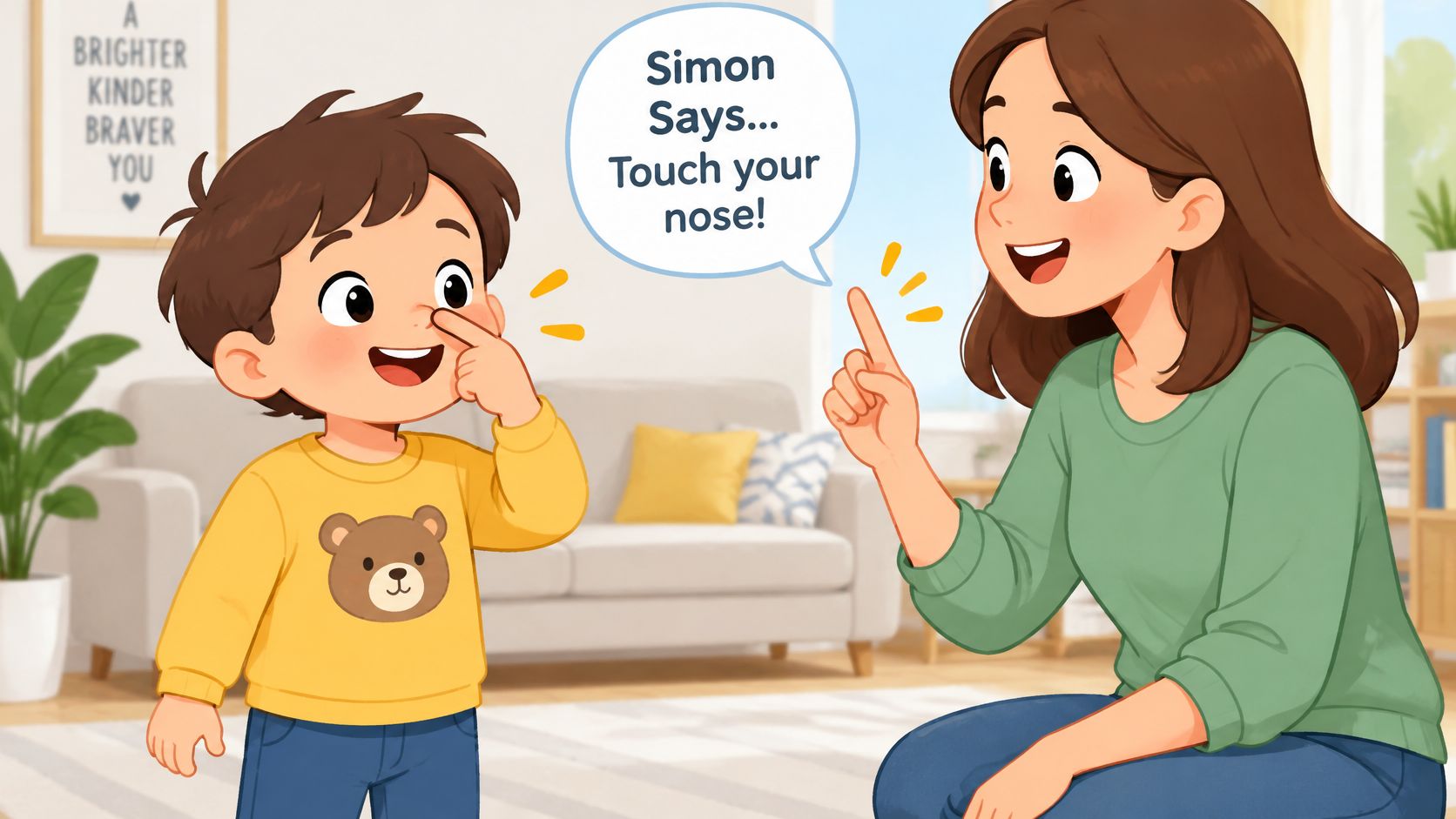
Keep participation open: A child who follows an instruction has something worth celebrating, even without saying the words.
Let the child become the leader
For a child who can't read yet, the adult can whisper a familiar command or demonstrate an action for the child to copy as leader. No command cards are necessary.
An older beginner might prefer a sports-coach theme. The child directs the adult through familiar actions and can combine them when ready, such as Touch the head, then clap.
If a command is confusing, show it again rather than repeating it more loudly. Finish while the game still feels enjoyable, and avoid turning a missed instruction into a penalty.
3. Listen, Point and Repeat Picture Book Time
A picture book doesn't have to become a reading test. A parent can open a familiar book, point to an animal and say dog, even when the printed story is in another language.
Choose clear pictures and a subject that interests the child. Animals, unusual vehicles or an adventure scene can suit an older beginner better than a book that feels babyish. The adult can use a simple description rather than translating every sentence.
UNESCO's guidance on languages in education highlights the importance of learning through language children understand. At home, that means keeping meaning clear and allowing brief explanations in the child's strongest language.

Follow the picture before the print
- Listen first. The adult says The dog is sleeping while pointing to the picture.
- Invite a response. Ask Where is the dog? and accept pointing.
- Offer repetition. Pause so the child can repeat dog or the short phrase if willing.
- Return to familiar pages. Another reading can focus on colours, actions or a favourite character.
A child who isn't reading independently can participate entirely through pictures and gestures. A confident reader who's new to English can look for a repeated written word after hearing it, without being asked to decode the whole page.
The guide to English-learning stories offers related ideas for making shared stories part of a home routine. Familiarity is useful here; there's no need to find a different book for every session.
4. Card Sort Review Game
Scrap paper and an envelope are enough for a review game. The child draws familiar objects on small cards, adding English labels only when those labels are helpful.
Make separate places for familiar words and words to revisit. The labels shouldn't suggest success and failure. A difficult word needs another meeting.
The parent names an object, and the child selects its picture. Alternatively, the adult shows a card and invites the child to name it. Cards that need help return to the practice pile without a score or an announcement.
Make the piles useful
- Add pictures. A recognisable sketch matters more than a neat drawing.
- Offer help early. Say the word and let the child point, copy or listen again.
- Return after a break. Bring out a tricky card during a later session, mixed with familiar ones.
- Allow movement between piles. A word can feel familiar today and need support another day.
For nonreaders, use picture-only cards and spoken prompts. Sorting shouldn't depend on recognising print.
For older beginners, give the child responsibility for organising the collection. Cards can be grouped as food, bedroom objects or sports equipment, with short phrases added when useful.
A typical round might begin with a picture of a spoon. If the child says cup, the adult points to the handle and says spoon, then offers another attempt without demanding it. The English vocabulary for kids guide can help families choose familiar topics rather than collecting unrelated words.
5. Pretend Shop and Café Role-Play
A kitchen café gives short English phrases a clear purpose. Someone orders, someone serves, and the same language can return with a different item.
Arrange available snacks, empty containers or paper food pictures on a table. The adult demonstrates a short exchange, using A banana, please, Here you are and Thank you. Longer language can wait until the basic exchange feels familiar.
Pressure isn't a useful shortcut to speaking. A study published in Language Teaching on parents' views of young language learners describes relationships between parental involvement, motivation and speaking anxiety, rather than a simple rule that encouragement always makes children talk.
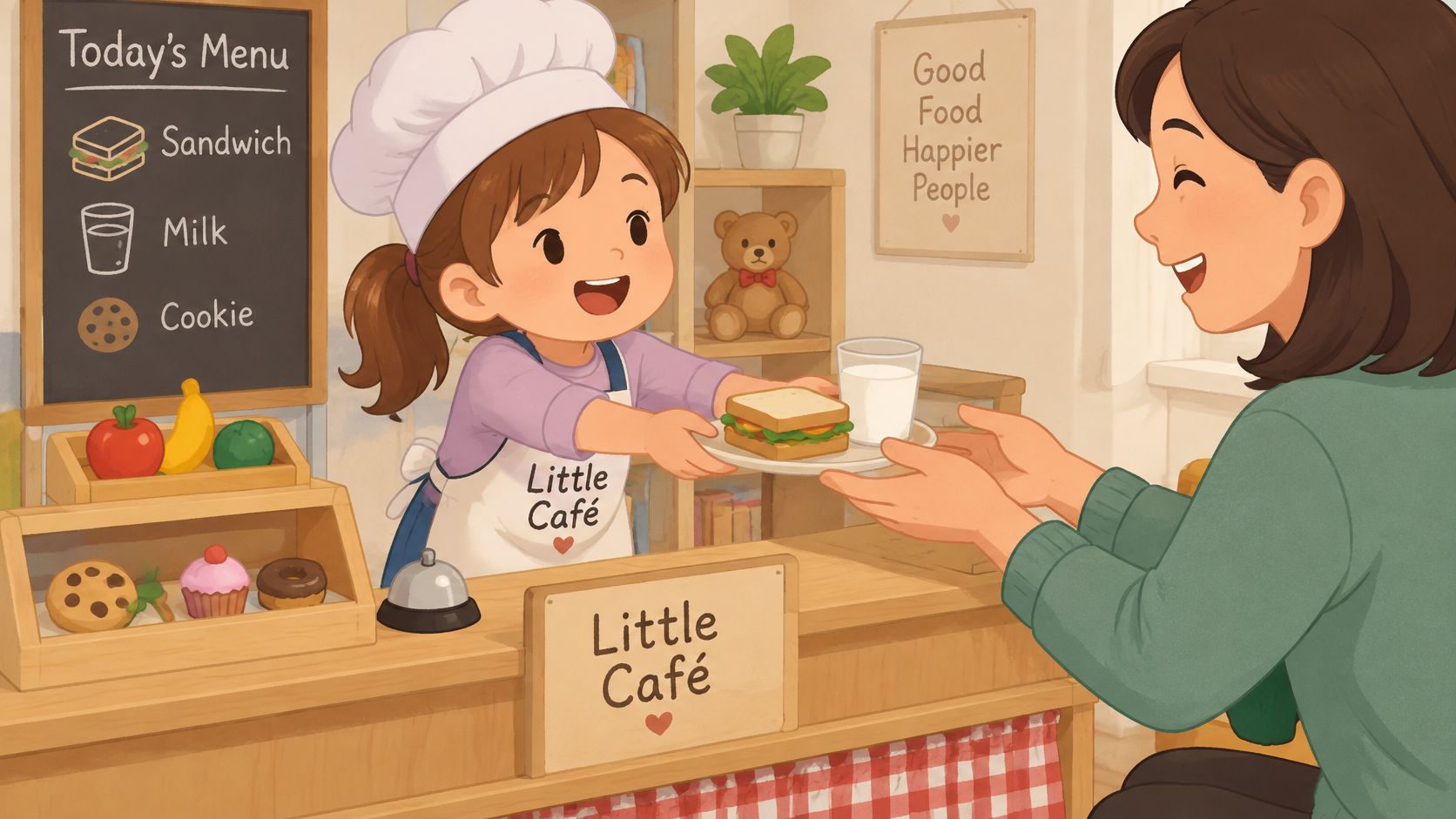
An order communicated by pointing can still be a successful turn. The adult can model the English without making speech the price of participation.
Offer a role that feels comfortable
A child who can't read can choose from a picture menu. The parent names the chosen food and leaves room for optional repetition.
An older beginner can design a café name, arrange the menu and decide who serves first. Useful challenges include asking Would the customer like milk? or adding How much is this? once the scene is familiar.
Switch roles rather than making the child perform the same part repeatedly. The guide to English conversation for kids provides related ways to practise short exchanges without demanding a full conversation.
6. Sound and Letter Treasure Hunt
This hunt is about hearing a sound, not reciting the alphabet. A parent can place a sock beside a spoon, say each word slowly and draw attention to the sound at the beginning.
Begin with words the child already understands. Otherwise, the child has to learn the object's English name and identify an unfamiliar sound at the same time.
Listen before looking for letters
- Model the sound. Say the starting sound in sun, then say the whole word.
- Offer a choice. Ask which starts like sun, sock or cup, while showing the objects or pictures.
- Search together. Find another familiar item with the same beginning sound.
- Add print when useful. Show the letter s after the child has heard the connection.
A child who isn't reading yet can complete the whole activity through listening and pointing. There's no need to copy letters or write a worksheet.
For an older beginner, turn the hunt into a sound detective's collection. The child can draw matching objects, photograph them with adult permission or label familiar examples.
Use a clear recording when the adult is unsure of pronunciation. Say the sound before the letter name, and avoid adding an extra vowel after it.
This activity shouldn't become a test of intelligence or overall reading ability. A child may read confidently in another language while still learning how English sounds connect with English print. Keep the task narrow and stop before the search becomes frustrating.
7. Yes or No Question Quest
Place familiar objects on the table and secretly choose a target. The child asks questions or responds to the adult's clues until the target becomes clear.
Begin with a visible example. Holding a red apple, the adult asks Is it red? and models Yes. Beside a dog picture, Is it a cat? gives a clear reason to answer No.
The question needs familiar language. A guessing game becomes unnecessarily difficult when the child is also trying to work out every colour, object and adjective.
Build from recognition to a sentence
- Accept a gesture. A nod, head shake or point can show understanding.
- Offer the short answer. Model Yes or No without insisting on repetition.
- Extend gently. Add Yes, it is or No, it is a dog when the child wants more.
- Share the questioner's role. Let the child ask a practised question while the adult guesses.
For a child who can't read yet, keep objects or pictures visible throughout. The adult can point to a colour while helping form the question.
An older beginner might enjoy a detective notebook, but writing remains optional. The child can cross out pictures as clues rule them out, then make a final guess.
If forming questions is too demanding, the child can choose a picture while the adult supplies the words. Teachers and tutors can use the same arrangement for paired supplementary practice, giving each learner a familiar question model rather than expecting spontaneous conversation.
8. Morning and Bedtime Routine Chants
Shoes on, shoes off can become a quiet rhythm while getting ready. A chant doesn't need a tune, a performance or a parent who enjoys singing.
Choose language that matches an action already happening. The adult says Wash the hands while washing, or Brush, brush, brush the teeth while preparing a toothbrush. The movement helps explain the phrase without a separate translation exercise.
The British Council's guide to teaching English at home recommends a regular routine and suggests adjusting session length to children's concentration and English ability. A routine chant can be a small part of that pattern, not an extra lesson squeezed into a tired evening.
Make repetition ordinary: Familiar words can return during everyday tasks without becoming a quiz.
Let an older beginner choose the style
For a child who isn't reading, demonstrate the action and say the phrase together. No lyric sheet is necessary.
A 9-year-old who dislikes nursery-style songs might prefer a spoken beat, a sports warm-up rhythm or a quiet pretend-radio announcement. The child can choose the delivery while the language stays simple.
Avoid attaching English to every family interaction. Morning routines still need to function, and bedtime still needs to feel calm.
If the child doesn't join in, the adult can model the phrase briefly and continue with the task. Participation can return another day; repeating a demand to repeat usually makes the moment less playful.
9. Audio Picture Matching in Talkio Kids
A 9-year-old can be a true English beginner and still want a grown-up way to practise. Talkio Kids is an iOS and Android app for complete beginners in the primary-school years, so it suits a child starting English from scratch without making the work feel babyish.
Each short lesson keeps the task small: hear a word or instruction, match it to a picture, answer a simple question, then say the word aloud. Audio can be replayed whenever needed, and early topics such as greetings, animals, colours, numbers, family and food stay close to home life. Nox, the friendly companion, and the space journey give a reason to continue while the learning stays calm; there are no hearts, lives or harsh buzzers, so a mistake leads to another try rather than a dead end.
For a child who cannot read independently, spoken instructions and pictures carry the meaning, with every instruction and word spoken as well as written. For an older beginner, the same setup feels private: they can replay a word, check a picture and practise aloud without calling an adult over each time. Speaking exercises use on-device recognition when available, and microphone audio or transcriptions are not saved or uploaded; if permission is declined or recognition is unavailable, the course still works through a tap-and-self-check flow.
Lessons work offline, progress stays on the device, and no account or sign-in is needed. Families can choose the explanation language from English, Spanish, German, French, Italian or Danish, set one quiet daily reminder or none, and use the gated Parent corner to delete local child data. A grown-up chooses a monthly or annual plan behind the parent gate before the course begins, with eligible trials and current prices shown in the app.
The American Academy of Pediatrics' screen-time guidance recommends considering content, context, balance and shared use rather than relying on a universal limit. Keep a session to one short lesson, then let the word reappear at dinner when the matching food is on the plate.
How the nine home practice options compare
Use the table as a quick filter rather than a ranking. The choice is the shape of the practice: movement, listening, sorting, pretending, chanting, or app-based matching. For a 9-year-old beginner, keep the English tiny while letting the task feel age-appropriate: hiding clues, dealing cards, taking the café order, or setting the pace.
| Item | Time per session | Materials | Reading needed |
|---|---|---|---|
| Household Object Hunt | 5–10 minutes | None | No reading needed |
| English Simon Says | About 5 minutes | None | No reading needed |
| Listen, Point and Repeat Picture Book Time | About 10 minutes | Picture book or reliable audio | Child can follow pictures; independent reading not needed |
| Card Sort Review Game | About 5 minutes | Paper cards and pen | Reading optional; words can be spoken or shown in pictures |
| Pretend Shop and Café Role-Play | About 10 minutes | Household items, toys, or drawings | Reading not required; phrase cards are optional |
| Sound and Letter Treasure Hunt | About 5 minutes | Objects, drawings, or pictures | No reading needed |
| Yes or No Question Quest | About 5–10 minutes | Pictures, toys, or household items | No reading needed |
| Morning and Bedtime Routine Chants | Less than 3 minutes | None | No reading needed |
| Audio Picture Matching in Talkio Kids | Short, self-paced sessions | Mobile device with Talkio Kids | No independent reading needed |
The times are typical ranges for one calm round, so stop while the activity is still easy. Picture cues, spoken models and phrase cards can carry a child who is still decoding. When a child wants more challenge, change the job rather than the vocabulary: let them give the Simon Says commands, write a tally, or run the shop in complete short phrases.
Pick One Small Routine and Start This Week
A family does not need every activity in this article, and it certainly does not need an English corner in every room. The kindest starting point is one small routine that fits a moment that already happens: an object hunt while dinner cooks, Simon Says after school, or a familiar picture book before bed.
Match the activity to the child in front of you, not to an ideal plan. A child who needs to move may welcome Simon Says. A tired child may prefer listening and pointing. A beginner who wants to feel independent might enjoy sorting vocabulary cards, hiding clues for a sound hunt, or taking charge of the pretend café.
A nine-year-old beginner is still nine. They can make decisions, create clues, lead a game and care about doing things properly, even while using very simple English. Keeping those abilities in the activity makes practice feel right for a primary-school learner.
Notice participation, not just correct answers
Progress at this stage often looks quiet. A child may recognise an object, anticipate an action, choose to replay audio, or volunteer one familiar word. Each of those responses shows engagement, and none requires perfect pronunciation or a complete sentence.
- When the child hesitates, offer a gesture, a model or a choice between two answers.
- When the child wants more, add a role, a clue or one useful phrase instead of a large batch of new vocabulary.
- When family life gets busy, return to something familiar rather than preparing a new activity.
- When a teacher or tutor is involved, share the words and games the child already knows so extra practice builds on familiar ground.
Parents do not have to become English teachers to give meaningful support. The Education Endowment Foundation's review of parental engagement links parents' involvement with a positive average effect on learning, while leaving open which home activity will suit a particular child.
Support can stay modest: help the child begin, listen briefly, make the meaning clear and acknowledge the attempt. Correcting every word is not required for that help to matter.
For a parent who is not confident in English, recorded audio can supply the model while the family's strongest language stays available for comfort and explanation. There is no need to pretend to understand everything or turn the household into an English-only space.
Start with a routine the family can comfortably repeat. Keep the language familiar, give the child real choices and leave room for quiet participation. A small, pleasant encounter with English is a better foundation than an ambitious session everyone hopes to avoid.
For families who want ready-made audio support, Talkio Kids offers short listening, picture-matching and speaking activities for complete beginners, with spoken instructions and pictures that help children who are not reading English independently yet. Visit Talkio Kids, download it from the App Store or Google Play, then check subscription prices and trial eligibility in the app before choosing a plan.