
English learning at home
How to Build Confidence in Speaking at Home
How to build confidence in speaking for children aged 5–10: a short home ladder, age-fit phrases, and calm practice without pressure.
By Talkio Kids ·

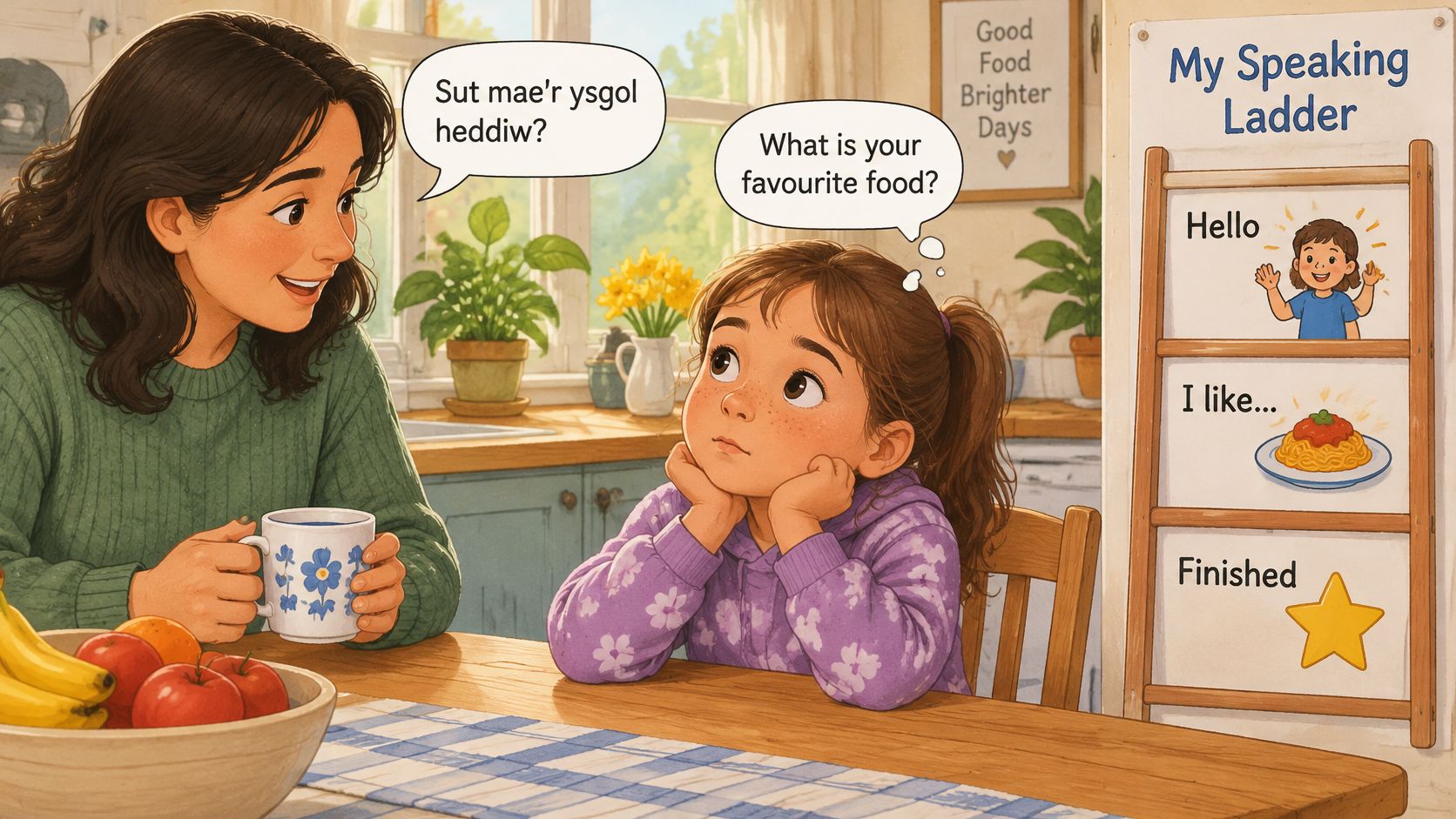
A nine-year-old tells long, lively stories in the home language over dinner. Then a visitor asks about favourite food in English, and the child goes quiet. A parent may wonder whether to help with the answer, ask again, or leave the moment alone.
For families considering how to build confidence in speaking, a useful starting point is smaller than a conversation: a child willingly starts and finishes a familiar phrase in a named situation. That gives parents something practical to support, without demanding a perfect accent, a public performance, or fluent English.
A Speaking Ladder You Can Start This Week
The nine-year-old who goes quiet may need a smaller speaking task, not stronger encouragement. Answering an unexpected question involves understanding the words, choosing an answer, finding the English, and speaking while someone waits. Practising a familiar phrase removes some of those demands.
For home practice, confidence means willingness to begin and finish a tiny turn. Accuracy still matters in language learning, but it isn't the only thing worth noticing during an early attempt.
Five-level speaking ladder for beginner English
The ladder below offers a plan for the week, not a schedule that every child must finish. The levels describe different kinds of support, so parents can keep a helpful support in place while changing something else.
| Level | Where | What the child does | What the adult does | Move up when |
|---|---|---|---|---|
| 1 Private replay | Alone or beside a parent | Hears and repeats a phrase such as I like rice | Plays audio and stays quiet during the try | The child starts the repeat on most tries that week |
| 2 Familiar listener | Home with parent or sibling | Says the same phrase to a known person | Listens and acknowledges the attempt | The child looks towards the listener and finishes the phrase, without required eye contact |
| 3 Supported choice | Home, picture or object in view | Points, then says the word, or answers in chorus | Offers a choice of pictures and joins the chorus | The child chooses and speaks without another prompt |
| 4 Short exchange | Home, still a known question | Answers Do you want water? with Yes, please or No, thank you | Asks only the rehearsed question | The child answers and can try again after a slip |
| 5 Voluntary offer | Home first, class only if the child agrees | Uses the phrase without a surprise call-out | Agrees the phrase beforehand and allows a pass | The child offers the phrase again during the week |
The move-up rule is to change only one difficulty at a time. A new listener should hear the same familiar phrase. A longer phrase should first stay with the same listener, rather than arriving alongside new vocabulary and a larger audience.
What counts as progress
Parents can stay at a level until starting feels reasonably willing on most attempts that week. An optional private finger rating from one to five can help a child signal how manageable the task feels, but it shouldn't become another test.
Practical rule: An imperfect phrase that the child willingly finishes counts as a speaking attempt.
A younger beginner may remain with pointing and a word. An older beginner can use the same supported approach with a sentence about food, sport, or friends. The useful record is concrete: started, finished, or chose to pass, rather than a judgement that the child was confident or shy.
Fit the Phrase to Ages Five Through Ten
Beginner speaking tasks by age
| Age | English can still be | Example phrase | Child's independence | Parent support |
|---|---|---|---|---|
| 5–6 | Complete beginner; may not read | cat or a cat, while pointing | Needs an adult beside them for a few minutes | Gestures, real objects, stop early |
| 7–8 | Beginner even if they read in another language | I have two brothers or I like blue | Can try a routine of about 10 minutes and tap replay | Stay nearby, don't hover over every sound |
| 9–10 | Beginner isn't the same as young; home-language reading can be strong | My favourite food is noodles | Chooses the topic and notices whether they tried | Agree the sentence first; avoid babyish topics |
These are starting options, not age-based requirements. A nine- or ten-year-old can be a complete English beginner, even with strong reading skills in the home language. Recognising English letters also isn't the same task as understanding a question and producing a spoken answer.
Age should influence the materials and the child's control over practice. English proficiency should influence the language difficulty.
Younger children need shared action
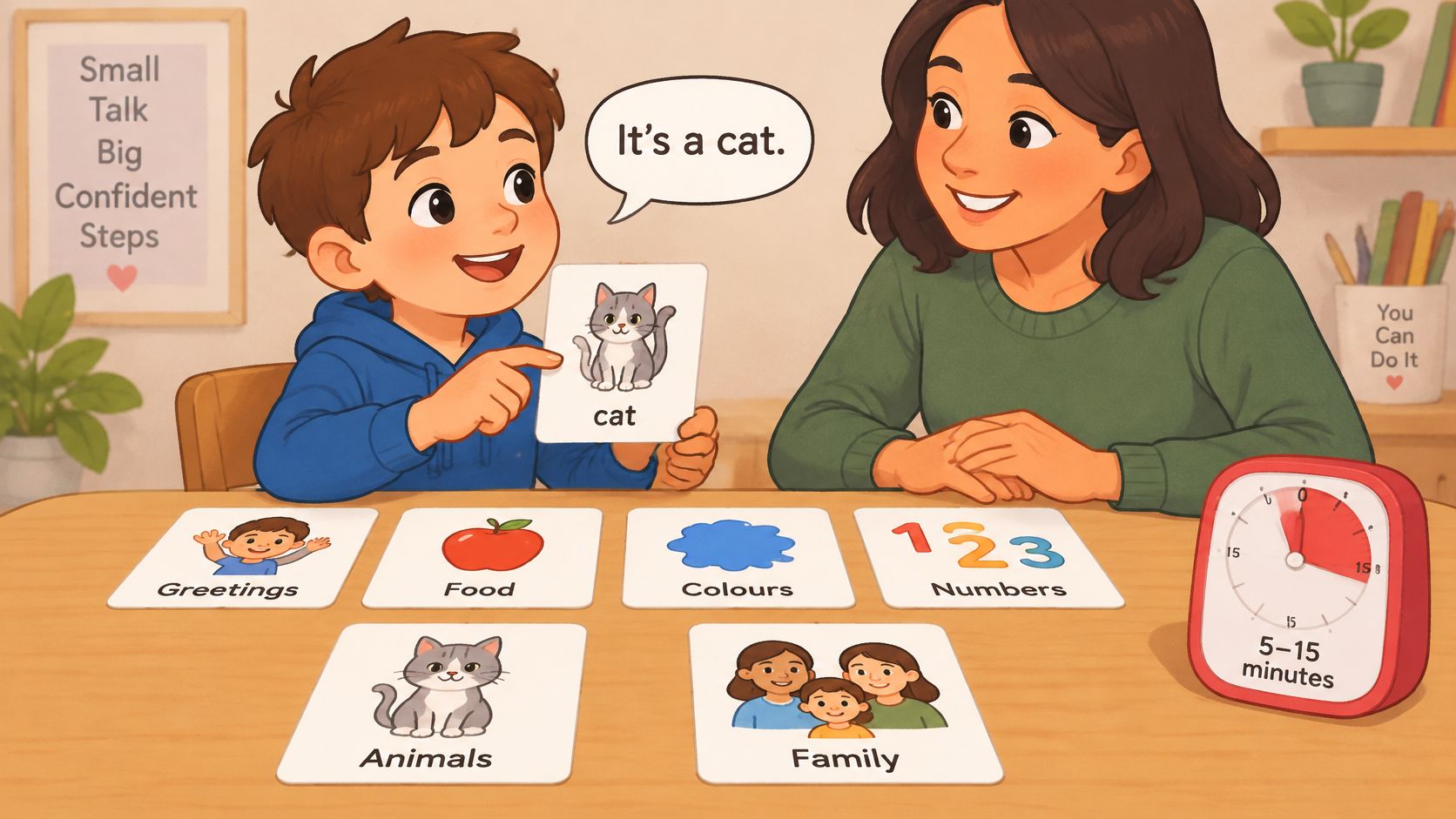
For ages five and six, an adult can sit beside a toy cat, point, and model cat or a cat. A gesture, a matching toy, and a spoken word keep the meaning visible without requiring reading.
A snack plate offers another option: the child points to an apple, hears the word, and decides whether to say it. If a younger child already uses short phrases comfortably, there's no reason to hold practice at single nouns because of age.
Older beginners need simple language, not younger interests
For ages seven and eight, a picture can support I like blue, perhaps linked to a favourite team's kit. A family drawing can support I have two brothers when that sentence fits the child's life. A parent can offer a short routine and let the child control audio replay rather than handling every tap.
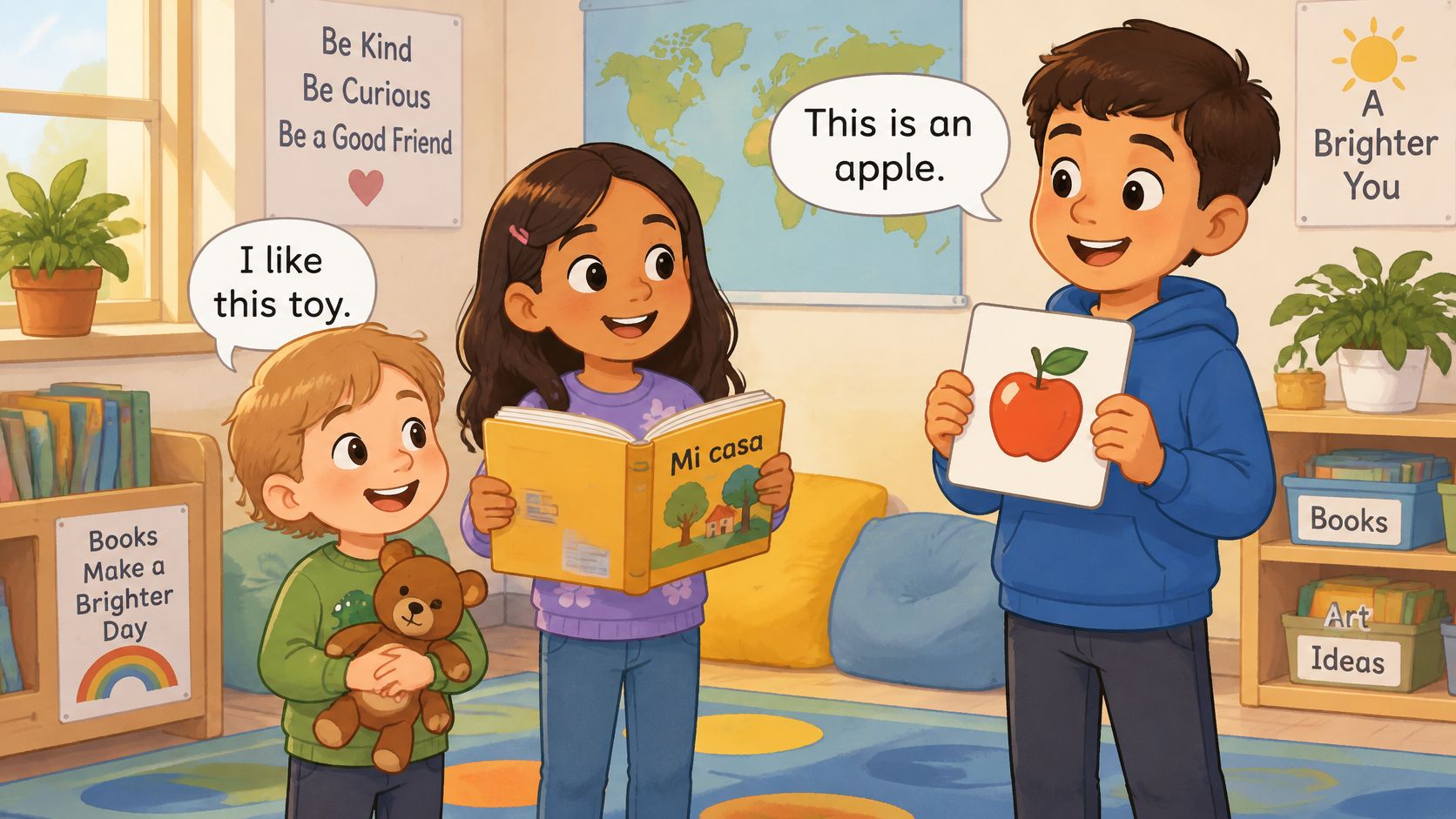
For ages nine and ten, topic choice matters. A child might prefer noodles, basketball, a friend, or a pencil case to another animal-naming activity. The vocabulary can remain basic while the task respects a primary-school child's interests.
An older beginner who doesn't read English can choose pictures and listen to audio. An early reader can keep a phrase card nearby, but shouldn't have to read aloud before being allowed to hear the sentence.
Simple English doesn't require babyish work. An older child can practise beginner language through an age-respectful choice.
Independence can also change without making the English harder. An older child might select three useful words and mark whether an attempt happened; a younger child may need the adult inside the game. Neither needs a test score before starting, and neither should have to perform for relatives to demonstrate progress.
Run a Five to Fifteen Minute Speaking Routine
A spoon, a snack, and a quick drawing are enough for a useful home session. The adult's task is to make the activity easy to repeat, not to prepare a different lesson every evening.
A repeatable home sequence
Choose words the child cares about. A practical starting set is three to six words from greetings, food, colours, numbers, animals, or family. A seven-year-old might choose kit colours; a ten-year-old might choose snack names. Familiar interests give the words a purpose.
Keep the routine short and frequent. A family can try 5–15 minutes on three or more days each week rather than a long weekly lesson. The Education Endowment Foundation evidence summarised in a Northern Ireland Assembly education briefing reports six additional months of progress on average across 188 studies, with the strongest effects when oral-language activities happen three or more times per week and continue over time. That is broad oral-language evidence, not a guaranteed result for home English practice or an app.
Make the meaning visible before asking for speech. The adult says or plays the word while showing an object or drawing. A useful practice choice is to let the child hear it twice, without requiring an immediate response.
Invite pointing or matching first. With an apple and a spoon on the table, the child can identify the named object. This gives the adult a way to check the task's meaning without treating silence as failure.
Model a phrase, then leave space. The adult can offer a red apple and invite a repeat or a shorter answer. If a sound is difficult, replaying the model keeps the activity moving more gently than stopping at every phoneme.
Reuse the word in a new tiny context. On another day, red can describe a shirt instead of an apple. The adult keeps the speaking demand familiar while changing the object, rather than introducing a completely new set.
Stop while the task still feels manageable. A brief note such as tried the phrase is enough. The session doesn't need a score, a recording, or a final performance.
Borrow the mechanics, not the promised outcome
The Education Endowment Foundation's Talking Time programme evaluation describes forty 15-minute small-group sessions using shared storytelling, playful language games, and familiar routines, with approximately one additional month of language-development progress overall and two for children learning English as an additional language. Those findings concern an evaluated early-years programme, not proof that a home activity or digital product produces the same result.
Parents can still borrow the practical mechanics: shared attention, familiar objects, listening, and a manageable speaking invitation. For an early reader, a picture book can replace homemade cards, with the adult choosing a familiar picture rather than asking for a whole-page reading performance.
For parents considering how practice fits into family life, Translate AI's guide to daily habits for English fluency offers broader routine ideas. For children, the useful adaptation is a predictable place for practice, not an adult-sized fluency target.
When Home Speaking Stops at the Classroom Door
Before a freeze
A child who talks freely at home but falls silent in class isn't necessarily showing the same difficulty in every situation. A 2025 study of 120 Year 6 students in Malaysian Tamil schools found the highest speaking anxiety when teachers called on students directly, with lower anxiety in less confrontational contexts, and identified games, songs, and non-threatening speaking tasks as useful approaches.
That finding supports avoiding surprise performances. It doesn't diagnose an individual child or establish what any particular beginner will experience.
Before an expected classroom turn, a parent can rehearse the exact phrase the child already manages. A short message to the teacher can identify the sentence, the support that helped, and whether the child has agreed to try it outside home.
Before, during and after a freeze
| Moment | What the adult does | Example |
|---|---|---|
| Before | Rehearses the exact phrase at the current ladder level | Practises I like rice at home first |
| During | Offers a chorus, pair turn, game, or song, and allows a pass | Everyone says I like rice together |
| After a freeze | Skips the post-mortem and returns to an easier rung | A private repeat at dinner counts as recovery |
During a freeze
A teacher or tutor can reduce the audience demand without turning the moment into a public rescue. A chorus answer lets the child speak alongside others; a pair turn offers a smaller audience. A familiar game or song can provide an entry point before a voluntary individual answer.
A pass should remain available. Repeating the question more loudly, asking classmates to wait, or announcing that the child already knows the answer can make the moment harder to leave.
For supplementary practice, tutors can use familiar picture choices rather than exam-style questioning. The English conversation activities for kids guide offers material that adults can narrow to a rehearsed exchange instead of an open-ended conversation.
After a freeze
The journey home doesn't need to become an investigation into why the child didn't speak. A parent can acknowledge that the moment was difficult, allow a change of subject, and offer an easier private task later.
A familiar repeat at dinner can count as recovery. It doesn't need to be followed by an immediate classroom redo, a video for the teacher, or proof for another family member.
A missed public answer doesn't erase a phrase the child can already use privately.
For beginner learners, a useful record separates willingness, starting, and finishing from pronunciation accuracy. A child may agree to try but stop midway, or finish only with a partner; those observations help adults choose the next task without labelling the child.
This is educational guidance, not a diagnosis or speech-therapy advice. If a child never speaks in any setting and distress is severe, the family should speak with the school and a qualified professional rather than attempt a home treatment. No speaking routine can promise that classroom freezing will disappear.
Helpful Habits When Your English Is Limited
A parent doesn't need to become an English teacher to make home practice welcoming. The useful role is to provide the frame around practice: a calm moment, a clear invitation, and permission to stop without embarrassment.
A 2025 study of parental support and children's English learning associated parental encouragement, valuing English, and a supportive home environment with children's motivation, confidence, and language development. That is an association, not proof that a particular family routine causes fluency.
The parent provides the setting, audio provides the model
At dinner, a parent can hold up a cup and gesture towards the water. The child might say water, point and attempt part of the word, or listen while the parent plays a familiar audio model.
For a rehearsed phrase such as I like rice, the parent can give a turn-taking cue in the home language, play the English, and wait. If the parent knows the phrase, saying it naturally is also an option; otherwise, there's no need to guess at pronunciation or pretend to know.
The distinction matters because support and language expertise aren't the same job. A parent can notice that a child began speaking, finished a difficult turn, or asked to replay the audio without judging every sound.
- Use meaning that's already present. A cup, a plate, and a gesture can make the task understandable without a long English explanation.
- Notice the action. Acknowledging that the child started or returned after a slip is more specific than praising only perfect speech.
- Leave comparisons out. A sibling's longer answer doesn't set the right demand for another child's attempt.
Set a limit on correction
During a confidence-focused turn, the adult can let the child finish before offering any model. If the meaning is clear, a natural repetition is often a more useful teaching choice than an interruption followed by several required repeats.
That doesn't mean every error must be ignored forever. It means the adult chooses the purpose of the moment: helping the child complete a turn, rather than correcting vocabulary, grammar, and pronunciation all at once.
Correction boundary: The child's sentence should be allowed to reach its end before the adult decides what needs attention.
A teacher can use the same boundary during a short supplementary game, while leaving the family in charge of the home routine. Small family studies can't establish cause and effect, so these habits are practical options, not guaranteed outcomes.
Parents who feel unsure about their role can find more examples in teaching a child English when the parent doesn't speak English. The aim isn't to make the evening resemble school; it's to make room for a small, understandable exchange.
Choose a Calm Tool and Try One Phrase Today
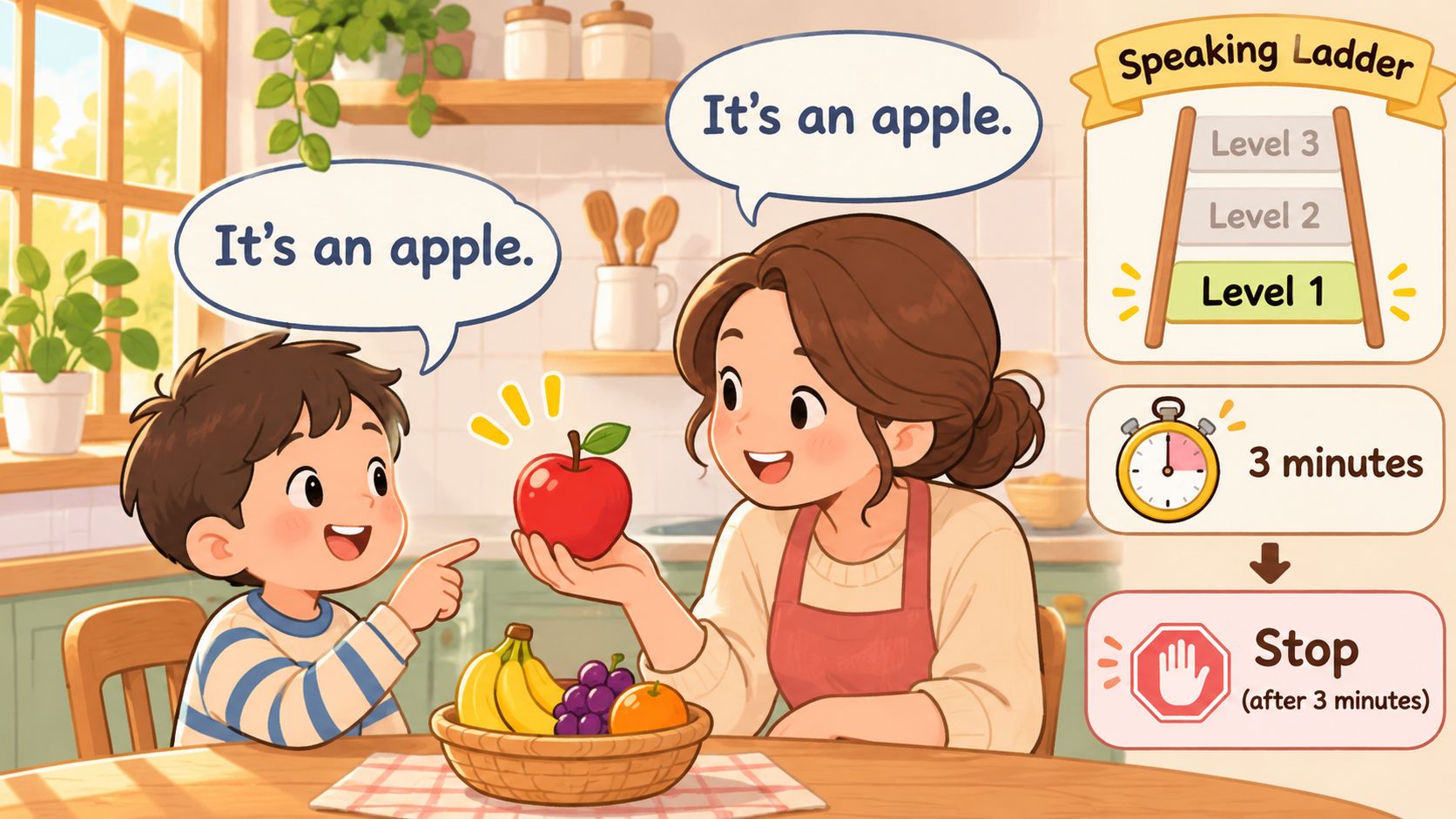
At the kitchen table, a child can point to an apple and try a red apple. That small phrase is a complete attempt, even for a 7- to 10-year-old who is just beginning English. Choose one familiar object and one manageable speaking step. Once the child has said the phrase, let the activity end without turning it into a performance.
For more ways to connect pictures with a speaking invitation, see English speaking practice with pictures. A useful tool keeps the child involved in listening and responding, while leaving room for real conversation and hands-on play.
Quick checks for choosing a beginner app
The NAEYC and Fred Rogers Center technology position statement describes intentional selection, developmental appropriateness, and adult-child engagement as important considerations. It recommends using technology to extend hands-on activity and human interaction, rather than relying on passive, non-interactive media for young children.
| Check | What to look for |
|---|---|
| Child action | The child listens, responds, matches a picture, or speaks |
| Adult role | An adult can join briefly without taking over |
| Fit with daily life | The activity sits alongside books, toys, movement, and real talk |
| Social and privacy | No ads, social features, open chat, or account signup |
A passive video is a weak fit when the aim is a speaking turn. Look for a chance to hear a model again, respond actively, and try once more without pressure. The goal is willingness to start and finish one small phrase, not a perfect performance.
An audio-led option with clear boundaries
Talkio Kids is an English-learning app for complete beginners approximately 7–10 years old. Each short lesson lets children hear English, connect words with pictures, answer simple questions, and practise saying words aloud. Audio can be replayed whenever needed. A space journey and alien companion Nox give children a reason to keep exploring while lessons remain clear and calm.
The course works offline, and progress is stored on the device. It has no ads, social features, open chat, open-ended AI conversations, or account signup.
Optional speaking exercises need microphone and speech-recognition permission, as well as a compatible on-device recognizer. If permission is declined or recognition is unavailable, the course remains usable. The child can tap when they have said the phrase and judge their own attempt. Speech recognition happens on the device; microphone audio is not saved or uploaded, and temporary transcriptions remain in memory only for the exercise.
New Talkio Kids profiles require an active Premium subscription before the course begins. Monthly and annual subscriptions are available, and the app shows current prices and any trial eligibility. Talkio Kids is an educational aid, not a school, tutoring service, or substitute for professional advice, and it does not guarantee a particular learning outcome.
Parents can visit the Talkio Kids website, find the app on the App Store or Google Play, and review subscription choices in the app. For activities that do not require a purchase, browse the home English learning guides.