
English learning at home
8 English Speaking Practice Pictures for Beginners
Eight English speaking practice pictures for kids aged 5–10: free matching cards, picture walks and games parents can set up in minutes at home.
By Talkio Kids ·
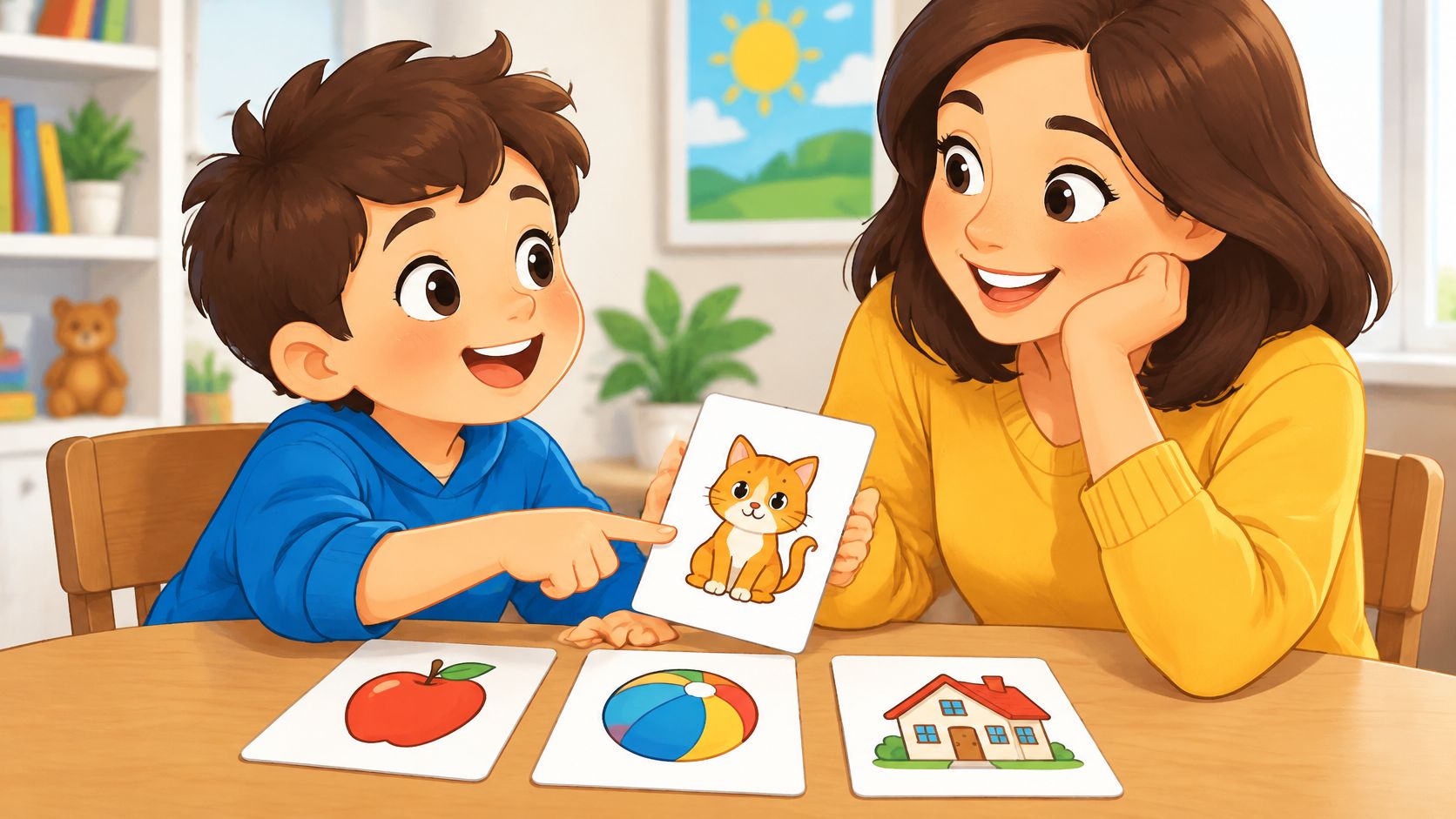
A parent who speaks almost no English sits down at the kitchen table with a seven-year-old, a stack of animal pictures printed at the library, and twenty minutes before dinner. There's no worksheet, no translation app, no tutor booked. The child picks up the goat. The parent says the word slowly, points, waits, and the child says it back.
That scene works because the picture carries the meaning. Nobody has to explain "goat" in two languages, and nobody has to read a sentence aloud to prove they understood. The image does the explaining. The adult supplies the sound and the pause.
Every activity below answers three questions: what you need, how to run it, and who it suits. None of them requires a purchase, a printer subscription or a confident English speaker at home. Ages 5-6 get the shortest version, ages 7-8 add phrases, and ages 9-10 get grown-up topics with the same picture support underneath. Treat English speaking practice pictures as a prompt for talk, not a vocabulary quiz.
1. Picture-Word Matching Cards
A stack of ten picture cards, two copies, cut apart. Pairing an image with its word is the cheapest way into English speaking practice pictures, because one set can run four or five different games before a child tires of it.
It takes one clear table and nothing else.
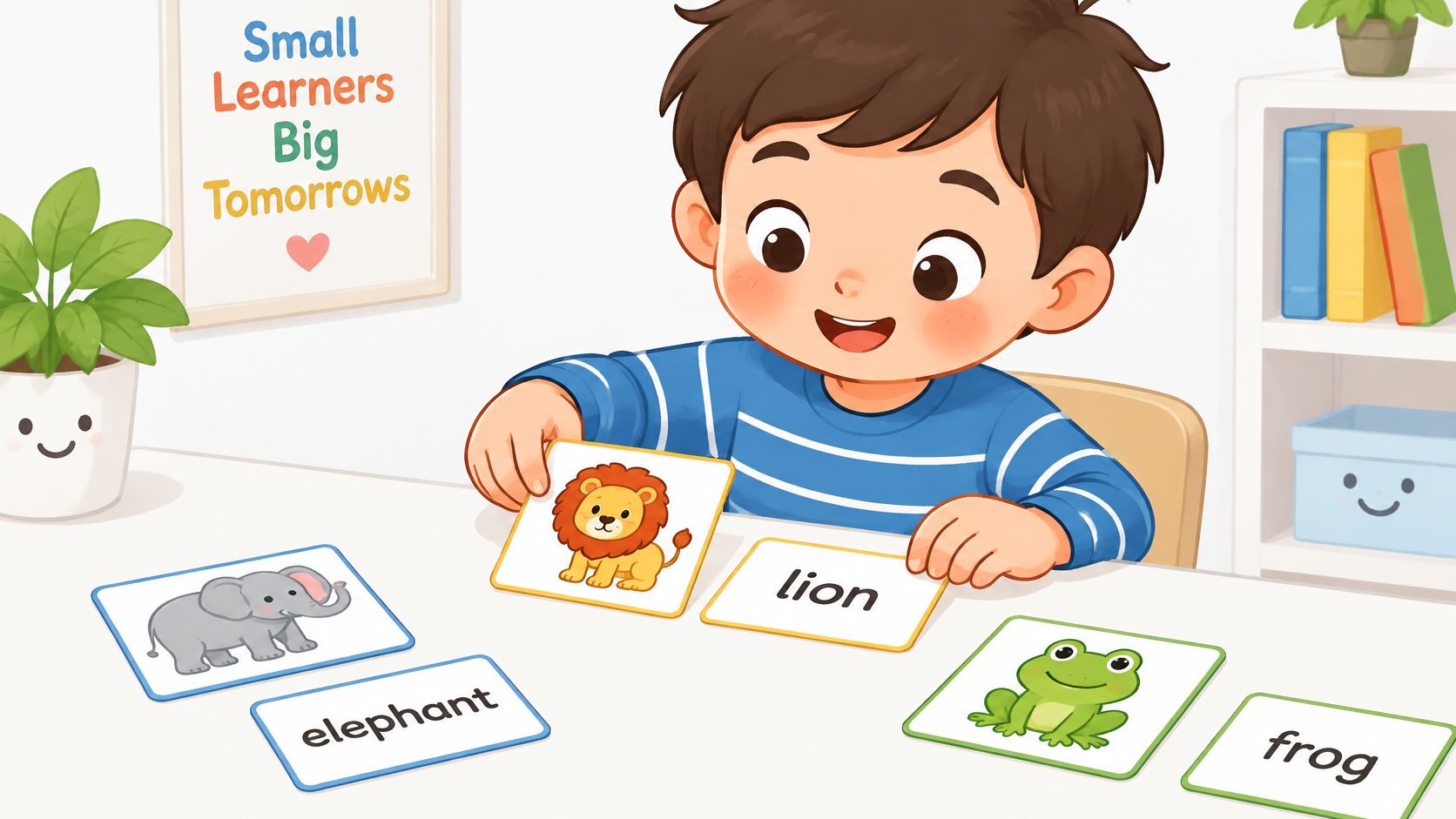
Start by matching picture to word with both faces up. Say the word as you lay each card down, ask the child to point to the one you named, and only then ask them to say it. Pointing comes before speaking because understanding arrives first, and a child who feels tested stops talking.
The matching format has classroom evidence behind it. A 2025 study of 12 elementary learners used an assessment built from matching, multiple-choice and jumbled-word items, and mean scores climbed from 65.83 to 95.00 after an interactive picture-based intervention, with p < 0.05 in the Journal of English Language Education report.
Three rules that keep it working
- Model, point, then speak. Reversing that order turns a game into a quiz.
- Begin with four or five pairs. Add more when the set is cleared in under a minute.
- Bring words back later. The NAEYC notes a child may gain only partial understanding from a single exposure, and repeated meetings in different contexts fill it in (NAEYC on learning new words).
A nine- or ten-year-old beginner plays the same game with sport, transport or weather cards. The routine stays, the topics grow up. First word lists sit in this guide to English vocabulary for kids.
2. I Spy with Pictures
The clue is the whole game. One player picks something in the picture and says "I spy with my little eye something that is red", and everyone else guesses. An adult who can't hold a conversation in English can still run this, because the only line needed is one sentence frame.
Why guessing beats pointing: the child listens for a colour, holds two or three candidates in mind, and answers out loud. That's a speaking turn, not a vocabulary check.
Materials: one busy picture, such as a farm, a market or a classroom poster, plus a card with ten to fifteen English words the adult can pronounce. Keep the card face up. Reading a word aloud is easier than retrieving it under pressure.
Guidance on early language is clear about where words come from: children learn more when they have chances to talk, use unfamiliar vocabulary and answer adults' questions, and conversation is what lets an adult repeat a new word and shape how it's used (NAEYC). I Spy is that conversation in its smallest form.
- Ages 5-6: colour and sound clues. "Something that says moo."
- Ages 7-8: a frame. "It is big and it is brown."
- Ages 9-10: the child gives the clue, with location and purpose. "It's the thing you use to cut bread."
Model one clue, then hand the turn over. Children copy the frame long before they invent their own.
3. Dialogic Reading with Picture Books
An English picture book opened at the pictures rather than the words is a full speaking activity. Ask "What's that?" or "What is the dog doing?", accept an answer in a word or a gesture, then say the English version back. The adult doesn't need to read the text aloud, only to keep asking.

This style has a name, dialogic reading, and a short set of prompts. Completion ("the bear is..."), recall ("what happened first?"), open-ended questions ("what's he doing?"), wh-questions and distancing ("what would you do?") give an adult five reliable things to say with no preparation.
Evidence for picture-supported comprehension among young beginners is encouraging. A 2025-2026 study of 15 children aged 5-6 saw mean scores rise from 2.07 to 3.67, a 1.60-point gain equal to roughly 77% of the starting mean, reported at p = 0.000 in the Edulite picture storybook study. The measure was comprehension rather than speech, so read it as support for picture-led input.
One prompt per age
- Ages 5-6: naming. One question per page, pointing allowed.
- Ages 7-8: expansion. "Apple" becomes "yes, a red apple".
- Ages 9-10: prediction, why questions, then a retelling in their own words.
NAEYC points out that storybooks use vocabulary differently from daily conversation, which is exactly why an adult explaining a word matters (NAEYC on reading together). Short picture stories for beginners are collected in English learning stories, and Setterfren's guide to interactive reading helps with book choice.
4. Picture Sequence Storytelling
Three to six pictures that show one event, shuffled. The child puts them in order, then narrates: "First he eats breakfast. Then he brushes his teeth." Sequencing pulls a beginner from single words into time words and short clauses, which is the step most picture activities skip.
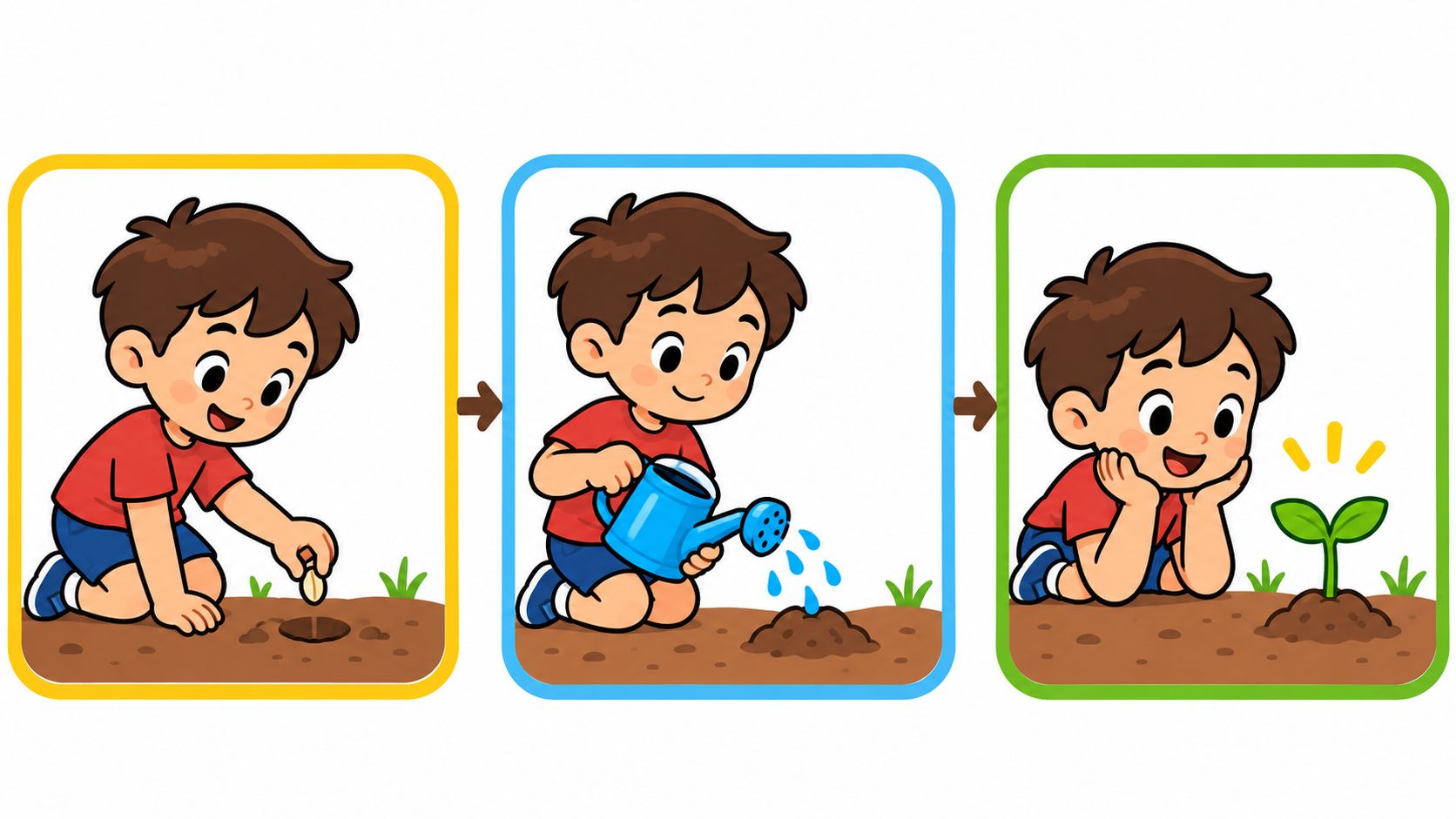
A worked example. Print four photos of your own morning: alarm, toothbrush, coat, door. Hand them over out of order and let the child arrange them on the table before saying anything. Then point to the first card, say "First I brush my teeth", and wait.
Ordered sequences appear to steady a group as well as lift the average. In a study of 25 fourth-grade learners using pictorial narratives, mean vocabulary scores rose from 72.20 to 85.44 while the standard deviation fell from 22.61 to 14.47, reported by Atlantis Press. Scores up and spread down points to more consistent performance across children.
Frames and age jumps
- Two or three cards to start. Add cards before adding grammar.
- A frame on the table. "First ___. Then ___. Finally ___." written out, so the child isn't holding the sentence in memory.
- Ages 5-6: three cards about a familiar routine.
- Ages 9-10: a hobby, a school day or a simple experiment, explained step by step to a listener.
Test recall by removing the cards and asking for the story again a day later. For narrative technique that transfers to any topic, Mike Bowers on storytelling structure is a useful read.
5. Total Physical Response with Picture Cards
Commands beat questions in the first weeks. Total Physical Response, the listen-and-move method James Asher developed, asks a child to show understanding with the body before producing a word. "Touch the red ball." "Jump like a frog." "Pick up the blue cup." The child moves, and nobody has had to speak yet.
Picture cards make the commands concrete. Hold up the cup card as you say the instruction the first time, then put the card down and repeat the command. Remove the picture and you can see whether the word stuck.
Model the action yourself once, then give the command with your hands still. If the child watches your body instead of listening to the word, the listening never happens.
Beginners need two- and three-word commands. "Touch the table" is fair game at five. "Put the apple on the table next to the bread" is where nine- and ten-year-olds start, and they enjoy the longer chains because the challenge feels bigger than the one a small child gets.
Materials are whatever's in the room: a ball, a cup, a book, a chair. Add five or six picture cards for the nouns, keep them face up on the floor, and let the child place each card next to its object after every command.
Hand the commands over
Once the child follows ten commands without hesitation, swap roles. The child gives the orders and the adult performs them, getting one deliberately wrong now and then so the child has to correct the English: "No, the blue cup." Shy children who won't repeat a word will happily issue a command, which is speech with the pressure taken out.
6. Home Picture Walk Labelling
The house is already full of English words waiting for a label. Draw or print small cards for ten objects in one room, tape them on, and walk the room together naming each one. Fridge, sink, table, door. The walk takes five minutes and needs no English from the adult beyond the words on the cards.
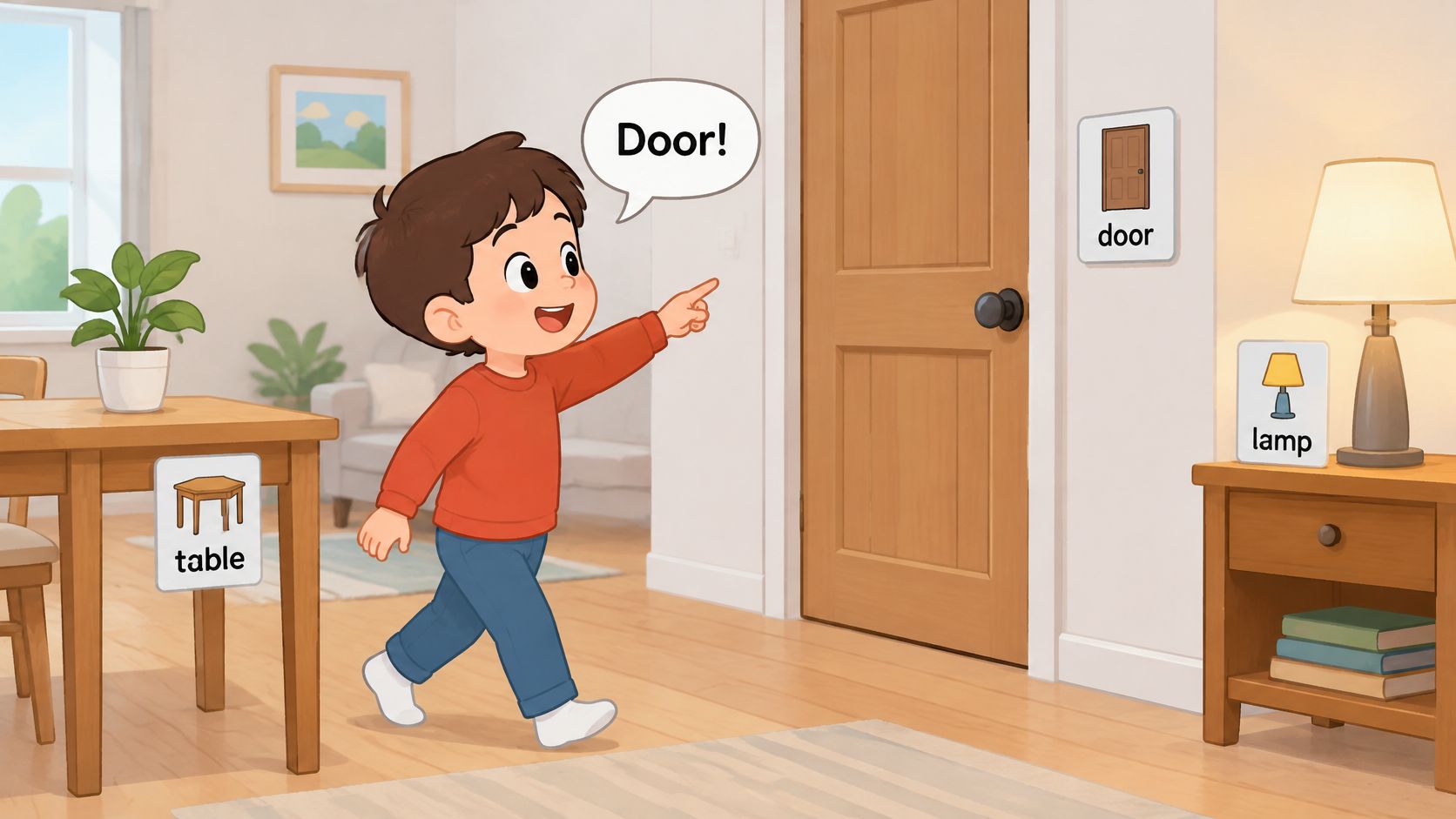
NAEYC treats routine activities such as singing, drawing and playing games as real vocabulary opportunities, and adds that talking, listening and reading aloud carry early literacy along with them (NAEYC on everyday reading and writing). A labelled kitchen is that principle with almost no preparation and no materials to buy.
Vary the question, not the route
- Ages 5-6: single nouns. "Where's the table?" Walk there together.
- Ages 7-8: add colour and position. "The book is on the bed."
- Ages 9-10: the child labels a room alone, then presents it. "This is my desk. I do homework here."
Change the labels weekly, or the walk becomes wallpaper. Rotate one room at a time so the child has to notice the word rather than recite it from memory.
An adult who isn't confident speaking English can still run this by keeping the ten words written on a list stuck to the fridge and reading from it. The child gets the sound, the object and the movement in the same thirty seconds, which is what makes a word stick. A tutor can use the same task with a drawing of a bedroom instead of a real room, and ask the learner to present it to the group.
7. Guess-the-Picture Describe Game
One player secretly picks a card and describes it until someone guesses. "It is an animal. It has four legs. It says woof." The describer is speaking, everyone else is listening for detail, and the guessing is genuine rather than a comprehension check.
Give the describer a frame to lean on: "It is a ___. It is ___. It has ___." Guessers ask yes or no questions, which teaches question forms without a grammar lesson.
The talk around the picture is where the language work happens. Research involving 448 young children found that higher screen exposure was associated with poorer language-development scores, while face-to-face child and adult talk was positively associated with those scores, as reported in Frontiers in Developmental Psychology. The picture isn't the intervention. The exchange around it is.
A child who points to the correct card has shown understanding. A child who says "it's a dog" has shown production. Both count, and they aren't the same milestone.
Age adjustments
- Ages 5-6: animals and colours, two clues only.
- Ages 7-8: add size and body parts.
- Ages 9-10: clues about where an object is found, what it's used for or how it feels. School objects work well: "It is used to write."
Two players is enough. Three is better, because the guessers then have to negotiate the answer in English too.
8. Audio Picture-Matching Practice in an App
When nobody at home can model the pronunciation, the audio has to come from somewhere. An app that pairs a spoken word with a picture and asks the child to say it covers the same ground as the card games, with consistent sound every time.
Talkio Kids, by Aidia ApS, is built for complete beginners aged 5-10 and runs short listening, picture-matching, speaking and review activities around a space adventure with an alien companion called Nox. Every instruction and every word is spoken as well as written, audio replays with one tap, and new words arrive in small steps with no previous English needed. Learning content works offline and progress stays on the device, which suits flights, waiting rooms and homes without reliable internet. Speaking steps use on-device recognition, and if the microphone permission is declined they become a "tap when you've said it" self-check.
A systematic review of 13 studies on visual support for young English learners found picture-based approaches produced notable vocabulary-acquisition improvements, and drew the practical conclusion that an image should be paired with a modelled spoken word and followed by retrieval (DiVA systematic review). That sequence is what to look for in any app.
Using it well
- Five to ten minutes, ending on a win. Stop before attention collapses.
- Say it before tapping. For ages 9-10, ask for the word aloud first.
- Sit alongside for the first sessions. Younger children lead the matching; the adult holds the pace.
It's available on the App Store and Google Play. Subscription options and any trial eligibility are shown inside the app. The reasoning behind spoken-first design is set out in this guide to audio-visual support for early readers.
Picture activities at a glance
Session times below are typical ranges, and the last column is the key filter for an adult who is not a confident English speaker: every activity here runs from pictures alone, so the adult points, reads a card or replays audio rather than inventing sentences.
| Activity | Materials needed | Best for | Time per session | Adult English level needed |
|---|---|---|---|---|
| Picture-Word Matching Cards | Picture and word cards, homemade or printed | Complete beginners learning everyday vocabulary | 5–10 minutes | Low; pictures carry the meaning |
| I Spy with Pictures | Picture book, picture card, or objects around the room | Listening, descriptive vocabulary, and turn-taking | Flexible; no set duration | Basic; a short target-word list can help |
| Dialogic Reading with Picture Books | Picture book | Speaking confidence and oral language through shared reading | 10–15 minutes | Low; simple questions and repetition are enough |
| Picture Sequence Storytelling | 3–6 sequence pictures or cards | Moving from vocabulary to sentences and storytelling | 5–10 minutes | Some modelling may be needed |
| Total Physical Response with Picture Cards | Picture cards and safe space to move | Listening and understanding through movement, especially for shy children | 5–10 minutes | Basic; short commands and gestures are enough |
| Home Picture Walk Labelling | Household objects, paper, markers, and tape | Practising everyday vocabulary in context | 5–10 minutes | Basic; a word list may help |
| Guess-the-Picture Describe Game | Clear picture cards | Descriptive language, listening, and simple sentences | 5–10 minutes | Some English needed to give and understand clues |
| Audio Picture-Matching Practice in an App | Talkio Kids app and a device | Beginner listening, vocabulary, and speaking practice | 5–10 minutes | Low; audio guides the practice |
Pick One Picture Routine and Start This Week
A five-minute picture routine is easier to repeat than eight activities tried once. Choose one activity and use it three times this week before adding another. The best fit depends on the child's age and how comfortable the adult feels speaking English.
If you are not confident speaking English, choose picture cards, a home picture walk or an audio-led app. Pictures and replayable audio give the child a clear prompt without requiring you to invent sentences. If you can say a few English phrases, try I Spy or the describe game, using a simple frame such as “I see a red bird.”
Keep the same activity as children grow, but adjust the challenge. For ages 5–6, use three or four pictures and ask one question at a time. For ages 7–8, add a colour or size to a sentence frame: “It's a big, blue bus.” For ages 9–10, use familiar subjects such as sport, transport or school, while keeping the picture in view. The vocabulary can change; the visual support still helps beginners.
Let the child point before expecting a spoken answer. Say the word clearly, pause, and accept a gesture as a response. Short sessions can end while the child is still engaged, leaving the same pictures ready for the next practice.
Screens also need a clear purpose. A Norwegian cohort study of 747 children aged 5–7, reported in JAMA Pediatrics, found an association between parents' smartphone use and slower growth in children's receptive vocabulary. Its observational design cannot establish cause and effect. For a picture activity on a device, sit together when possible, invite the child to answer aloud, then put the device away when practice ends.
When no one at home feels confident speaking English, an app can provide spoken prompts alongside offline picture activities. Talkio Kids offers short English lessons for complete beginners aged 5–10, combining audio, pictures, simple questions and speaking practice. Learning content works offline, and no account is required. Monthly and annual subscriptions are available; eligible trials and current prices are shown in the app. Find Talkio Kids on its website or download it from the App Store or Google Play.