
English learning at home
Help a Shy Child Speak English: A Gentle Home Routine
Help a shy child speak English at home with short, low-pressure picture, sound and action routines that build confidence gradually, step by step.
By Talkio Kids ·
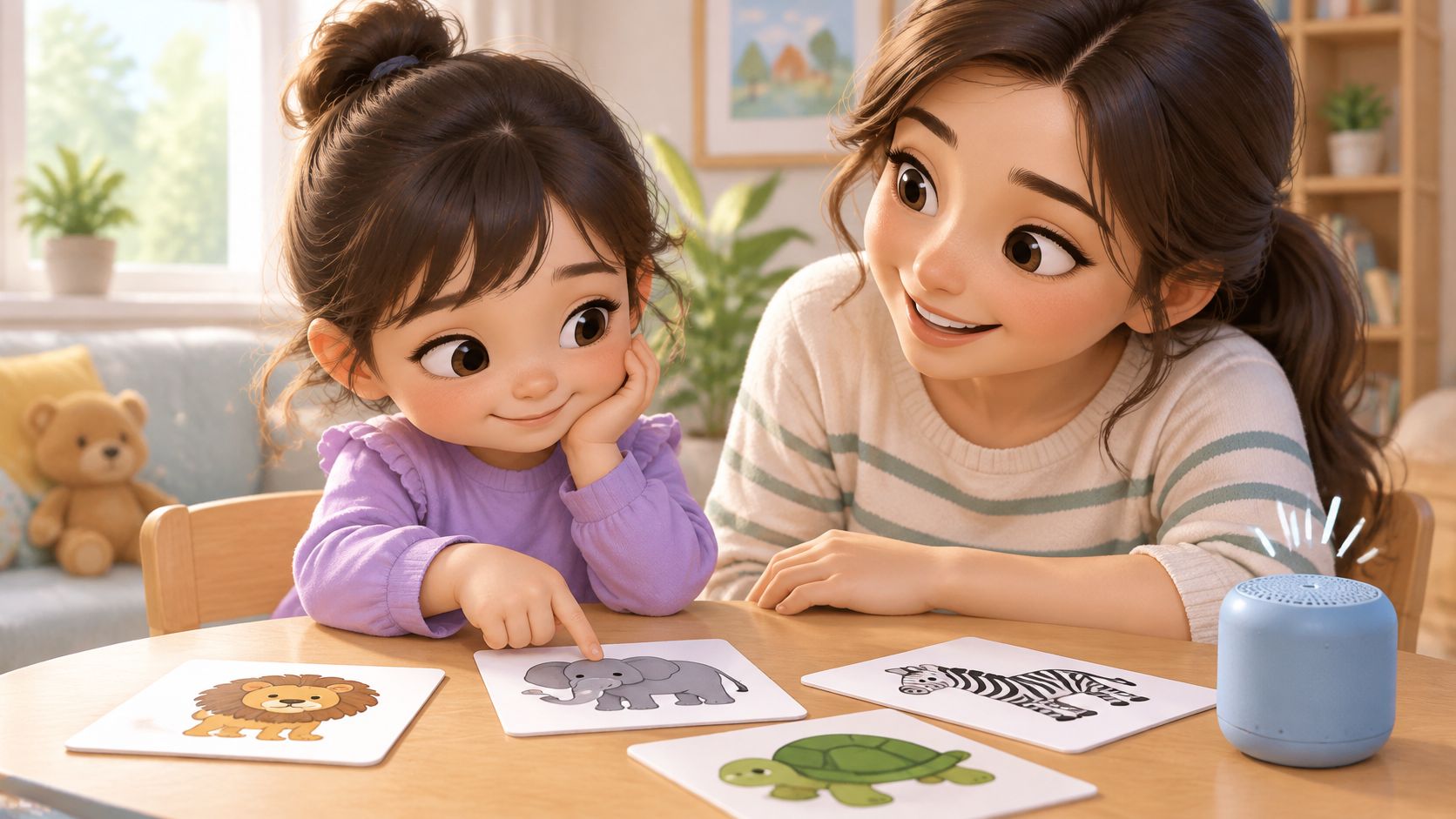
At breakfast, a child names every animal on a picture book in a happy whisper. At school, the teacher holds up the same dog card, classmates turn to look, and there's silence. That gap doesn't usually mean the word has vanished. It often means the moment feels too risky, and a calmer first step will help a shy child speak English sooner than a louder prompt.
Why a Shy Child Freezes Even When They Know the Words
The word can be ready in the child's head and still refuse to come out. Producing it while people wait is a different job from recognising a picture.
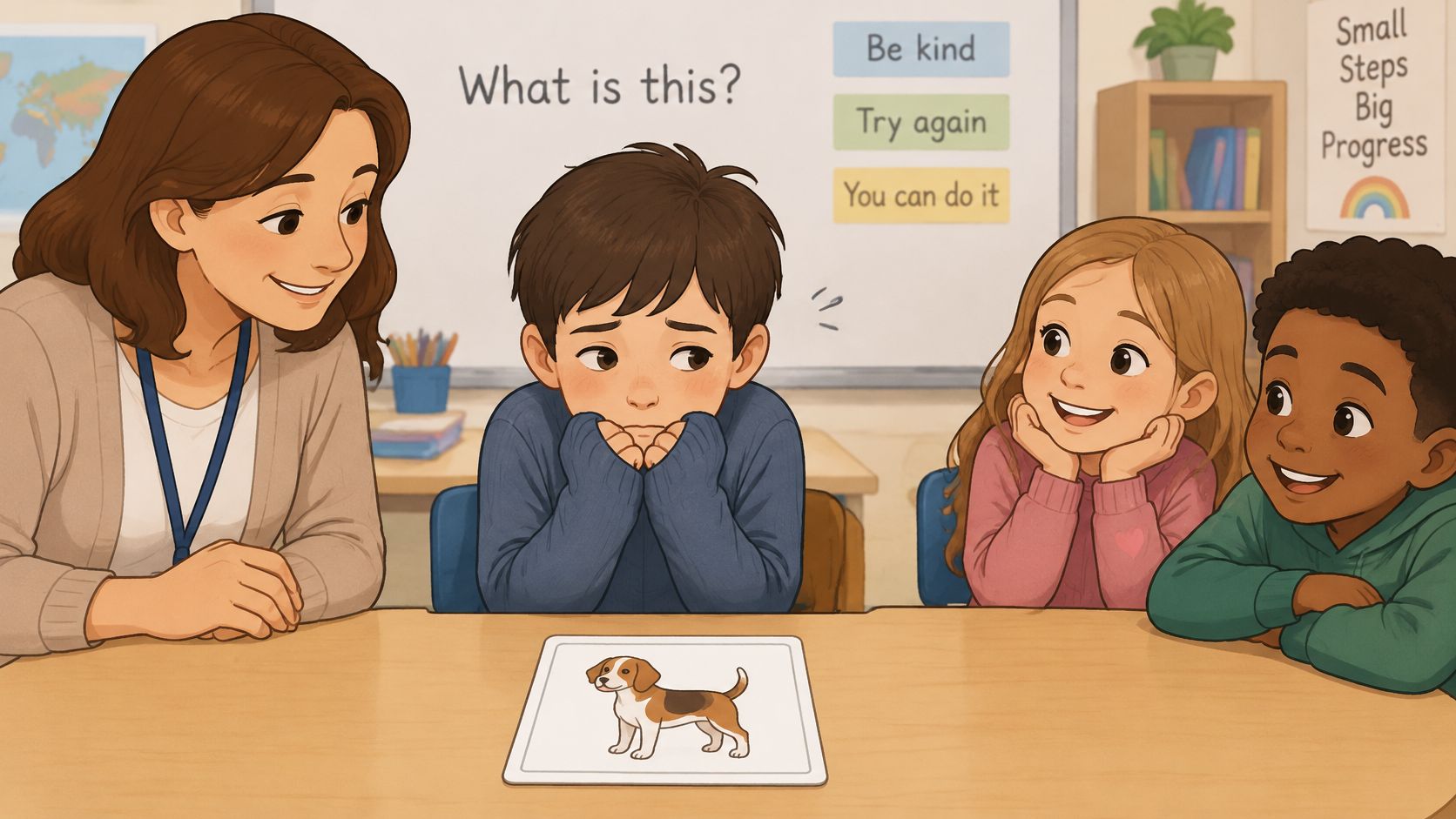
What anxiety does to speaking
Speaking on demand works like tying a shoelace while a room watches the knot. The same fingers manage easily when nobody is counting. A meta-analysis on foreign-language anxiety found a correlation of approximately -0.36 between anxiety and language achievement. More worry tends to sit alongside weaker results, so silence is often an anxiety trigger you can lower, not a personality fixed in place.
Four triggers show up often: vocabulary retrieval under a stare, fear of mistakes, self-consciousness, and a perceived lack of competence. Any one of them can close the mouth even after the child has already matched the picture.
A child who is quiet in every setting and relaxed at home may be reserved. A child who chats one to one, then freezes after a direct question in front of others, is showing a situation-specific response. Pressure to “just say it” usually raises the risk they already feel. Parents who want a clear line between everyday shyness and a condition such as selective mutism can read this plain-language guide to understanding selective mutism in children, without trying to diagnose at home.
You do not need confident English to change the order of speaking tonight. Sit with one familiar picture, let the child whisper the word only to you or to a toy, and keep that private success going until it feels ordinary. A turn in front of anyone else can wait.
First action: For three days, note when the child goes quiet and what happened just before, then choose one trigger to reduce first.
Adapting the Routine for Ages 5 to 10
Age and English level aren't the same thing. A 9- or 10-year-old can be a complete English beginner, and babyish songs will embarrass that child even though the English itself fits. Reading ability differs too, so matching the activity to the child matters more than matching the age on a box.
Starting point by age band
| Age band | Best starting activity | Speaking step to aim for | Watch for |
|---|---|---|---|
| 5 to 6 years | Picture matching with songs and actions | Repeating single words with the adult | Keep sessions playful and expect single words only |
| 7 to 8 years | Picture-word games and simple questions | Fixed phrases such as It is a red bus | Comparison with classmates or school talk |
| 9 to 10 years | Listening routines with pictures and short audio | Answering one question aloud before any peer turn | Embarrassment about being a beginner; keep speaking private at first |
For ages 5 to 6, a farm picture with a short song works well. The child points to the pig, flaps arms for the duck, and joins the word while the adult sings it. Speech stays inside play, and a single word counts as a full turn.
For ages 7 to 8, a picture-word game adds a short frame. The adult asks, “What is it?” and the child answers, “It is a red bus.” Early readers can follow the printed word while listening, which strengthens the link between sound and letters.
For ages 9 to 10, a short audio clip with picture choices feels more respectful. The child points yes or no, whispers the fixed phrase to the adult first, and only later says it when a sibling joins. Privacy protects dignity at this age.
When the parent isn't confident in English
Children who can't read yet still take part fully through sound, pictures, gestures, and pointing. An audio model does the pronunciation work, so the adult only repeats the same everyday phrase and accepts pointing as a valid answer. Offline activities also keep practice going during travel or with unreliable internet.
Choose the row that fits the child's English level and reading ability, not the age printed on the box.
The Five-Rung Speaking Ladder for Home
Dinner is over, the picture of a red bus is on the table, and your child knows the words. You ask once. They look at the card and say nothing. That pause is usually anxiety, not a gap in English. Fear of a mistake, fear that someone will laugh, and uncertainty about the task can lock the voice even when the meaning is already clear.
The ladder treats that freeze as something you can shrink. Speech stays private until the child has already succeeded with you. Only then does a sibling or friend hear the same words.
The order never changes. 1. Listen and point, 2. repeat one word, 3. say a fixed phrase, 4. answer a predictable question, 5. speak with a sibling or peer. A child who jumps from pointing straight to a group turn is being asked to perform before private success has had time to grow.
The five speaking rungs and when to move up
| Rung | What the child does | What the adult does | Move up when |
|---|---|---|---|
| 1. Listen and point | Points to the picture that matches a word | Says the word and points first | Child points without hesitation across several sessions |
| 2. Repeat one word | Says one target word after the adult | Models the word, then waits | Child repeats most target words without a prompt |
| 3. Say a fixed phrase | Uses a set phrase such as It is a red bus | Says the phrase first, then asks the question | Child uses the phrase with the same frame on several days |
| 4. Answer a predictable question | Answers What is it? in the same frame | Keeps the routine identical each session | Child answers without preparation time |
| 5. Speak with a peer | Takes a turn with a sibling or small group | Stays nearby and speaks last | Child volunteers a turn without being asked |
Among 8- and 10-year-olds learning a foreign language, research on shy pupils in foreign-language classrooms describes three triggers: fear of mistakes, fear of peer criticism or laughter, and insecurity when children do not understand the teacher, vocabulary, or task. Pointing and shared turns are ordinary teaching moves for those triggers. A finger on the right picture proves understanding while the voice is still catching up. A turn taken beside someone else spreads the attention, so one child is not standing alone in the silence.
Oral fluency in a new language often takes a long time, even for children who already understand a great deal. A quiet week at home is not proof that English is missing.
You do not need a confident English accent to hold a rung. Say, or play, the same short model, then wait. If your own pronunciation feels shaky, borrow gentle wording from this guide to English conversation practice for children and keep only the rung your child already manages.
How to run each turn
- Model first: Say the answer, give preparation time, then invite the child to copy it.
- Repeat the frame: Use “What is it?” and “It is a red bus” until answering takes little effort.
- Correct afterwards: Wait until the child finishes, then say the correct form once, naturally.
A wrong word in the middle of a turn is still a turn. Fixing it on the spot often sends the child back into silence. Hearing the right form once, after they finish, keeps the door open for the next try.
Stay on the rung the child can already do for one week. Look for less avoidance, more voluntary attempts, and accurate use of familiar phrases. Fluency can wait.
Ten-Minute Picture, Sound and Action Routine
Ten minutes is long enough when every step has a job. The adult can draw simple pictures, cut them from a magazine, or use objects from the kitchen, so nothing needs buying.
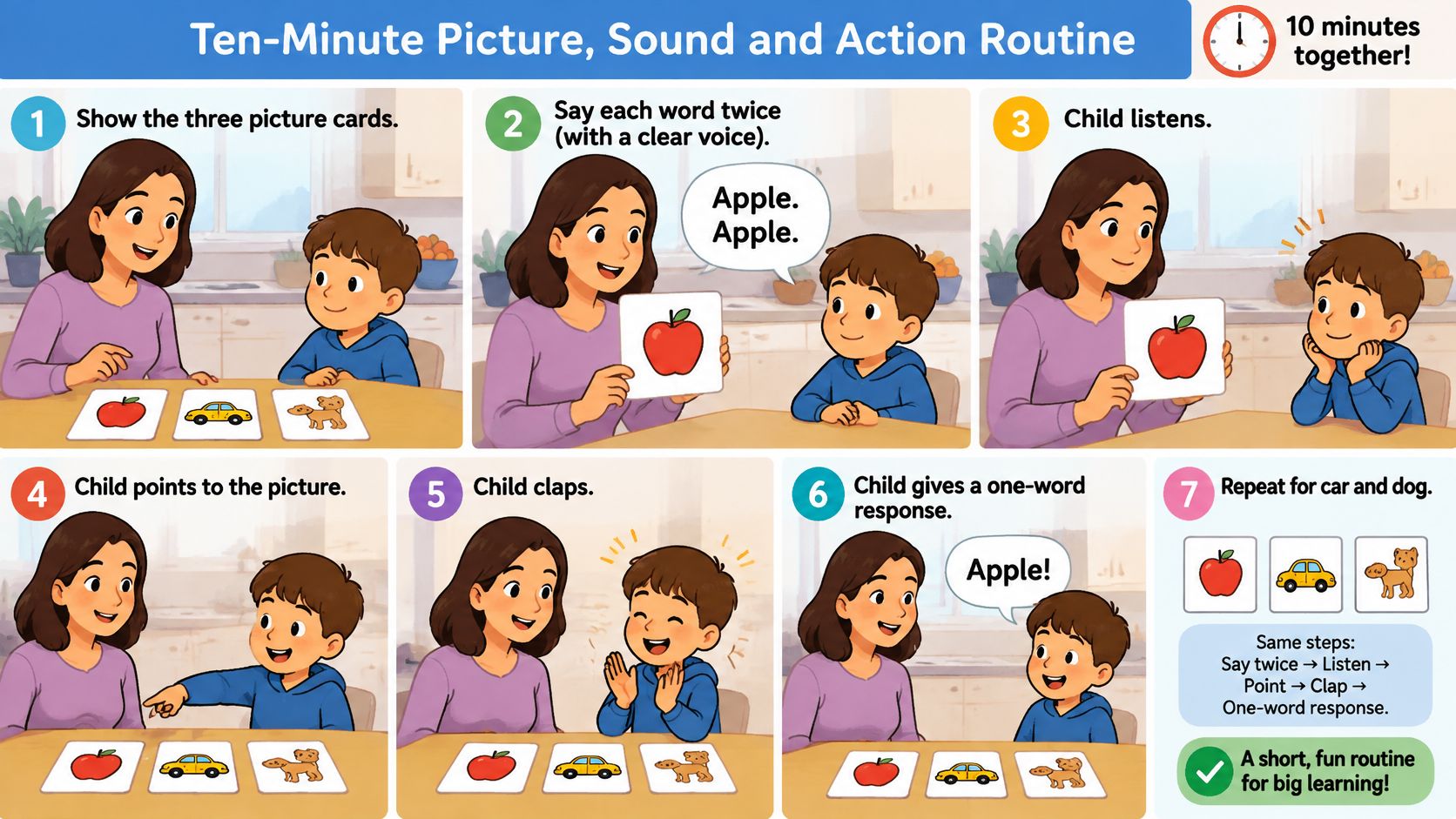
The steps in order
- Pick one topic: Choose three to five words from food, animals, or colours. A small set lets the child meet each word many times without overload.
- Show and say: Hold up each picture, point, and say the word twice, clearly and at normal speed. The child only looks and listens, which removes any demand to perform straight away.
- Listen and point: Play a short audio clip or say each word in a mixed order, pausing while the child points. Pointing shows understanding before speech, so success arrives early.
- Add an action: Mime eating for apple or hopping for rabbit, and do each action together. Movement gives shy children something to do besides worrying about their voice.
- Say it together: Use choral repetition, with adult and child saying each word at the same time. Speaking in unison hides individual mistakes and feels safer than a solo turn.
- Point, then name: Name a picture for the child to find, then point to one and wait for the child to name it. Count to five before helping, since planning an answer takes time.
- Play a guessing game: Hide one card behind a book and let the child guess using the same frame, such as “Is it a banana?” Wrong guesses still use English, so the game can't really be lost.
- Finish together: Repeat one favourite phrase side by side, name what the child did, and stop before tiredness sets in. Ending while it's still enjoyable makes the next session easier to start.
A second option for busy evenings
Families can also play three picture-word matching games supported by audio, then place five cards on the table after dinner for drawing, pointing, or miming. Early readers can look at the printed word, while non-readers rely on the picture and sound. More variations appear in these English speaking activities for kids, and parents can borrow only the steps that suit their child's current rung.
Timing guide: Run the routine for about ten minutes, three to five times a week, and note which step gets the most willing response after the second session.
Track Confidence Without Adding Pressure
Progress isn't only louder speech. A study of young Turkish EFL learners in research combining Total Physical Response with Communicative Language Teaching produced a statistically assessed reduction in reported speaking anxiety, with a post-intervention anxiety mean of 3.9 (SD 0.87). Output and feelings can move at different speeds, so tracking them separately gives a fairer picture.
Three weekly measures of speaking confidence
| Measure | How to record it | Sign of progress |
|---|---|---|
| Voluntary speaking attempts | Tally each time the child speaks without being asked, per session | Tally rises across the week |
| Target phrases without prompting | Count phrases completed alone out of those used that day | Share rises over several weeks |
| Child-rated anxiety | Child points to a 1 to 5 face before and after the session | Scores stay low or fall over time |
Paper works fine. A tally mark captures each unprompted try, a sticker marks each phrase said alone, and a row of five faces lets the child show feelings without explaining them in words.
Pitfalls that undo progress
- Forcing performance: Demanding eye contact or a turn in front of visitors raises the stakes too fast.
- Correcting everything: Fixing every pronunciation error teaches the child that speaking invites criticism.
- Adding too many words: New vocabulary each day leaves no time for phrases to feel automatic.
- Replacing the adult: An app or video can't notice hesitation and slow down the way a responsive adult can.
Lower-stress contexts suit most children better, and anxiety rises when tasks feel incomprehensible or beyond their ability. Success means improvement against the child's own baseline, not a universal target, so recording that baseline this week comes before changing anything else.
When Silence Continues
It is Thursday evening. The picture is familiar, the phrase is the same one from Monday, and your child still looks at the floor. Two or three calm weeks with very little speech do not mean the routine failed. Silence here works like a stiff door, not a missing key. The words may already be in the room. One trigger is still active, or the rung sits one step too high.
A calmer reset, step by step
- Check the trigger log: Look again at the notes from the first three days and confirm which situation still causes silence, such as an audience, a new word, or a surprise question.
- Drop back one rung: Return to pointing or saying the phrase together so the child succeeds at a level already managed, and stay there without apology. A parent who is unsure of their own English can point at the picture and repeat one short model. Your child does not need a fluent performance from you.
- Shorten the session: Five minutes that end while the child is still willing beats ten minutes that end in tears or refusal.
- Remove comparisons: Drop references to siblings or classmates, and drop "say it now" language completely. Competition rarely relaxes a hesitant speaker.
- Keep one phrase: Use the identical adult phrase every time and accept pointing as a full answer, so nothing about the task feels new. A quiet success at the kitchen table comes before any turn in front of visitors.
- Ask the teacher: Find out which classroom moments feel hardest, then practise that exact language frame at home so school and home match.
- Seek wider support: If worry continues or affects wellbeing beyond English, speaking with the school or a qualified professional is wiser than deciding alone. Families exploring local professional support sometimes start by reading about options such as counselling for autistic people in Kelowna, then choosing a qualified provider who fits their child's needs and location.
No routine guarantees a result, and timelines differ a great deal. One willing attempt, kept small enough to finish calmly, is enough for this week.
Checklist for Choosing a Low-Pressure App
App store pages promise adventure, but mechanics determine whether a shy child will speak. The British Council guidance for parents supporting English learning points to audio, picture matching, replay and review as the concrete features worth looking for, rather than relying only on claims about games or adventure themes.
Eight features to check
- Audio for every word: The child hears a clear model as often as needed.
- Picture matching: Answering by tapping comes before answering aloud.
- Replay within one tap: Repetition happens without asking an adult.
- Built-in review: Earlier words return across several days.
- A non-speech answer option: Tapping after listening keeps beginners included.
- No timers or harsh buzzers: Mistakes don't cost lives or hearts.
- Offline use: Practice continues during travel or weak internet.
- Parent-gated purchases and privacy: No real name required and no open chat.
Parents of non-readers will find more detail in this guide to English learning apps for children who cannot read. The same checklist compares any tool, including Talkio Kids, before a family decides.
Start With Three Words This Week
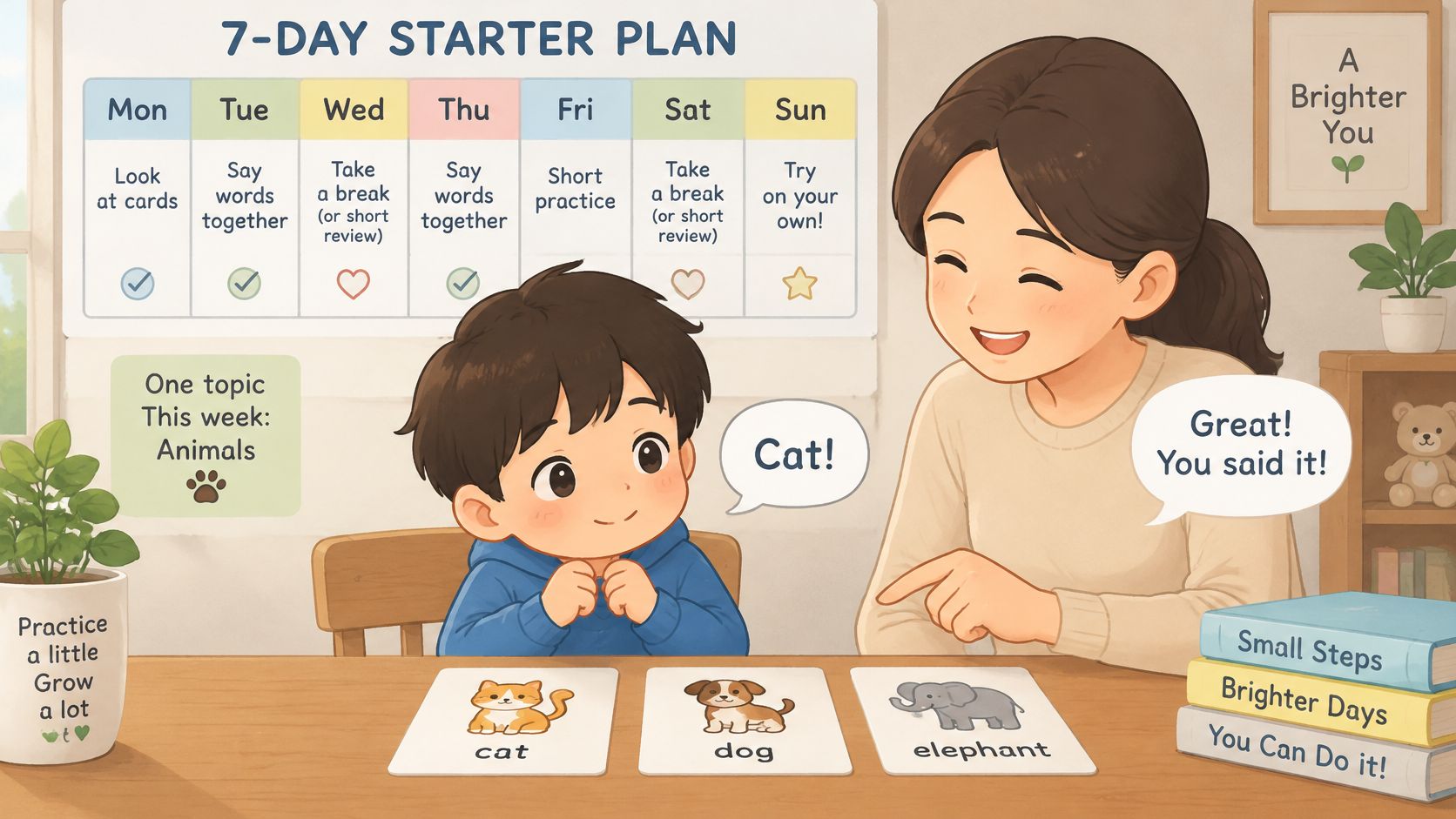
Tonight, choose one familiar topic and stop at three words. Cat, dog, and bird is enough. Hello, please, and thank you is enough too. Silence here is usually anxiety about being heard, not a sign that the English is missing, so the first tries stay private, just the two of you, before any bigger audience.
A seven-day start needs only one topic and three words. On days 1 and 2, parents run the ten-minute routine at the child's current rung and fill in the tracker. On days 3 to 5, the same words repeat with no new vocabulary. On days 6 and 7, families review, note the most willing step, and decide whether to stay or move up one rung. If a parent's own English feels uncertain, the audio can be the model and the child copies what they hear.
Parents who'd rather have listening, picture-matching, speaking, and review activities ready to use can look at Talkio Kids for complete beginners aged about 7–10. Each short lesson lets children hear English, connect words with pictures, answer simple questions, and practise saying words aloud, with audio replayable whenever needed, starting with greetings, animals, colours, numbers, family, and food. Nox, a friendly companion, introduces words and celebrates effort, and there are no hearts, lives, or harsh buzzers, so children can try again without getting stuck.
Content works offline, progress stays on the device, and no signup is needed. Monthly and annual subscriptions are chosen in the app, with eligible trials and prices shown there. Parents can explore Talkio Kids and get the app, download it from the App Store or Google Play, and find more home routines on the Talkio Kids blog.
Say the three words at the table tonight, picture in view, no audience. That private step is the whole assignment for this week.