
English learning at home
Fun English Speaking Games for 10 Year Old Beginners
Fun English speaking games for 10 year old beginners, with easy home setups, simple adaptations and tips for early readers. No purchase needed to start today.
By Talkio Kids ·
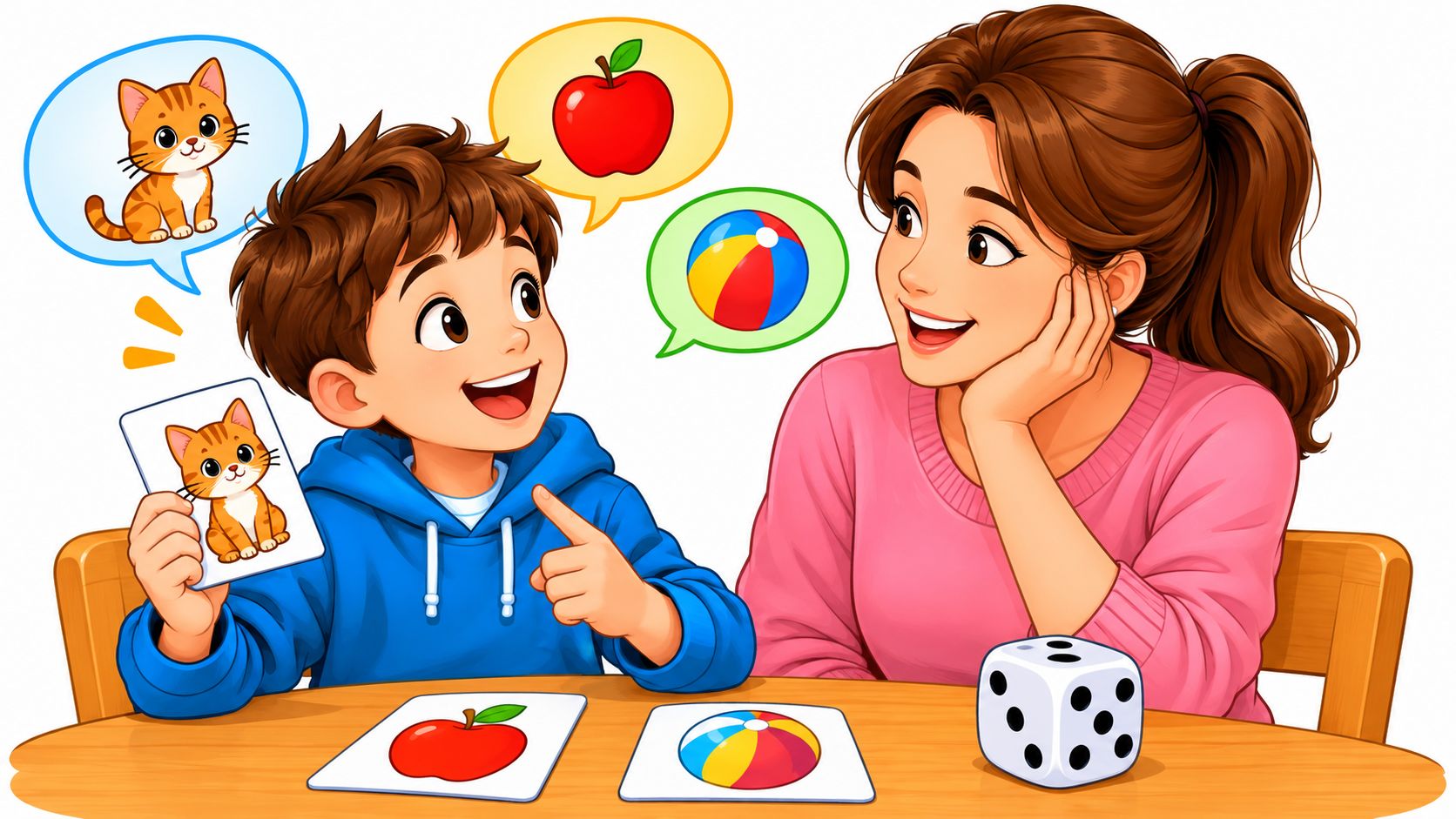
A ten-year-old recognises English words on a worksheet, but freezes when a visitor asks a simple question. A parent offers a hint, the child looks away, and a friendly exchange starts to feel like a test. The next practice session needs less pressure, not another page of exercises.
English proficiency isn't the same as age or reading ability. A ten-year-old can be a complete English beginner while reading confidently in another language, enjoying complex games, and wanting more independence. Beginner English activities can use simple language without treating an older child like a preschooler.
Well-chosen English speaking games for 10-year-old beginners give children a reason to listen and a manageable way to respond. A systematic review of digital game-based language learning found particularly consistent benefits for vocabulary and speaking, alongside motivation, self-efficacy, and reduced anxiety. That supports playful practice as a supplement, not a promise of rapid fluency.
- Start with meaning. Let the child listen, point, or act before expecting speech.
- Offer a small speaking step. A familiar word or repeated phrase is enough to begin.
- Keep the interest age-appropriate. Sports, space, pets, drawing, and running a pretend shop can all suit older beginners.
The following games need little preparation, and parents don't need fluent English to join in.
1. Simon Says for Action Vocabulary
Practises listening, body words, action verbs, and short commands. Simon Says makes a useful warm-up for a child who isn't ready to answer questions aloud.
The parent demonstrates a command such as Simon says touch your nose. The child copies the action, but stays still when a command doesn't begin with Simon says. Start slowly, with visible demonstrations, rather than trying to catch the child out.

Let the child become the leader
Begin with familiar commands such as touch your knees, jump, and clap. Once the child understands them, hand over the leader role, with a written prompt or drawing available for support.
- Make it easier. Demonstrate every action and leave out the trick commands.
- Make it harder. Combine familiar actions, such as clap and turn around.
- Support limited parent English. Keep the same command list available so both players can rehearse before playing.
A ten-year-old interested in space might lead a pretend astronaut training session using stand, turn, and jump. The theme changes, but the language stays manageable.
The trade-off: following commands demonstrates listening, not independent speaking. Letting the child lead adds spoken practice, but there's no need to eliminate anyone for mistakes. A smile, another demonstration, and another turn keep the game moving.
2. I Spy with Pictures and Simple Words
A crowded room can make I Spy harder than it needs to be. Start with a clear picture or a small collection of familiar objects, so the child has a realistic chance of finding the answer.
The parent gives a clue such as Find something red. The child points to a red cup, then hears the model a red cup. On another turn, the child can say the colour, name the object, or give the clue.
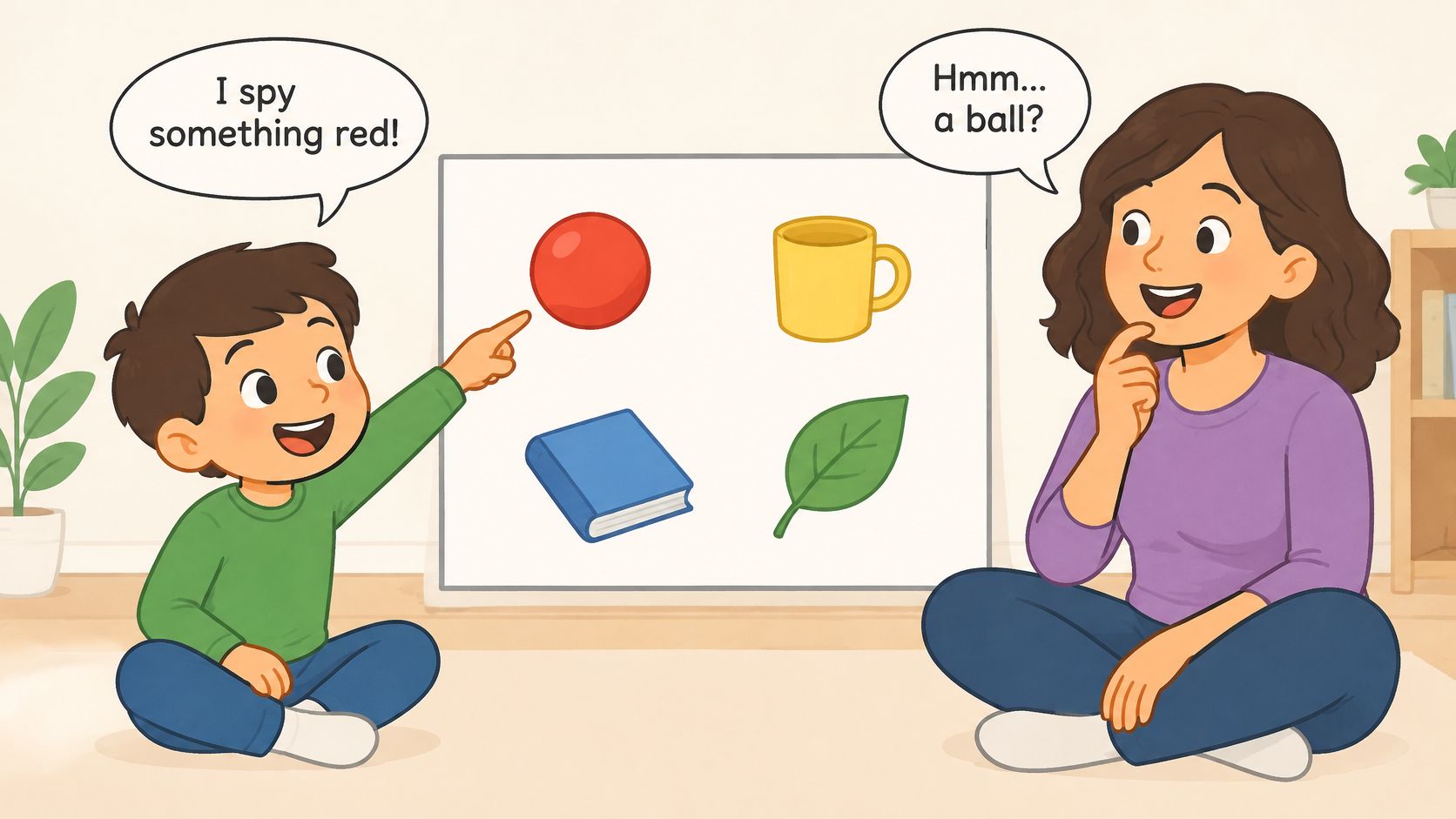
This practises colours, shapes, everyday nouns, and descriptive phrases. The English vocabulary for kids guide can help parents choose a familiar topic rather than mixing unrelated words.
Use interests without increasing the language load
For an older beginner, use a football picture, a bedroom design, or a scene containing vehicles. A child can choose the picture and decide which objects belong in the game.
- For early English readers. Use pictures without labels, then add written words when helpful.
- For confident readers. Offer word cards to match with objects before guessing.
- For hesitant speakers. Give spoken alternatives, such as cup or book, instead of asking an open question.
The trade-off: vague clues can turn vocabulary practice into frustrating guesswork. Accept a sensible answer when several objects fit, then make the next clue clearer.
3. Picture Charades for Mime and Guess
Mime a familiar action, then name it together. Brushing teeth, riding a bike, sleeping, and playing football are useful starting points because the actions are easy to show.
One player acts while the other guesses in English. A complete beginner can answer with swimming before moving towards a longer phrase such as The girl is swimming.
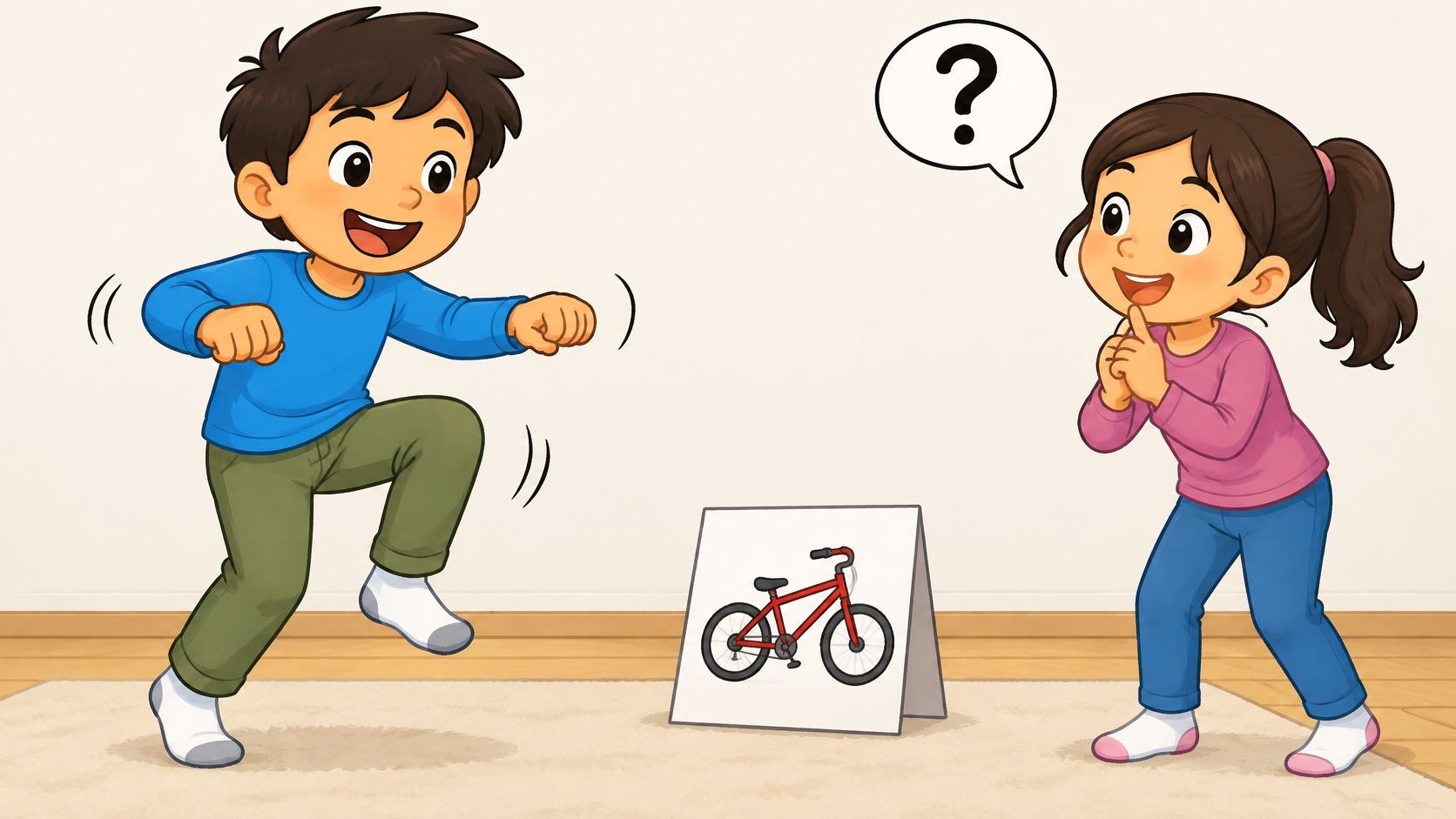
This game practises action vocabulary and short descriptions. For example, a child mimes feeding a cat; the parent says feeding the cat, and the child repeats whichever part feels manageable.
Keep the prompt visible
Draw action pictures on scrap paper, or write familiar phrases beside simple sketches. A parent with limited English can use the same prompts rather than inventing new language during each turn.
- Child-led version. The child chooses a sports or daily-routine theme and prepares the action cards.
- Easier version. Both players look at the possible answers before the mime begins.
- Harder version. The guesser describes the action in a short sentence.
Practical rule: don't make a complete sentence the entry fee for joining the game. Build towards it after the child can retrieve the action word.
The trade-off: a timer can add excitement, but it can also make a beginner rush or stop speaking. Start without one, and introduce timed rounds only if the child enjoys them.
4. Describe and Draw Game
The parent describes a strange creature with a green head, a round body, and long arms. The child draws it, then compares the result with the parent's original sketch.
Describe and Draw practises colours, size words, body vocabulary, and sentence patterns. It gives older beginners a creative task without requiring complicated English or polished artwork.
Keep the first description simple. It has a green head is more useful for a complete beginner than a detailed explanation involving position, shape, and several unfamiliar nouns.
Give the speaker usable language
Place sentence starters beside the paper, with a quick sketch showing their meaning.
- Use It has. Describe a robot, creature, vehicle, or imaginary pet.
- Use There is. Describe objects in a bedroom or outdoor scene.
- Use position words gradually. Add on, under, and next to after the objects themselves are familiar.
Swap roles so the child gets a speaking turn. A ten-year-old might design a robot and dictate its features while the parent draws, deliberately waiting for each instruction rather than guessing ahead.
The trade-off: drawing skill can distract from the language. Stick figures and rough shapes are enough, and differences between pictures aren't automatically English mistakes.
For parents with limited English, colour pencils and labelled sketches provide shared support. The parent can point to a sentence starter, pause, and let the child choose the next feature.
5. Market or Shop Role Play
A pretend shop provides a predictable reason to speak. The child can request an item, offer it, and thank the customer without needing to invent a whole conversation.
Use food packets, stationery, or drawings already available at home. Older beginners may prefer running a sports shop, game shop, or café rather than playing with toy food.
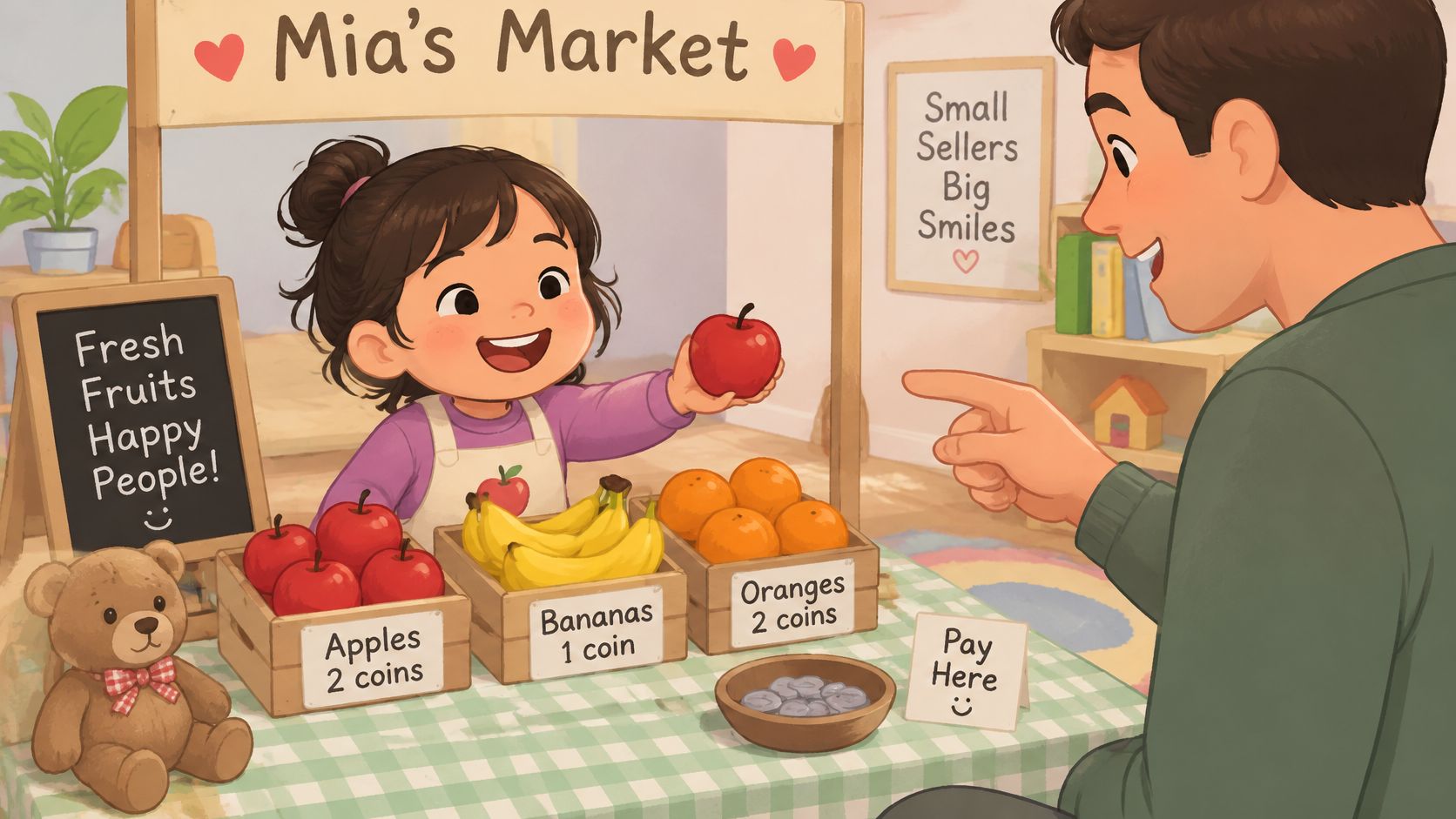
The parent might request an apple, please. The child hands it over with Here it is, and the parent replies Thank you. Repeating that exchange with different objects practises everyday nouns, requests, and polite responses.
Keep the conversation predictable
Prepare separate customer and shopkeeper prompt cards. The basic English phrases guide offers language parents can adapt to familiar home situations.
- Begin with objects. Rehearse their names before opening the shop.
- Add choice. Let the shopkeeper ask Red or green? or offer another familiar option.
- Add counting later. Introduce quantities or pretend money when the basic exchange feels comfortable.
The trade-off: shopping games can accidentally become arithmetic lessons. Leave prices out if numbers distract the child from speaking.
A parent doesn't need to correct every pronunciation attempt. Respond to the request, model the intended phrase naturally, and keep serving customers. The child can lead by arranging the stock and deciding which familiar items the shop sells.
6. Sentence Chain Story
A space dog finds a ball. The ball opens. A tiny alien comes out.
A sentence chain lets an older beginner create something imaginative using manageable language. Each player adds a short contribution, with drawings or written prompts available throughout.
This game practises listening to a partner, retrieving familiar vocabulary, and connecting simple sentences. It isn't the best starting point for a child who doesn't yet know the words needed for the story.
Build the story together
Start with a character and setting chosen by the child. Use familiar sentence starters such as There is, The dog has, and The alien likes.
- For complete beginners. Offer a choice between pictures, then say the resulting sentence together.
- For emerging speakers. Let the child supply a missing word while the parent provides the rest.
- For more independent beginners. Let the child add a short sentence without a model.
Write or sketch each contribution so neither player has to remember the whole story. The English learning stories guide can help parents connect story time with familiar vocabulary.
The National Literacy Trust's guidance on sharing books explains that shared reading combines talking, listening, and storytelling while providing a topic for conversation.
The trade-off: imaginative ideas can exceed available English. Let the child explain an idea in the home language, then help express a small, useful part in English. Creativity doesn't need to stop just because vocabulary is limited.
7. Echo Reading for Early Readers
Echo reading gives the child a spoken model before asking for independent reading. The parent reads a short line, then the child repeats it while looking at the same words and picture.
A sentence such as The bus is red is enough to begin. The activity practises listening, pronunciation attempts, rhythm, and connections between print and speech.
A ten-year-old who reads confidently in another language may still need help decoding English. Choose clear, short text with an appealing subject, not automatically a preschool book.
Turn repetition into a shared performance
Let the child choose a robot voice, a sleepy voice, or a storyteller voice. After rehearsing a familiar line, the child can become the leader and invite the parent to echo.
- Use matching pictures. The image should help explain the words rather than merely decorate the page.
- Follow the print. Point along the sentence without demanding that every word be read independently.
- Use recordings when helpful. Pause after a short line and repeat together.
The National Literacy Trust's audiobook guidance describes parent-reported benefits involving vocabulary, language understanding, and conversations about stories. Recordings can also give a parent with limited English a model to share.
A child who repeats a line successfully has practised that line. Independent use in a new situation is a separate step.
The trade-off: repetition can become tiring. Stop while the activity still feels comfortable, rather than insisting on finishing the page.
8. Spoken Bingo with Everyday Words
A bingo card with a small set of familiar pictures gives a beginner a manageable vocabulary set to work with. Draw foods, animals, or household objects together, then use buttons or coins as markers.
The parent calls bread, and the child covers the matching picture. That first round practises listening and word recognition. When the same words feel familiar, hand the calling cards to the child: each turn then requires retrieving the English name and saying it aloud. Picture matching checks recognition; calling the word checks retrieval. A systematic review of digital vocabulary-learning studies found that studies most often measured receptive word-meaning knowledge rather than productive use.
Make every player a caller
- Prepare together. Let the child choose the topic and draw the pictures; a pet, food, or space card can feel right for a ten-year-old without needing stronger reading.
- Rehearse openly. Name every picture before the cards are mixed, so the child hears each model first.
- Extend gently. Move from apple to a green apple once the basic noun comes easily.
For example, a ten-year-old creates a pet-themed card and calls animal names while the parent searches. If a word gets stuck, the child can show the picture, hear the model, and try again without losing the turn. A parent with limited English can still play by keeping the picture card visible and repeating the child's model.
Silent covering can win the game, so keep the caller role rotating. Cooperative play also works: both players try to cover every picture together.
9. Yes or No Question Ping-Pong
Does the cat like milk? The child answers Yes, then asks the same question back.
Question ping-pong practises turn-taking and predictable question-and-answer patterns. No ball or fast response is necessary, although passing a soft object can show whose turn comes next.
Begin with a pattern the child already understands. Picture cards can support questions such as Is it red? and Is it a dog? before moving into preferences or abilities.
Choose comfort before speed
Model a short answer, then offer a fuller version when the child is ready. Keep the same question structure while changing the picture or topic.
- Make it easier. Let the child answer by pointing before saying yes or no.
- Make it more independent. Hand the child a question card and answer it yourself. A parent with limited English can reply with a nod or a point, so the child still does all the speaking.
- Keep it personal without pressure. Stick to familiar food, hobbies, and pets, where the answer only needs a word or a gesture.
A Swedish year-four study of cooperative English gameplay found that most participating learners felt more comfortable speaking after the activity. Let the child set the speed once they are comfortable with the pattern.
Slow rounds are fine.
Quick rounds reward fast retrieval of phrases the child already knows. For a beginner, the same timer usually freezes the conversation, so leave it aside until the child actively wants a faster round.
For a reluctant speaker: listen together, repeat together, offer a spoken choice, then invite an independent answer. There is no need to jump straight to a performance.
10. Talkio Kids for Short Daily Audio-Led Practice
A ten-year-old who freezes during charades may still happily copy a recorded voice in private. Talkio Kids by Aidia ApS gives children approximately 7–10 years old that kind of low-pressure practice, with short lessons where the child hears English, connects words with pictures, answers simple questions, and says each word aloud. No previous English is needed, and every instruction is spoken as well as written, so early readers can follow by ear.
New words arrive in small steps around familiar topics: greetings, animals, colours, numbers, family, and food. Nox, a friendly alien companion, guides each lesson and celebrates effort, while the space journey keeps everything calm and easy to follow. There are no hearts, lives, or harsh buzzers; a wrong answer earns another try.
Where the app fits beside the games
Replay sits one tap away, so a child who needs five hearings takes five without embarrassment. Lessons, pictures, and recordings work offline, progress stays on the device, and no account or signup is required. The loop of short input, instant replay, and spoken response matches what parents of auditory learners look for in effective ways to study by listening.
- Speaking, two ways. With microphone permission and a compatible on-device recognizer, the app checks pronunciation; declined permission or unavailable recognition switches the step to "tap when you've said it" and the child self-judges.
- Home-language support. Instructions and word explanations work in English, Spanish, German, French, Italian, or Danish, so a parent with limited English can still join in.
- Purchases behind a parent gate. Monthly and annual subscriptions are available in the app, which shows trial eligibility and current prices.
The trade-off: the app never improvises, so new words still need a live game from this list to meet an unpredictable partner.
The American Academy of Child and Adolescent Psychiatry's guidance recommends healthy screen habits and limits rather than one fixed allowance for school-age children, so an earlier slot beats app practice at bedtime.
What each game needs and how to start it at home
A 10-year-old starting from zero can join every game in this list. The reading column shows how much written English is involved, and even echo reading can lean on audio so a child who reads little still takes part.
| Item | Materials | Reading needed | Good starting session |
|---|---|---|---|
| Simon Says for Action Vocabulary | None | None | 5–8 commands; about 5 minutes |
| I Spy with Pictures and Simple Words | Room objects or a picture | Little; optional word cards | 6–8 visible objects |
| Picture Charades: Mime and Guess | Picture cards or a written action list | Little; optional | 10 actions; 30 seconds per turn |
| Describe and Draw Game | Paper and pencil | Little; sentence starters optional | Three short sentences |
| Market or Shop Role Play | Toy food, paper money, or picture cards | Little; phrase cards optional | 5–6 items and a few key phrases |
| Sentence Chain Story | None; paper optional | Little; optional sentence starters | One sentence per turn |
| Echo Reading for Early Readers | Short picture book; audio optional | Some; simple words | About 10 minutes or less |
| Spoken Bingo with Everyday Words | Picture or word cards; small markers | Little; picture matching helps | 8–10 words |
| Yes or No Question Ping-Pong | None; timer optional | None | 30-second round |
| Talkio Kids: Short Daily Audio-Led Practice | Mobile device with the app | None; audio and pictures support early readers | About 5 minutes |
The last row is the optional app rather than a home game. It is the only entry that needs a device, and it can stand in for a game on days when a parent has little time or limited English.
Pick One Game Tonight and Keep It Short
A parent doesn't need every game on the list. Choose an activity that suits the child's interests and current English, then stop before practice becomes a struggle. Movement may suit a restless child, drawing may suit a careful observer, and a pretend shop may appeal to a child who likes taking charge.
Keep the vocabulary familiar enough for the child to participate. A British Council parent guide recommends picture–word matching with audio for home vocabulary revision. That makes a useful preparation step before asking the child to name, describe, or request the same items aloud.
Repeat the activity, not the pressure
A simple routine can follow the same sequence while changing the game. First, hear the words and establish their meaning; next, practise with support; finally, offer a small opportunity to speak without a model.
- If the child refuses to repeat. Return to listening, pointing, or taking actions together. Offer another speaking opportunity later without making refusal the centre of attention.
- If the child makes a mistake. Give a clear model and continue. Save longer explanations for a moment when the child wants help.
- If the child wants more independence. Hand over the cards, caller role, shop, or drawing instructions.
- If the parent isn't confident in English. Use pictures, replayable audio, and a familiar set of phrases rather than improvising a lesson.
Notice readiness as well as accuracy. Choosing another turn, attempting a familiar word, or speaking with less prompting can all be useful observations. They're not proof of fluency, but they help a parent decide whether to repeat, simplify, or extend an activity.
Keep age and proficiency separate throughout. An older beginner may need very simple English while still wanting meaningful choices, interesting topics, and control over the game.
For a structured option alongside home games, parents can explore the app download options, then choose the App Store listing or Google Play listing. Current subscription prices and trial eligibility are shown in the app before subscribing.
Talkio Kids offers short listening, picture-matching, speaking, and review activities for complete beginners, giving families vocabulary to reuse in home games. Parents can visit Talkio Kids to explore audio-led practice with Nox and choose the download option for their device.