
English learning at home
English for Kids at Home: Short Practice
English for kids at home can start with short, playful routines. See age-based sessions, no-cost activities and how to choose a beginner app.
By Talkio Kids ·
Across the EU, most primary school pupils learn English as a foreign language, and in several countries participation is close to universal. English is already a familiar school subject, but starting at home doesn't require a parent to become an English teacher. A parent who isn't confident in English can still guide short, simple practice while speaking the family's own language.
Why Everyday English Comes First at Home
The most useful starting point for English for kids is ordinary life: greeting someone, recognising a colour, asking for food, or understanding a simple instruction. Grammar charts and exam exercises can wait until children have words they understand and reasons to use them.
A child's age isn't an English level. A child aged nine or ten can be a complete beginner, including a child who reads confidently in the family's language. English print may still be unfamiliar, so pictures and spoken examples remain useful.
Older beginners need beginner language, not babyish activities
Age should guide the subject matter, independence and adult support. A younger child might enjoy finding a red toy; an older beginner might prefer identifying the colours of football shirts or planning a pretend journey.
Reading ability also needs a separate judgement. A child who can explain a complicated story in the home language may need to hear a basic English word before recognising it on a page. That isn't a reason to lower the child's intellectual expectations.
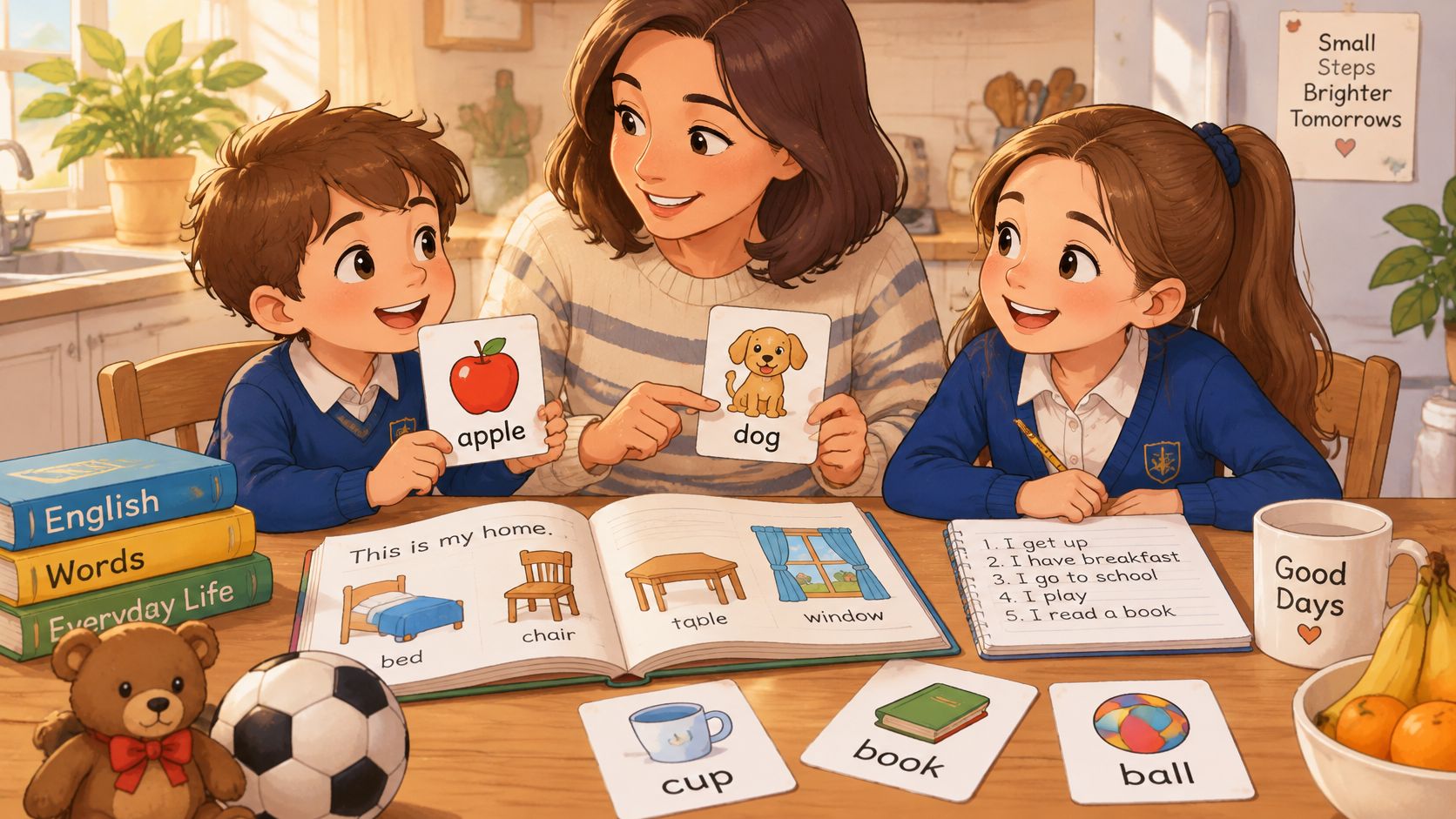
For home practice, the adult's job is manageable:
- Choose something familiar. Household objects and personal interests make meaning easier to demonstrate.
- Make participation possible. Pointing, moving an object and attempting a word all give the child a way to respond.
- Keep expectations narrow. Understanding and using a few useful expressions matters more than completing a difficult worksheet.
A practical home plan combines an age-aware schedule, a small vocabulary selection, family-language support and games made from things already available. Tutors can use the same short activity pattern as a warm-up rather than treating it as a complete lesson.
Short Practice Times for Ages 5 to 10
| Who | Session | Focus | Adult role | Try this |
|---|---|---|---|---|
| Ages 5–6 | 5–8 minutes, 4 days weekly | Colours, animals, greetings | Point, replay audio, celebrate the attempt | Find three colours in the room |
| Ages 7–8 | 8–10 minutes, 4–5 days weekly | Family, food, numbers, one question | Ask What is it? and accept a point or a word | Pretend snack shop with five foods |
| Ages 9–10 beginners | 10–12 minutes, 5 days weekly | Everyday phrases and listening before reading | Child runs the timer; adult checks meaning in the home language | Directions with a box: open, close, under, on |
| Tutor warm-up | 5 minutes | One topic, heard then spoken | Model once, invite a try, no score | Same object game before reading |
These are suggested starting schedules, not required learning doses. A tired child may need a shorter session, while an interested child can continue the activity away from the screen.
A schedule that survives ordinary family life
A parent can try the chosen row for two weeks before adding more words or activities. The purpose is to discover whether the routine fits around meals, homework, play and rest, not to prove that the child can tolerate a timer.
A missed day doesn't create a learning debt. The next session can restart with the same familiar words rather than becoming a longer catch-up lesson.
For each minute spent with audio or a screen, the child can complete a connected no-screen action: pointing, acting something out or finding the matching object. This is a practical pairing rule, not a requirement to measure equal blocks of screen and movement time.
Practical rule: A short session that ends comfortably is preferable to a longer session that becomes an argument.
Different support for different ages
For ages five to six, the adult usually handles the materials and audio. A response can be physical: waving after hearing hello or touching a blue object.
For ages seven to eight, a little choice helps make the activity collaborative. The child can select the snack-shop items, decide which family photo to use, or choose who asks the question.
For ages nine to ten, responsibility can grow without making the English harder too quickly. The child can operate the timer, arrange the objects and choose a topic, while the adult checks understanding in the home language.
- Notice recognition. Does the child choose the intended object without watching the adult's hand?
- Notice willingness. Does the child attempt a sound or word without needing repeated persuasion?
- Notice useful transfer. Does a familiar English word appear during an ordinary activity?
A reasonable topic sequence is greetings, colours, animals, numbers, family and food. Keeping the same topic across the week reduces the work of explaining a completely new activity each day.
The row should fit the child's beginner needs, then the example should fit the child's actual interests. Football may suit an older learner; a pretend snack shop may appeal to a younger primary-school child.
Starter Words by Topic
A starter list is a menu, not a spelling assignment. A parent can select a small part of a row tonight and leave the remaining words for another session.
| Topic | Starter words | No-cost action |
|---|---|---|
| Greetings | hello, goodbye, thank you, please | Wave at the door each morning |
| Colours | red, blue, green, yellow | Find three colours in the room |
| Animals | cat, dog, fish, bird | Make the sound where possible and point to a picture |
| Numbers | one, two, three, four, five | Count stairs or snacks together |
| Family | mum, dad, sister, brother | Point to family photos and say each name |
| Food | apple, milk, bread, water | Run a pretend snack shop with five foods |
The food row doesn't require buying anything. Existing food, empty packaging or drawings can supply the shop, with another familiar item added to the listed vocabulary.
From a list to something meaningful
Keeping a topic for a full week gives the child repeated encounters without requiring a new explanation every evening. Moving on makes sense when the child recognises the selected words during play, rather than merely repeating them immediately after an adult.
Family vocabulary should reflect the child's actual household and relationships. There's no need to introduce a sibling word through a personal photo if that relationship isn't part of the child's life; a drawing or story character works instead.
- For a football fan: Colours and numbers can describe shirts, players and goals.
- For a child interested in travel: Bus, shop and stop can replace less appealing vocabulary.
- For an early English reader: A written label can sit beside the object, without making reading the condition for joining in.
Parents who aren't confident speakers can say a word once if comfortable, point to its meaning and let audio provide the repeated model. An uncertain adult doesn't need to perform a confident accent.
Useful expressions can follow familiar vocabulary. The guide to basic English phrases for children offers a way to think beyond isolated labels without turning the starter list into a grammar lesson.
Home Language and a Parent-Led Five-Minute Routine
More English isn't automatically better if it replaces enjoyable family conversation or makes every interaction feel like a lesson. Stories, jokes, explanations and feelings can remain in the language the family uses most comfortably.
A 2025 longitudinal study of 241 Chinese children learning English as a second language found that literacy resources and direct teaching supported English skills, while earlier vocabulary and phonological awareness also influenced later parental home-literacy practices, with relationships varying according to child interest and home-language use. This is a more complicated picture than a simple instruction to maximise English exposure.
Translation can clarify, then step aside
A brief home-language explanation can reveal a word's meaning. After that explanation, the child can hear the English again while looking at the relevant picture or object.
For example, an adult can explain under in the family language, place a pencil beneath a book and play the English word. The next turn can involve moving the pencil rather than translating again.
Continued conversation and reading in the home language don't need to become rewards available only after English practice. They remain valuable parts of family life in their own right.
English can be an extra layer in family life, not a replacement for the language of comfort and connection.
The parent manages the routine, not the pronunciation lesson
A 2025 mixed-methods study involving 517 parents and six focus groups found that families struggled to balance work, limited digital literacy and teaching responsibilities, while parental English proficiency affected the support available at home. These constraints call for a smaller, clearer task for adults, not blame.
A parent doesn't need to explain grammar, read an unfamiliar English story aloud or judge every sound. The adult can organise the setting and encouragement while recorded audio supplies the English model.
The division of work can stay simple:
- The parent's work: Set the timer, prepare an object or picture, explain the activity in the strongest language and notice effort.
- The child's work: Listen, look, point, make a choice and attempt the English when ready.
- The audio's work: Supply a repeatable spoken example without requiring the adult to invent one.
If pronunciation is unclear, replaying the word is usually a gentler response than repeatedly identifying an error. The adult can use the home-language equivalent of an invitation to listen again, then allow another attempt without demanding a public performance.
A five-minute session in practice
A simple session can use an object such as a cup and a picture of the same object. Everything should be ready before the timer starts, so preparation doesn't consume the child's attention.
- Timer and audio. The adult sets a five-minute timer and plays the selected word.
- Picture or object. The child locates the matching item, with a home-language explanation if meaning remains unclear.
- A question. The adult asks What is it? if comfortable, or uses the home language to invite identification.
- Attempt and praise. The child may point first, then try the word; the adult notices the specific effort.
- Stop. The session ends when the timer sounds, without an extra test.
Progress can be recorded as an informal list of words recognised during ordinary play that week. A blank space means another encounter would help; it isn't a mark against the child.
The parent's closing script stays predictable: timer, audio, picture, a question, praise, stop. Predictability leaves less for the adult to organise and less for the child to worry about.
Five Games That Teach a Few New Words
Guided play means the adult follows a child's interest while adding useful language and opportunities to use it. The National Association for the Education of Young Children describes meaningful, engaging experiences as more effective for building knowledge and vocabulary than memorising word lists.
In a vocabulary comparison described by NAEYC's guided-play article, children defined target words more readily after guided-play review than after picture-card review following shared book reading. That finding supports connecting words with meaningful actions; it doesn't establish that any particular app produces the same result.
Household games with a clear language purpose
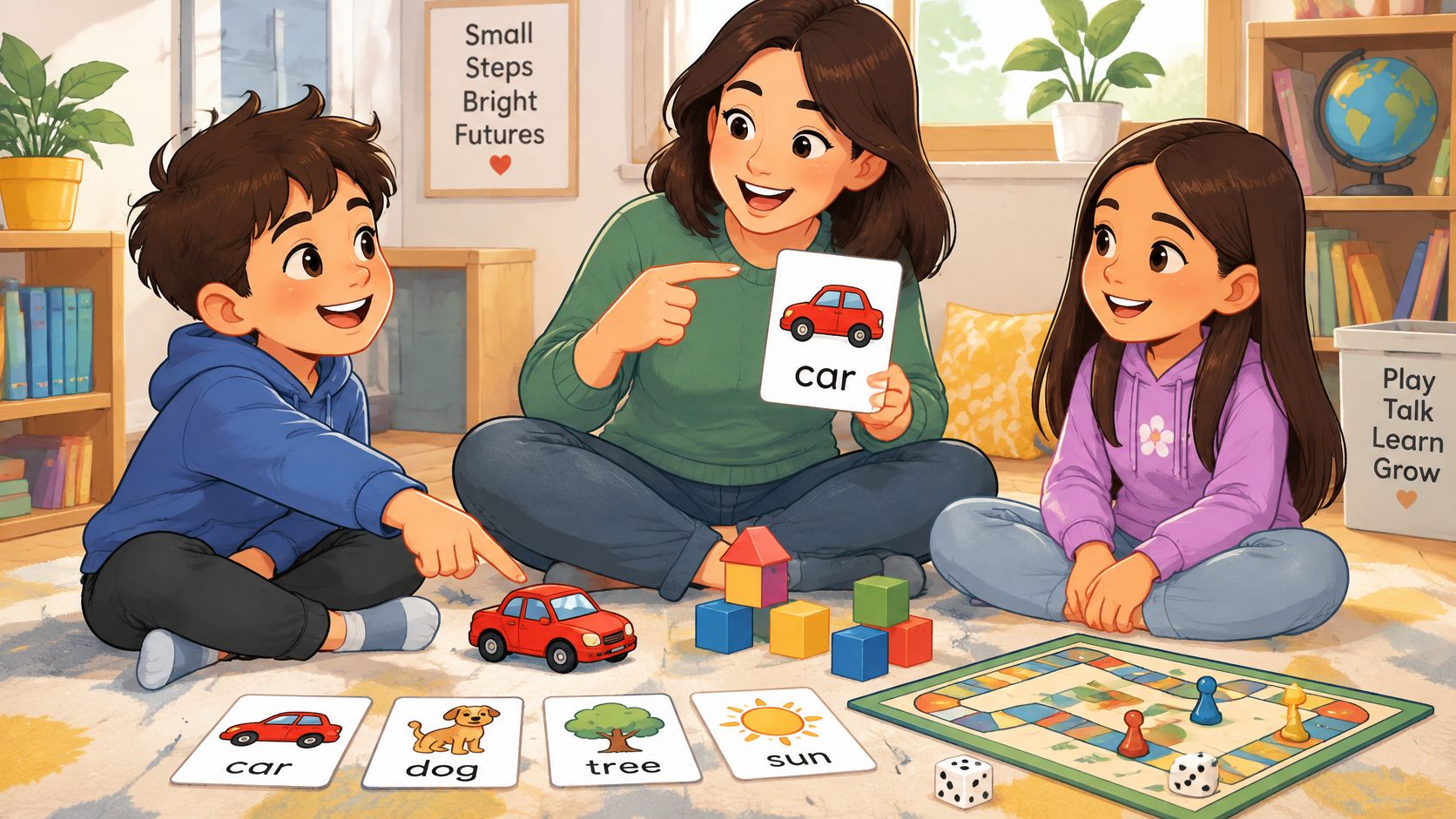
Colour hunt. The adult introduces red or blue, then the child finds something matching. Both can repeat the word while touching or holding the object. An older child can search a sports kit or design a team flag.
A pretend shop starts with five foods, packages, toys or drawings. The child selects an item by pointing or asking, and the adult supplies its English name. Only one or two names need to be new; familiar items keep the shopping game moving.
Box directions for ages seven to ten. A box and a small object make open, close, under and on visible. The adult introduces a pair of terms, demonstrates them and lets the child give a direction back. A tutor can use this as a five-minute warm-up before reading.
Family photo or drawing. The adult selects three relevant family words, keeping most familiar and introducing only what the child needs. A phrase such as my sister can accompany a picture. The child can arrange a pretend family album rather than answer repeated identification questions.
A shared picture book in any language offers a gentler change of pace. At an interesting image, the adult adds an English word and invites a response, then continues the story in the home language. The guide to English-learning stories provides further ideas for connecting pictures and language.
Keeping the play age-appropriate
Each game can follow the short listen, look, question, attempt and finish pattern. There's no need to add points, eliminate a player or interrupt every turn for correction.
For ages nine to ten, a sports lineup, bus route or recipe may be more appealing than a toy scene. Family Xchange offers a place to find games for family play when adults want broader ideas for shared play, though the household activities above need no purchase.
One new idea, used in a real action, is enough for a session.
What to Check Before You Download an App
An app deserves a place in the routine only if the child has something useful to do with it. UNICEF's guidance on children's digital connectivity recommends considering what children do on screens and whether screen use takes too much time away from sleep, play and physical activity.
Beginner app checks for ages 5 to 10
| Check | Why it matters | A good sign |
|---|---|---|
| Learning goal | Screen time should practise English, not fill a gap | A short activity teaches a few everyday words |
| Audio and pictures | Beginners and early readers need meaning without a text wall | Every word can be heard and matched to a picture |
| Speaking turn | Children need an invitation to participate, not only listen | The child says a word and can try again calmly |
| Replay | A child may need another listen | Audio is easy to repeat without restarting |
| Beginner path | Age is not the same as English level | No previous English is required |
| Offline use | Travel and weak internet interrupt streaming lessons | Lessons and pictures work without a connection |
| Child safety | Ads, social feeds and open chat introduce distractions and unwanted contact | No ads, no open chat, purchases behind a parent gate |
| Age fit | An older beginner isn't a preschooler | Interests and phrase length suit primary-school children |
A polished video may hold attention while offering no opportunity to respond. A word-list drill may require tapping without making the child connect the word to anything meaningful. Neither should automatically count as interactive English practice.
A parent can inspect the first activity before handing over the device. The important question is whether an adult with limited English could understand the task, help the child find meaning and support a calm retry.
A small decision test before subscribing
- Check the response. The activity should ask the child to identify, choose, act or speak, rather than watch indefinitely.
- Check the exit. A clear stopping point makes it easier to return to meals, outdoor play or bedtime.
- Check the purchase details. Trial eligibility, renewal terms and current prices should be visible before a subscription is accepted.
- Check the teaching role. A tutor should be able to use a short activity as supplementary practice without mistaking it for a full curriculum.
If a store page doesn't show enough detail about a trial or price, the purchase decision can wait until the terms appear in the store purchase flow or inside the app. There's no need to rank brands by claims that a parent can't verify.
The following option illustrates this kind of beginner routine rather than a best-app ranking. Its usefulness depends on the child's interests, the family's preferences and how the activity fits into daily life.
Start a Short Course with Talkio Kids
A child of seven, eight or nine can know almost no English and still complete a first lesson. Talkio Kids is built for complete beginners aged 5–10, with short listening, picture-matching, speaking and review activities that build everyday vocabulary and simple phrases. Nox, a friendly alien companion, guides a calm space journey that gives children a reason to keep exploring while the learning stays easy to follow.
Greetings, animals, colours, numbers, family and food provide familiar starting topics. Every instruction and every word is spoken as well as written, so early readers never have to decode text before taking part, and replaying audio is always one tap away.
A manageable role for the adult
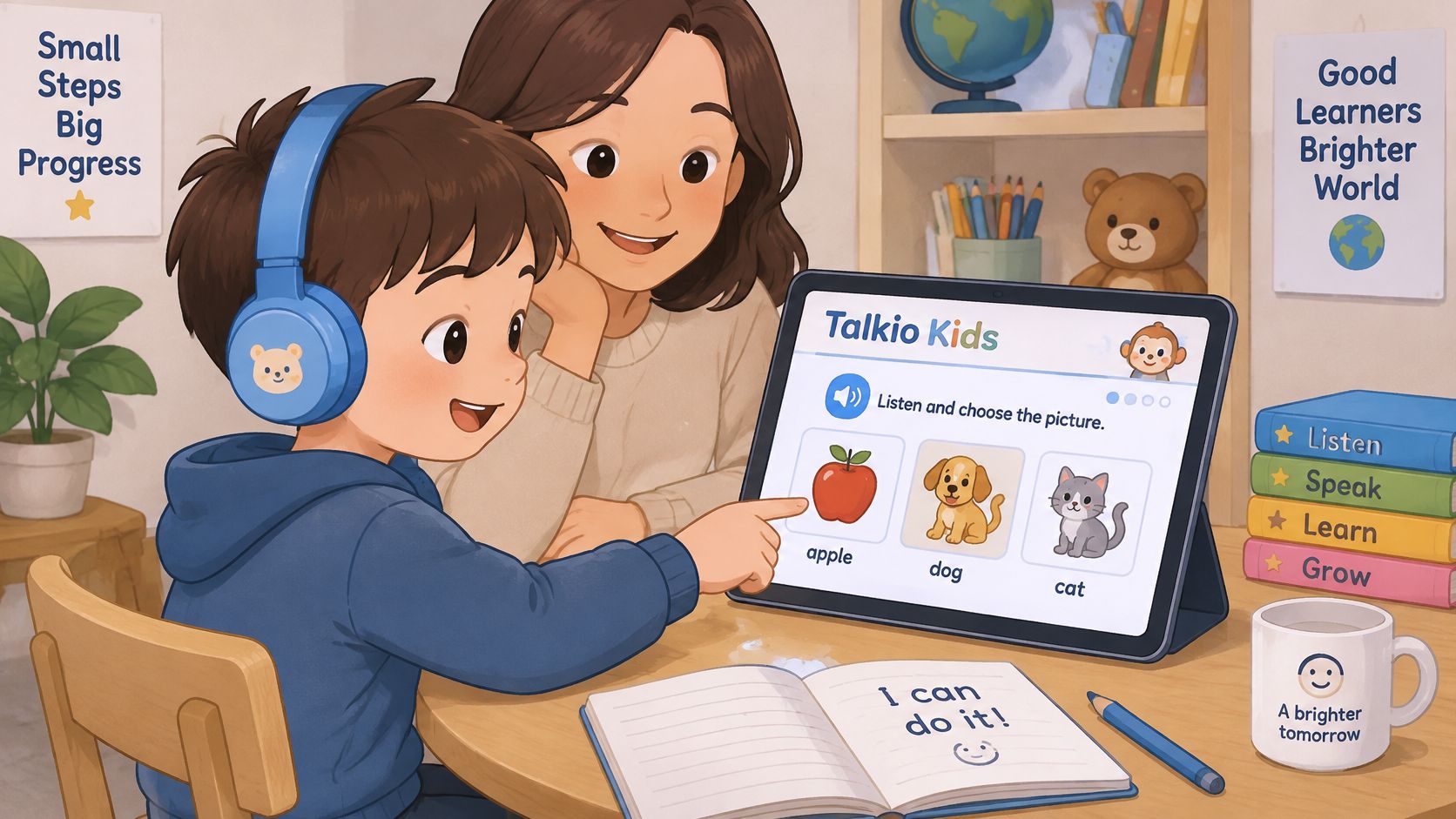
A parent sits alongside the child, explains the task in the home language and lets the recording supply the English model. The app itself speaks English, Spanish, German, French, Italian and Danish, and explains new words in whichever of those languages the family uses at home. No previous English knowledge is required, for the child or for the adult.
Every lesson, picture and recording ships inside the app, so the learning content works offline and progress stays on the device. No account or sign-in is needed, and speaking exercises are recognised on the device without saving or uploading microphone audio.
- A quieter environment: There are no ads, social features, open chat or open-ended AI conversations, and no hearts, lives or harsh buzzers. A child can try again, get help and keep learning without getting stuck.
- Adult purchase control: Purchases sit behind a parent gate.
- Local progress: There's no cloud progress sync, school dashboard or emailed parent report.
- Adult-managed stopping: The app doesn't provide parent-defined time limits, so the family supplies its own stopping routine.
For younger primary-school learners, the guide to English lessons for six-year-olds offers additional age-specific ideas. Older beginners can take more responsibility for operating the device while an adult remains available to clarify meaning.
Clear expectations before a purchase
Talkio Kids is an educational aid, not a school, tutoring service, assessment, medical service or substitute for professional advice. It builds basic vocabulary and simple phrases rather than guaranteeing fluency, and the company doesn't guarantee a particular learning outcome.
An active Premium subscription is required before a child begins the course. Monthly and annual subscriptions are available, and eligible new subscribers can try the complete course free for seven days, with current prices and trial eligibility shown in the app and the applicable store purchase details.
Parents can read more on the Talkio Kids website, then visit the App Store or Google Play. The subscription decision belongs with the adult, after reviewing the displayed terms.