
English learning at home
English Activities for 7 Year Olds Learning Their First Words: Home Games
English Activities for 7 Year Olds Learning Their First Words: six simple home games with steps, examples and ideas for ages 9–10.
By Talkio Kids ·
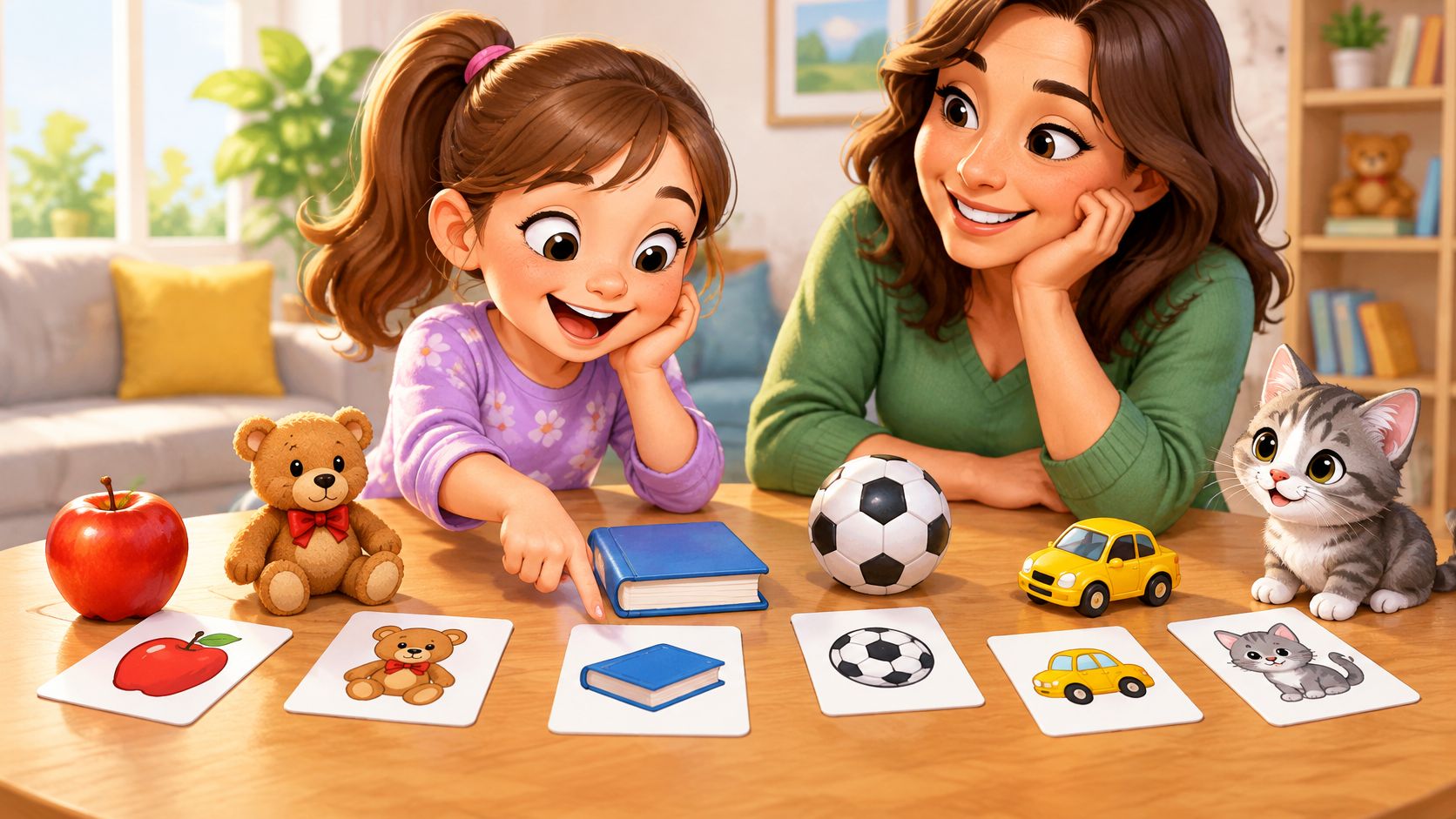
It's Tuesday evening, dinner's nearly ready, and a restless 7-year-old is circling the kitchen. A parent wants a little English practice, but not homework, not a worksheet battle, and not a long video. That small window is exactly where English activities for 7 year olds learning their first words work best.
The six main games below, plus one audio-led routine, use things already at home. Each takes five to ten minutes, needs no special materials, and gives a parent simple lines to copy tonight. Every activity also includes a separate adjustment for 9- and 10-year-old complete beginners, because an older child can know a lot in another language while still starting from zero in English. Younger children aged 5 to 6 can join most games too, with fewer words and more pointing.
Parents don't need fluent English to run these games. Short prompts, clear pictures, real objects, and lots of praise do most of the work.
1. Picture Word Hunt Around the House
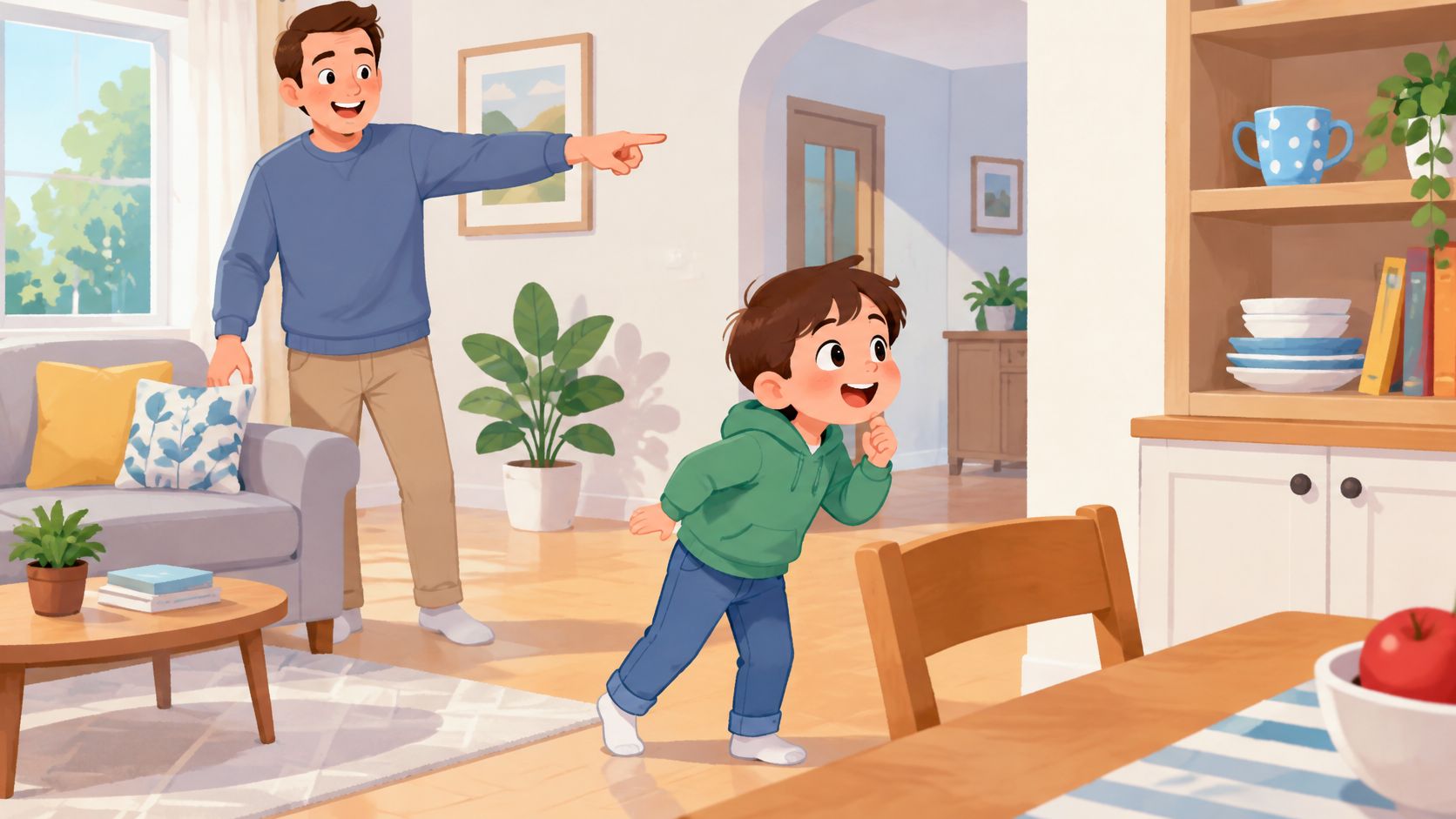
This hunt turns the home into a word board. A parent picks five to eight everyday words, such as door, spoon, cup, chair, window, and bed, says one clearly, and sends the child to touch or fetch it. The child repeats the word at the object, then races back for the next one.
Movement helps because the English label lands on a concept the child already knows. Research summarized by the U.S. National Institutes of Health reports that first words typically emerge at or before 12 months and average expressive vocabulary reaches about 100 words by 18 months. A 7-year-old beginner in English isn't starting language from zero, so matching new sounds to familiar things makes sense.
A quick kitchen round
Say "door," point together, and ask the child to touch it and say "door" before moving to "window." Before breakfast, a family can hunt for cup, plate, and fork in under five minutes. Parents who want more word sets can browse everyday English vocabulary ideas for kids and copy the same routine.
- Start small: Add new words only after the first five are easy to find.
- Repeat the same set: Play across several days so retrieval gets faster.
- For ages 9 to 10: Add a timer, or ask for three things that start with the same letter.
2. Simon Says and Action Commands
No cards, no setup, just listening and moving. A parent gives short commands such as "touch your nose," "jump," "clap your hands," or "close your eyes." The child acts only when the command starts with "Simon says."
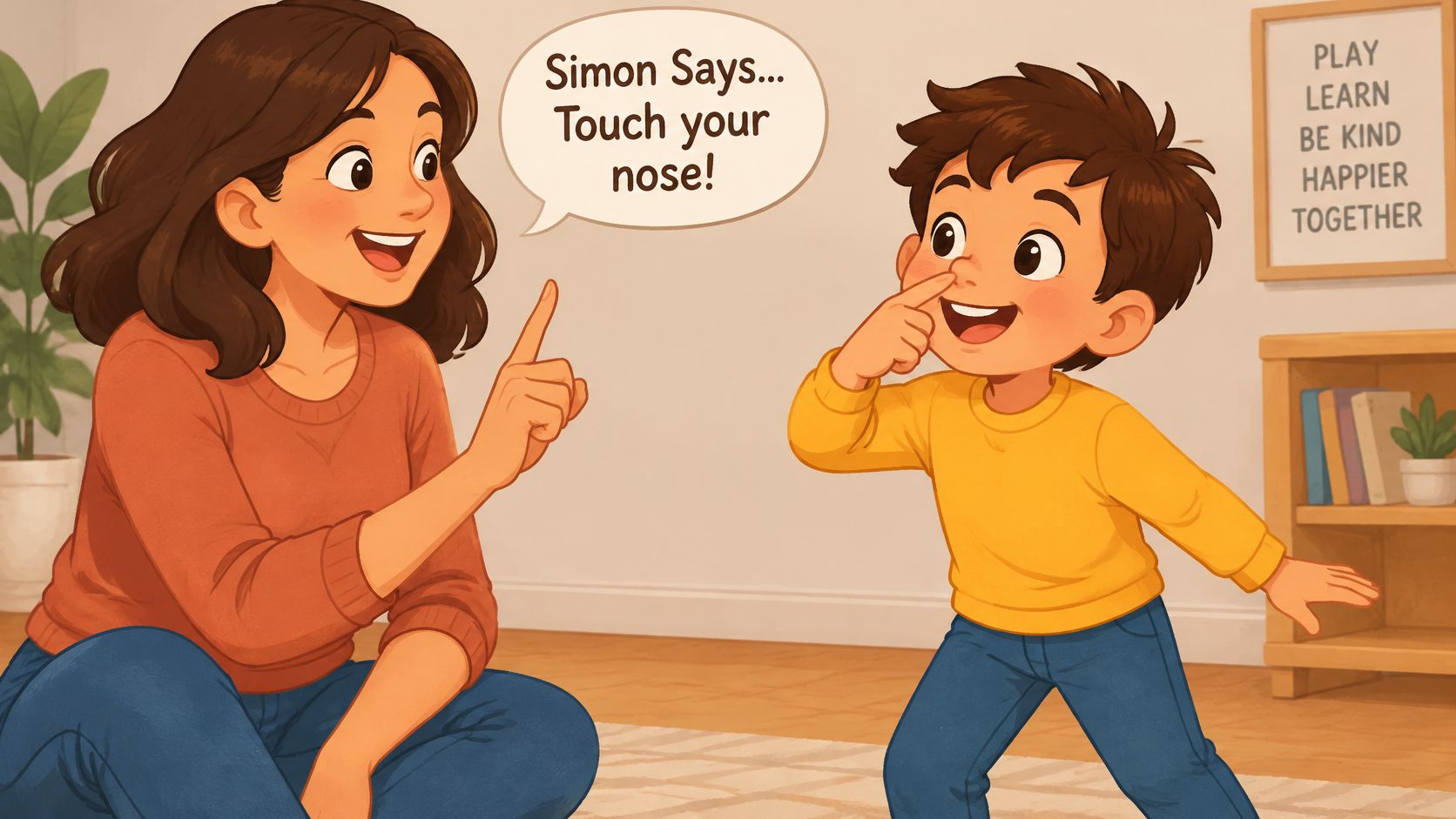
The trick creates the learning. A child who hears "Simon says touch your toes" and then "touch your head" without Simon has to listen for meaning, not just copy. Body parts and action verbs stick because the body answers before reading or writing is needed.
Let the child lead
After three or four commands feel easy, the child becomes Simon. Saying the words aloud builds memory in a different way than only obeying them, and siblings can take turns. Families can pair this game with other short English speaking activities for kids on a different evening.
Practical rule: Pause clearly before each command. That quiet second gives a beginner time to hear the verb before moving.
- Keep it short: Stop before ten minutes, while it's still funny.
- Add slowly: Repeat the first commands before introducing new verbs.
- For ages 9 to 10: Use two-step instructions such as "hop, then sit down."
3. Sticky-Note Home Labels
Some children prefer a quiet game they can revisit all day. Parents write fridge, lamp, sofa, bathroom, door, and window on sticky notes in large, clear print and place each note on the object. Every pass through the hallway becomes a tiny reading and speaking moment.
For early readers aged 7 to 8, a small drawing beside the word matters more than neat handwriting. The picture carries the meaning while the letters slowly become familiar. A child can point, read the label aloud on the way to school, and hear a parent echo it back.
Word choice should stay concrete at first. The British Council guide for parents starting English at home recommends beginning with numbers in stages, colours, and simple adjectives such as big, small, tall, happy, sad and tired for children aged 5 to 12. Labels can follow that order, moving from objects to big chair or red cup.
Make labels the child's job
A 9-year-old complete beginner can choose which items to label and write the notes, with a parent checking spelling. That older child can then read the labels to a younger sibling, which feels responsible rather than babyish. Tutors can use the same idea in a classroom corner.
- Keep places stable: Don't move notes daily, routine builds recognition.
- Refresh weekly: Swap in a few new words every week or two.
- Ask first: Let the child say the label before a parent reads it aloud.
4. Picture Bingo with Everyday Words
Bingo gives listening practice a clear finish line. A parent draws a simple grid with nine or twelve pictures, such as apple, cat, car, ball, book, and sun, then calls one word at a time. The child covers the matching picture with a coin, button, or piece of pasta.
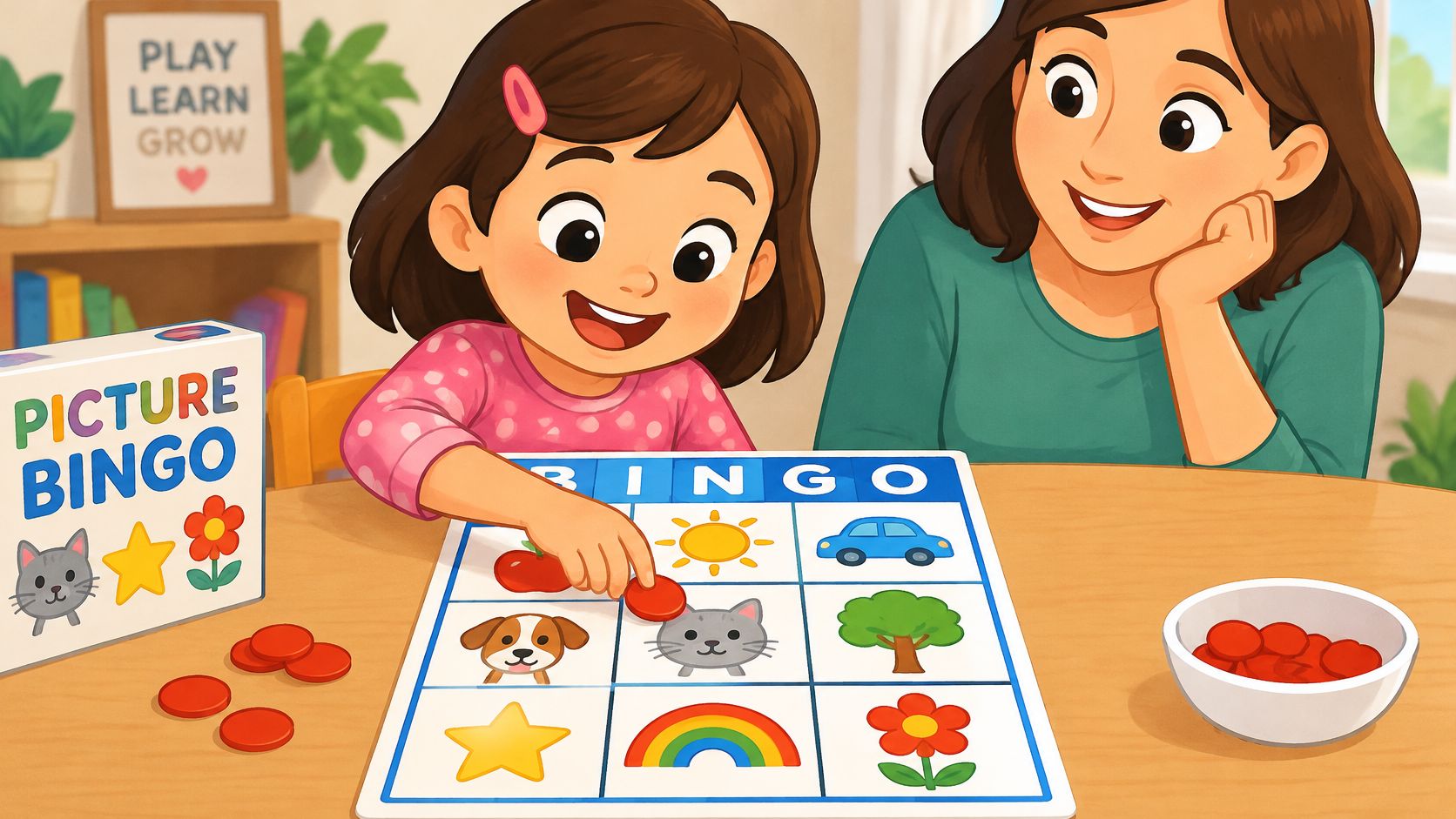
Say each word twice, once slowly and once at normal speed. When a parent calls "cat," the race to cover the cat picture before a sibling does keeps attention high without any test language. A printable bingo worksheet for sight word recognition can save drawing time, although hand-drawn cards work just as well.
When the child becomes the caller
That's a step up. A 10-year-old beginner who calls words for a parent practises pronunciation and reading at the same time, and often laughs at a parent's deliberate mistakes. Tutors can make different cards each week for a small group, reusing last week's words for review.
Use clear, simple pictures and avoid crowded images. A beginner should spend energy on the word, not on decoding the drawing.
- Reuse old words: Build new cards from the previous week's set.
- For ages 9 to 10: Add harder words or require a tiny phrase, such as "a red car."
5. Memory Pairs with Picture and Word Cards
Scissors, scrap paper, and ten minutes are enough to build this game. A parent makes pairs, one card with a picture and one with its English word, places them face down, and lets the child turn over two at a time. The child says each word aloud, match or not.
Start with four pairs and grow to six or eight once the game feels easy. A 7-year-old who matches a dog picture with the word dog and says it every turn gets recall, reading, and speaking in one loop. The same small deck can travel in a pocket for a long car journey.
A daily review habit makes those cards last longer. The British Council support page for parents describes a bag routine where a child takes out five words each day and might spell, define, translate, draw, or use each one in a simple story. Beginners can swap spelling for pointing, acting, or choosing the picture.
Older beginners need a bigger job
A 9-year-old can create the deck, then say a full sentence for every match, such as "The dog is small." That child can also deal the cards and teach a younger sibling. A cheerful timer keeps rounds brisk without turning errors into penalties.
- Same deck, several days: Change words only after matches feel automatic.
- Say every card: Silent turning wastes the speaking practice.
6. Market Stall and Shop Role Play
Role play puts first words into phrases a child might use. Toys, fruit, or drawings of food become a stall, and a parent and child swap roles as shopkeeper and customer. Two model lines are enough to start, "I would like an apple, please" and "How much is it?"
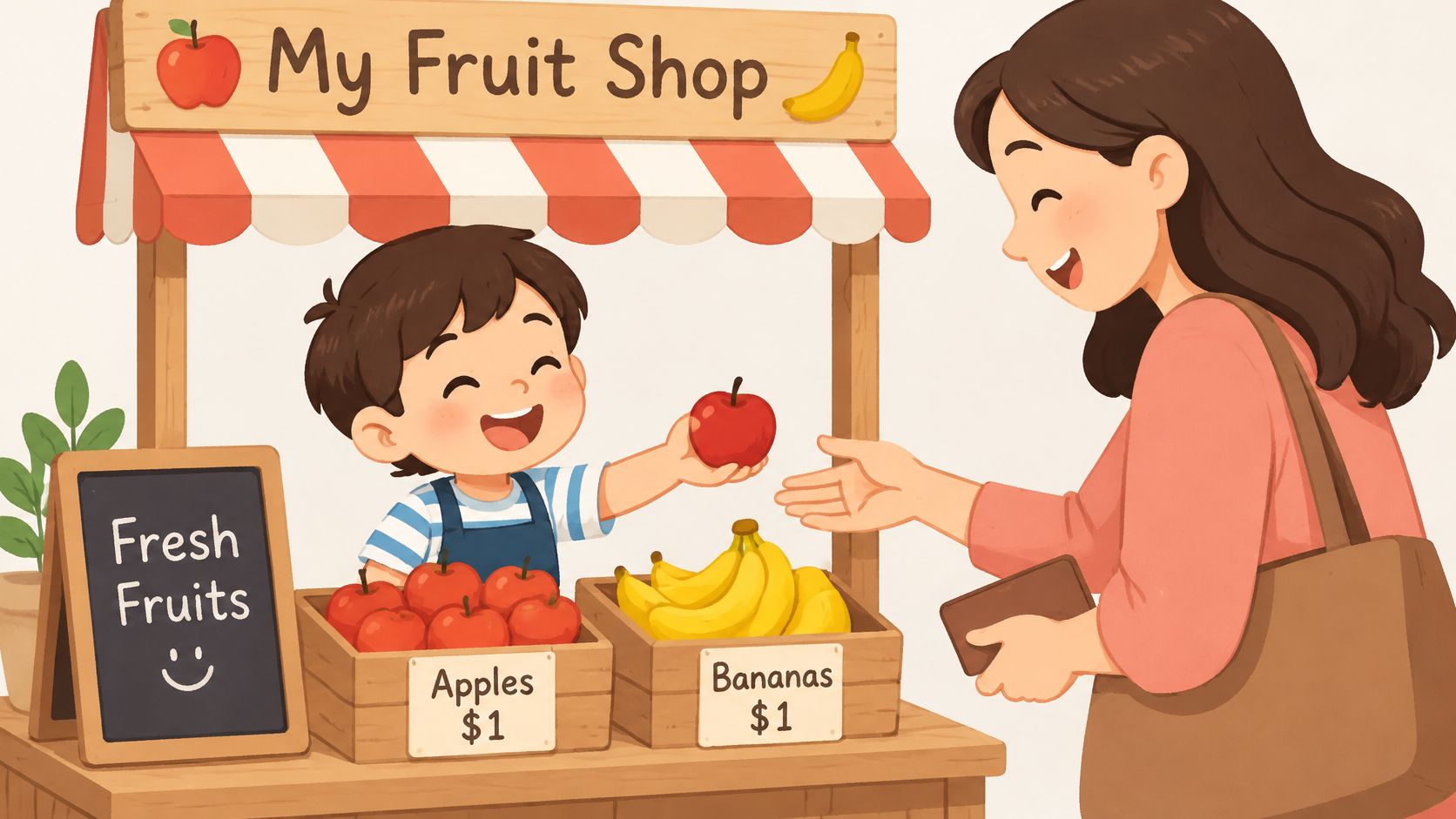
Real kitchen items keep the game concrete for a 7-year-old. A child who hands over a banana and says "banana, please" is already speaking with purpose, even if the sentence is tiny. Praise the attempt first, then repeat the phrase naturally so the child hears a clean version without a correction lecture.
Stretch it for ages 9 to 10
Add prices, polite phrases, and short conversations. A 9-year-old running a pretend bakery can say "two dollars, please," count play money, and answer "Would you like a bag?" Changing the setting to a café or toy shop refreshes the vocabulary while the sentence patterns stay familiar.
- Model, then hand over: A parent says the phrase once or twice, then the child owns it.
- Keep props visible: Colours and numbers are easier when items sit on the table.
7. Audio-Led Picture Listening with Early Readers
Some days a parent can't model pronunciation confidently, and that's fine. In this routine, the child hears an English word or phrase, looks at clear pictures, and points or taps the match. Sound and image carry the meaning, so independent reading isn't required.
That pairing has solid support. In a controlled study of 97 eight-year-old German children reported in research on picture and gesture enrichment for English vocabulary, picture and gesture support both improved test performance compared with listening alone, and the advantage remained after 8 days, 2 months, and 6 months. A simple loop follows from it: hear the word, find the picture, say it, then retrieve it again on another day.
Picture books can do similar work at bedtime. Reading Rockets guidance on vocabulary during read-alouds describes effective adults weaving in questions, comments, naming, labelling and elaboration while reading. Parents exploring story-based routines can also see English learning stories for young beginners for ideas that fit the same pause, point, and repeat pattern.
- End on a success: Five to ten minutes is plenty, and the last word should feel easy.
- Bridge off-screen: After hearing "shoe" and saying "my shoe," the child finds a real shoe in the room.
- For ages 9 to 10: Ask for a short phrase about the picture, not just the single word.
How the six home activities compare
| Item | Main skill | Materials needed | Session length | Best for |
|---|---|---|---|---|
| Picture Word Hunt Around the House | Everyday vocabulary and movement-based learning | Household objects | 5–10 minutes | Beginners learning concrete words through active play |
| Simon Says and Action Commands | Listening, action words, and body-part vocabulary | None | Under 10 minutes | Active learners practising simple commands |
| Sticky-Note Home Labels | Reading and object vocabulary | Paper or sticky notes, tape, optional pictures | Ongoing, informal practice | Early readers learning words through repeated exposure |
| Picture Bingo with Everyday Words | Listening and word recognition | Picture bingo cards and markers | Short rounds | Beginners who enjoy games and picture matching |
| Memory Pairs with Picture and Word Cards | Recall, reading, and speaking | Picture and word cards | A few minutes | Learners practising vocabulary through matching |
| Market Stall and Shop Role Play | Speaking and everyday phrases | Toys, food, drawings, or play money | Flexible play session | Learners building confidence with practical conversations |
| Audio-Led Picture Listening with Early Readers | Listening and word recognition | Picture book, flashcards, or app with audio | 5–10 minutes | Early readers and beginners learning through sound and pictures |
Start Small Tonight and Explore Talkio Kids
One activity, five minutes, three or four words. That's a realistic start for a tired family, and it beats waiting for a perfect weekend lesson plan. Keep the same words for several days, let the child lead when ready, and celebrate effort more than perfect pronunciation.
Parents who don't speak English confidently still have a real role. Prompts such as "point," "listen," and "show me" keep a parent inside the game without turning that parent into a teacher or translator. Research published in a 2025 mixed-methods study of 517 parents found that parents actively support children's listening, speaking and reading, but also struggle to balance work, limited digital literacy and teaching responsibilities. Short, audio-led routines respect that reality.
Language load deserves the same respect. A UNICEF study of primary classrooms in Nigeria found that 66.7% of pupils were proficient in literacy and numeracy in the local language at Primary 3, compared with 45.7% in English. School age doesn't guarantee English comprehension, so pictures, gestures, and recorded audio should come before independent reading.
For families who'd like a structured option beside these home games, Talkio Kids offers short listening, picture-matching, speaking, and review activities for complete beginners aged 5 to 10, guided by Nox in a space adventure. Eligible new subscribers can try the complete course free for seven days, and eligibility and prices are shown in the app. Content works offline, progress stays on the device, and no account is needed. Parents can explore Talkio Kids and get the app, download it from the App Store or Google Play, and teachers comparing support tools may also note Tutorbase for language schools.
Talkio Kids helps complete beginners aged 5 to 10 build everyday English vocabulary and simple phrases through short listening, picture-matching, speaking, and review activities led by Nox, with clear audio that supports early readers and offline lessons stored on the device. Families who enjoy the home games above can visit Talkio Kids to see how the app fits the same five-minute routine.