
English learning at home
8 Daily Word for Kids Ideas for Everyday Home Practice
Eight simple daily word for kids ideas for beginner English at home, with short activities, plain definitions and practice prompts parents can use.
By Talkio Kids ·
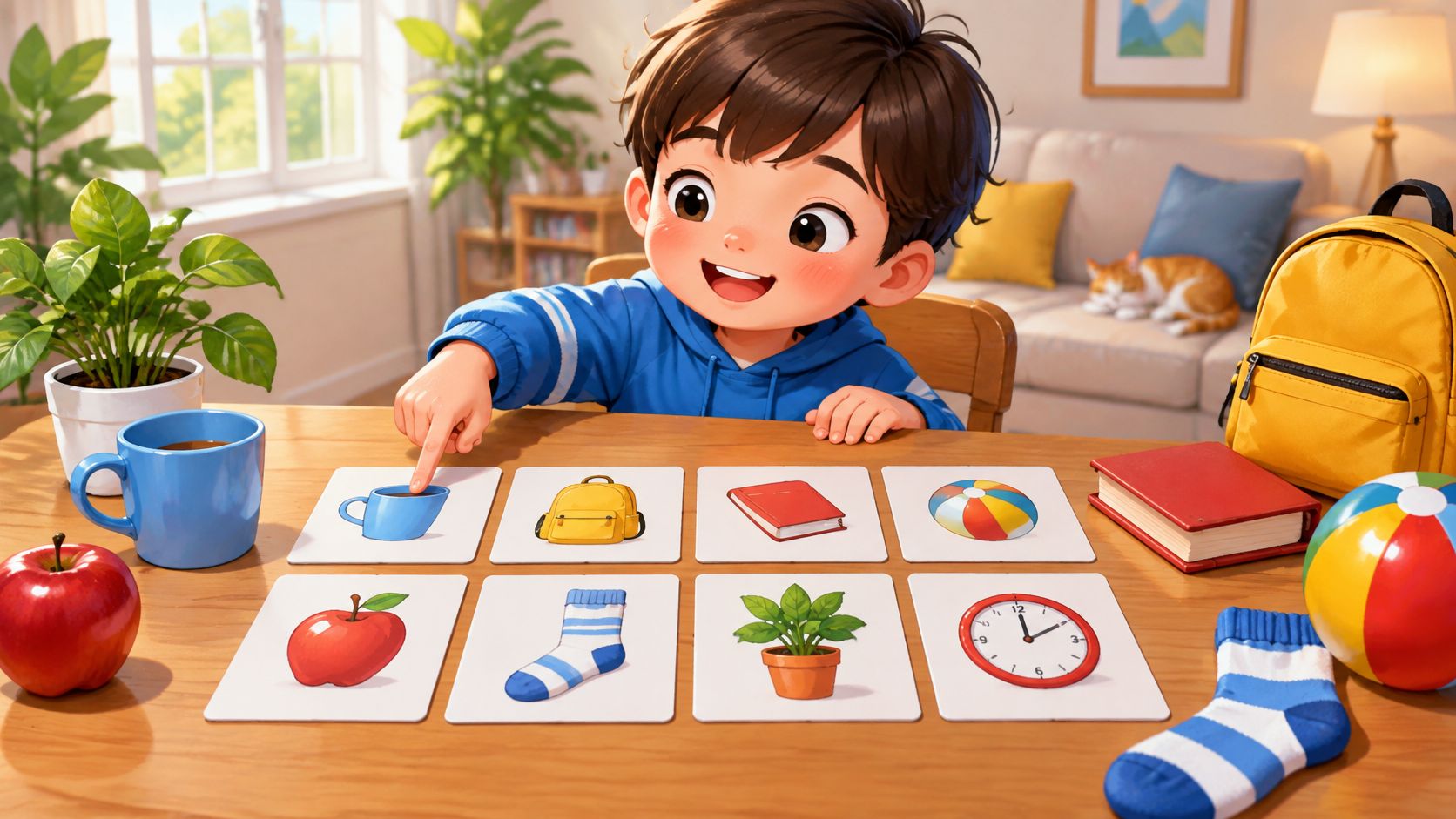
Most children learn their first English words in ordinary moments, not in lessons. A glass at dinner. A bag by the front door. A book before bed. If you're the parent of a child aged 5 to 10 who is starting from zero, those moments are already there in your day, waiting to be used.
This guide shares eight daily word ideas for kids, each one built around a routine your family already has. Every word gets a plain definition, a few playful activities and practice prompts. Children aged 7 to 10 can be true beginners too, so each idea shows how to adapt it for older learners who want to feel independent rather than babied. You don't need to buy anything, print anything or set aside lesson time.
One note before starting. A single word practiced in a real moment beats ten words on a flashcard app. Repetition is what makes a word stick, and research on kindergarten classrooms shows why. A study of 55 kindergarten classrooms found that teachers averaged 8.14 vocabulary-teaching episodes per day, but children typically encountered each explicitly discussed word only once during the observed day (Wright and Neuman's 2014 observational study of kindergarten instruction, published in the Journal of Literacy Research). One encounter isn't much. Your kitchen can offer five.
1. Water: a first everyday word for daily routines
"Water" earns its place first because it comes up at meals, at bath time and whenever someone is thirsty. Children hear it many times a day, which makes it easy to practice in real situations with nothing extra to buy. For parents who aren't confident English speakers, one word tied to one daily moment is a calm place to start.
The routine
Drinks at dinner, or the bath. Pick one, not both.
The activity
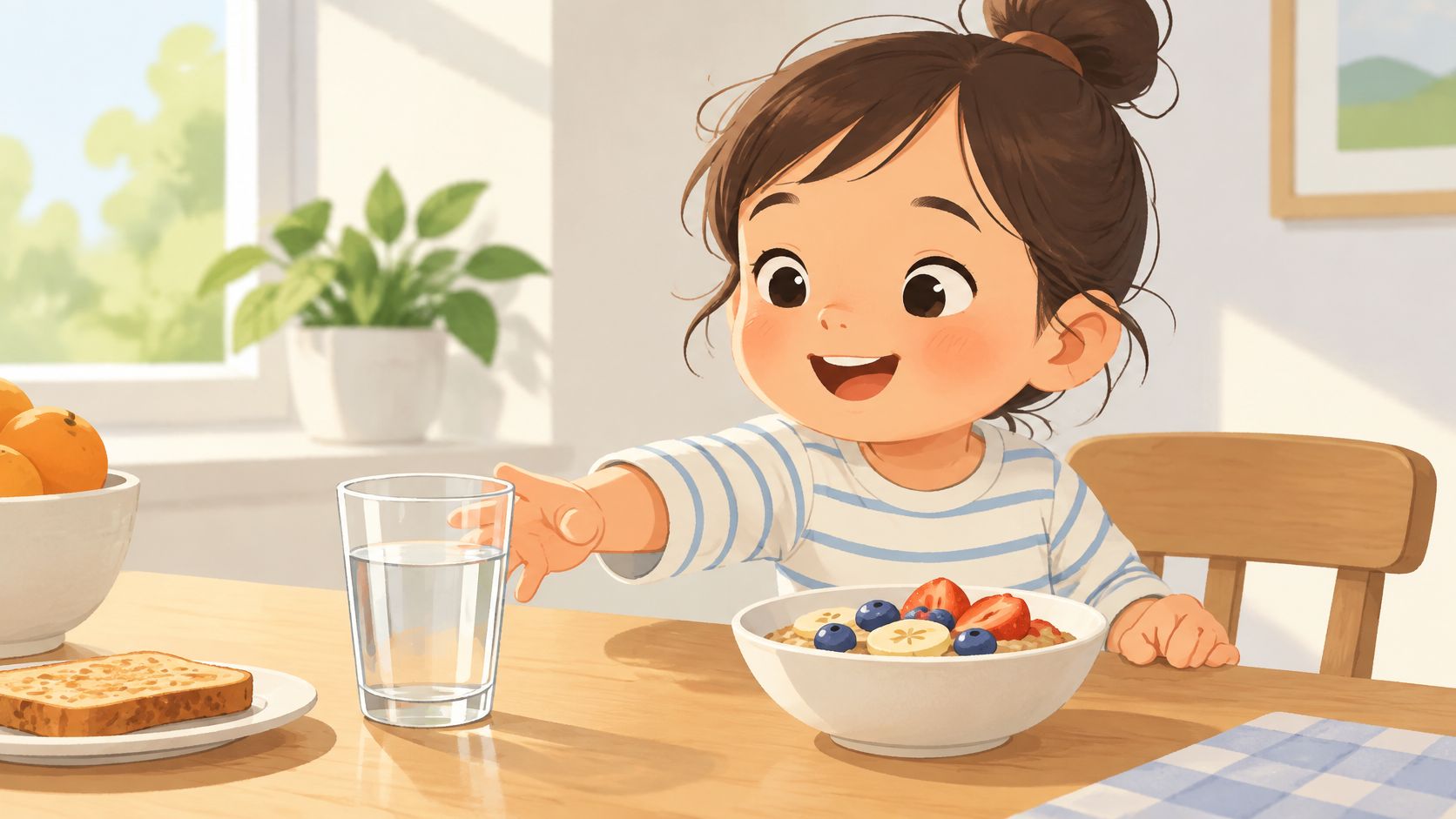
At breakfast, hold up a glass and say "Water?" Then wait. A nod counts. A sound counts. During a bath, let the child pour water between two cups and say "water" each time. The pouring keeps little hands busy while the mouth catches up.
The prompt
Ask the yes or no question before asking for the full word. "Water?" is easier to answer than "Can you say water?"
Try this for a week: Use the word only at drinks time. Nowhere else. By Friday it will feel like part of dinner rather than a test.
For ages 7 to 10
Older beginners can carry a short phrase instead of a single word. "Water, please" at the table. "Can I have water?" if they're ready. Let them be the one who pours for everyone and names what they're pouring. That small job gives a nine-year-old a reason to say the word that a five-year-old doesn't need. Talkio Kids uses the same approach with short audio and picture-matching activities, and its companion Nox keeps the space theme light rather than babyish.
2. Bag: a playful word for getting ready
"Bag" fits the morning rush and the after-school unpacking, when children pack, carry and empty. It's a concrete object they touch every day, which makes the link between sound and thing almost automatic. It's also a word that survives contact with real life: you'll say it dozens of times a week without trying.
The activity
Before school, hold up the bag and ask "Where is your bag?" Then let the child answer by pointing or saying it. At the shop, hand over a shopping bag and say "bag" as items go in. A short car game works too: "Touch your bag!" and wait for the hand to move.
The prompt
Use a sentence frame so children hear a full phrase, not just a label. "My bag." "Bag, please." Two words are enough to start building the habit of speaking in chunks. Hiding a small toy in a bag and asking the child to find it turns the word into a game.
If mornings are chaos in your house, the backpack packing routine for school mornings pairs well with this word, because a child who packs the bag also names it.
For ages 7 to 10
Give older beginners ownership. "What's in your bag?" invites a real answer, even a short one: "book." "lunch." For a nine-year-old, naming three things from the bag is a satisfying challenge, and it builds the same vocabulary without a worksheet. For a wider set of first words to rotate through the week, this guide to English words for kids gives you options that fit the same routines.
3. Door: a simple word for movement and position
"Door" works because it's a doing word as much as a naming word. Open the door. Close the door. Go through the door. Children act these out, and the movement helps them attach the sound to something their body already knows.
The routine
Arrivals and departures. Leaving the house, coming back in, or the moment before bedtime.
The activity and prompt
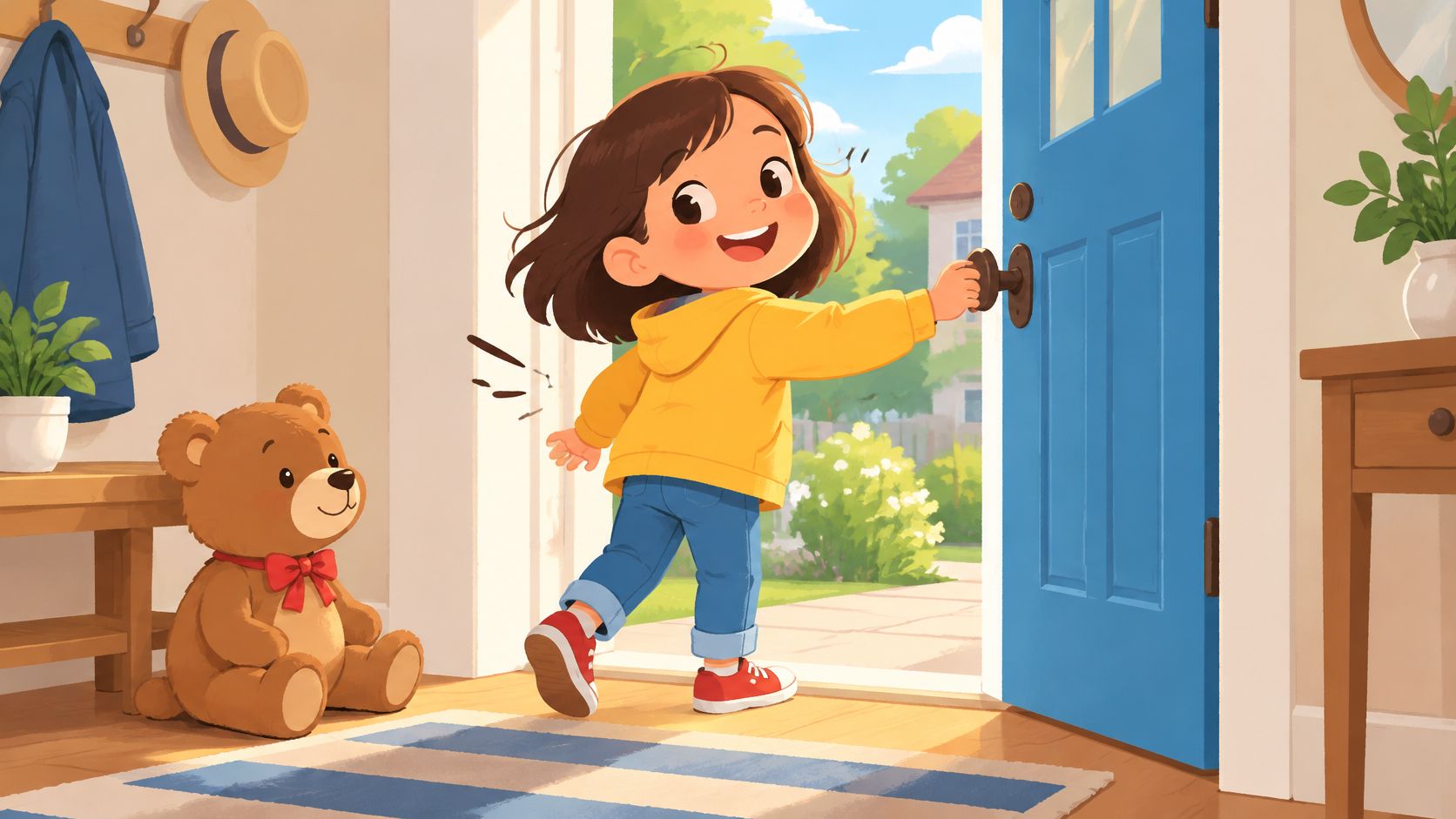
Keep commands short. "Door, open" or "Close the door" lands better than a full sentence for a five-year-old. Then play knock on the door with a teddy bear and let the child answer it. A picture book with a door on the page works for a quieter version: point and say the word.
Three things make this word work harder than most:
- It's physical. The child moves their body while saying it, which links the word to an action.
- It repeats naturally. Every trip out of the house is another chance.
- It builds listening. "Open the door" is a two-word instruction a beginner can follow.
For ages 7 to 10
Older beginners can add position words: "Open the door, please." "The door is closed." Or turn it into a small responsibility, such as checking the door is locked before bed. A ten-year-old who says "I close the door" has produced a full English sentence, and it came from an ordinary evening.
4. Book: a word that opens the door to reading
"Book" matters because it links spoken English to reading. Children who hear the word while looking at picture books learn that sounds match pages, and that words carry meaning before they can decode letters. For parents who can't read English well, pointing at pictures and saying the word still shares reading time in a way that counts. The Child Mind Institute's guide to reading with your child notes that reading together builds language, vocabulary and background knowledge, and that repetition of the same book is part of how children master language.
The routine
Bedtime, or the quiet ten minutes after dinner.
The activity
Point to the cover and say "Book!" before opening it. Then name the pictures slowly as you turn pages. A child showing a favourite book to a grandparent and saying "my book" is doing real English, not practice.
Audio support is not cheating. If you're not confident reading English aloud, a recorded story lets the child hear clear pronunciation while you point at the pictures together.
The prompt
Ask the child to find the book among a pile of other items. Then ask which one they want. Choosing is a form of answering, and it keeps the session warm rather than instructional. The Education Endowment Foundation reports that storytelling and shared-reading activities consistently improve children's language-comprehension skills, and that vocabulary knowledge contributes significantly to reading comprehension in children aged 7 to 8 and 10 to 11 (EEF blog on reading aloud).
For ages 7 to 10
Let older beginners choose a book slightly above their reading level and listen to it. Hearing chapter books while reading picture books independently is normal and useful. For families who want stories built for beginners, these English learning stories work alongside a bedtime book rather than replacing it.
5. Hat: a colourful word for describing things
"hat" is short, clear and easy to act out, which makes it a good word for children who are just starting to speak. It also opens a door to describing: "red hat," "big hat," "my hat." That jump from one word to two is where beginners start sounding like speakers.
The routine
Getting dressed, or heading outside on a sunny day.
The activity
Put on a sun hat and say "hat" before going out. Hold up two hats and ask "Which hat?" and let the child choose and name. A simple picture card game works as a rainy-day version: match the hat pictures and say the word each time.
The prompt
Build the phrase together. Say "red hat," then pause and let the child repeat. Then point to a different hat and ask what colour it is. The aim isn't perfect pronunciation. It's a child who reaches for a second word without being told to.
For ages 7 to 10
Older beginners can go further: "I wear a hat." "This hat is blue." "My hat is too small." Describing something in front of them is easier than recalling a word from memory, so it's a good bridge for children who freeze when asked to speak. A hat also gives a nine-year-old something to laugh about, which lowers the stakes considerably.
6. Bed: a bedtime word for calm routines
"Bed" is dependable because it's said at the same time every day. A calm, predictable routine helps children link words to actions and feelings, and bedtime is the least hurried moment most families have. Keep it gentle. The point is a word heard in a warm voice, not a lesson squeezed in before lights out.
The routine
The last five minutes of the day.
The activity and prompt
Say "Time for bed" and let the child climb in while repeating the word. Ask a teddy bear where it sleeps and let the child answer "bed." Then a quiet listening game: point to the bed when you hear the word. One or two words is plenty. A full list at bedtime turns a calm moment into a task.
If bedtime is a battle in your house, this bedtime routine chart guide offers a structure that makes the word easier to say because the moment is already predictable.
A rule that saves the routine: If the child is tired, say the word and let them listen. Listening counts. On hard nights, it's the only thing that does.
For ages 7 to 10
Older beginners can handle a short exchange. "Are you tired?" "Yes, I'm tired." "Goodnight, bed." A ten-year-old might roll their eyes at teddy bears, so skip the toy and use the actual routine instead. Ask them to tell you one thing about their day in English, even one word. "School." "Football." That's a complete answer.
7. Happy: a feeling word that builds speaking confidence
"Happy" is a feeling word, and feeling words do something vocabulary lists can't: they let a child talk about themselves. It's easy to show with a smile and a gesture, which helps children who are still building confidence. A child who can say how they feel has a reason to speak.
The routine
After a game, after school, or at the end of the day.
The activity
Show a smile and say "happy" clearly before asking the child to repeat. Use a simple feelings chart with a face for each mood. Then ask "Are you happy?" and accept a nod, a point or a single word as a full answer.
The prompt
Model the word with your face, not just your voice. Your expression carries the meaning for a child who doesn't know the word yet.
Three ways to keep it low-pressure:
- Accept gestures first. A nod is an answer. Speech follows.
- Ask about characters. "Is the bear happy?" takes the focus off the child.
- Use it at the right moment. Ask after something fun, not during a meltdown.
For ages 7 to 10
Older beginners can use the word in a real sentence: "I'm happy because it's Friday." Or pair it with its opposite: "I'm not happy. I'm tired." For a child who goes quiet when asked to speak, this guide on how to help a shy child speak English gives practical steps that work alongside a single feeling word.
8. School: a daily word that connects home and learning
"School" is heard every weekday, which makes it one of the easiest words to practice without planning. It connects home life with learning, and many children enjoy talking about school even when their English is minimal. For parents, it's a way into a conversation about the day that doesn't feel like an interrogation.
The routine
The walk or drive to school, and the unpacking afterwards.
The activity
Say "Let's go to school" on the way and let the child repeat it. Point to a school building in a picture book and say the word. A picture card of a school in a short matching game makes a five-minute version for a rainy afternoon.
The prompt
Ask a simple question first: "Is it school?" Then build: "Do you like school?" Keep school talk positive and short. One word or one sentence is enough, especially if the school day was hard.
For ages 7 to 10
Older beginners can answer with a little more: "I go to school at eight." "My school is big." "I like art at school." A nine-year-old who can name one subject in English has connected two pieces of knowledge, which is exactly what beginner vocabulary is for. A ten-year-old might enjoy being the teacher and quizzing you instead.
How the eight daily words compare at a glance
| Item | Everyday routine | Physical cue | Best for |
|---|---|---|---|
| Water | Meals, drinks, or bath time | A glass, bottle, or water | Repeated practice without reading |
| Bag | Getting ready for school or going out | A real bag to hold or pack | Practising practical words and short phrases |
| Door | Opening, closing, or passing through | A door and simple actions | Active listening and movement |
| Book | Shared reading time | A picture book to point to | Connecting spoken words with pictures |
| Hat | Getting dressed or playing dress-up | A hat to try on or describe | Learning descriptions like “red hat” |
| Bed | The bedtime routine | Lying down or a bed to point to | Calm, predictable practice |
| Happy | Talking about the day | A smile, gesture, or feelings picture | Expressing feelings and building speaking confidence |
| School | The weekday routine | A school picture, bag, or uniform | Connecting English with school and daily life |
Choose One Word Today and Build From There
The eight words work like a menu. Pick the one that already lives in your day: water at dinner, the bag by the door, bed at bedtime. Practice that single word for a week, and add the next one only when the first feels easy. Short, calm sessions will carry a child further than a long list ever does.
Two things decide whether a routine like this sticks. The first is repetition spread across days rather than packed into one sitting. In one study, children who were trained daily on spoken labels linked to objects learned an average of 5.93 word pairs per day, and each target word received an average of 38.67 exposures across up to six sessions (Journal of Speech, Language, and Hearing Research). Around six new word-meaning connections a day is a realistic pace for a beginner.
The second thing is the quality of the interaction, which matters more than the medium itself. A review of 63 studies involving approximately 11,413 children found a small positive relationship between screen-media exposure and vocabulary, stronger for e-books than for television or apps, with effects ranging from very large when target words were repeated 12 times to almost zero when words appeared only four times (Child Development). That much repetition sounds demanding. Spread across a week of family dinners, it happens almost on its own.
For parents who want a playful way to continue at home, Talkio Kids is an iOS and Android app with short listening, picture-matching and speaking activities for complete beginners aged 5 to 10. Its lessons work offline, and eligibility for trials and current prices are shown in the app. You can explore it at Talkio Kids.
One more finding is good news for beginners. Experimental research found that picture-enriched and gesture-enriched second-language instruction improved learning relative to auditory-only instruction, with pictures raising outcomes by about 20% in sixth graders and gestures by about 22%, while a research synthesis on preschool word learning reports children learned approximately 45% of newly presented words across studies (review of vocabulary learning research). This is exactly what every idea in this article already does: it pairs a spoken word with a picture, a gesture or a real object a child can touch.
Talkio Kids builds on the same everyday-word approach. Its short guided missions let a child hear a word, match it to a picture and practice saying it aloud, with every word spoken as well as written and audio replayable whenever it is needed. A mission lasts a few minutes and then it ends, with no streak to protect and no daily quota. A space journey with a friendly companion called Nox gives children a reason to keep exploring while the learning stays calm, and there are no ads and no account or sign-in to worry about. Monthly and annual subscriptions are available inside the app. Visit Talkio Kids to see how it works and find the app on the App Store or Google Play.
So pick a word. Say it at the sink tonight. That is the whole method.